
2025 Nobel Prize in Chemistry
Context:
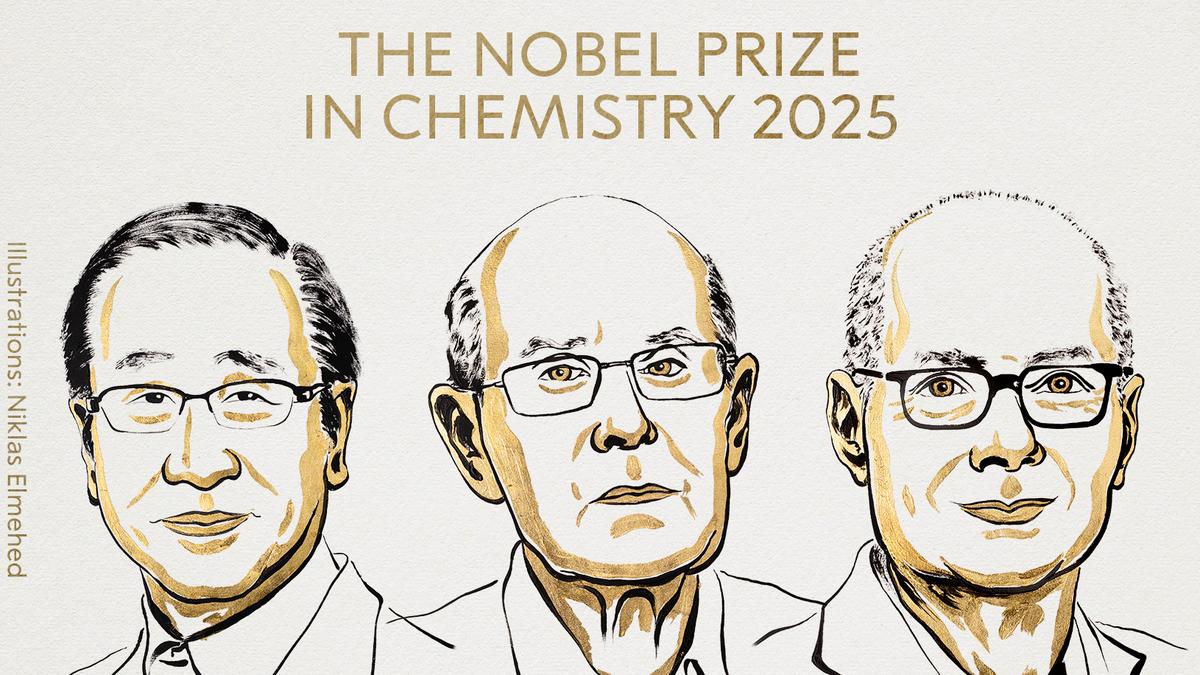
The 2025 Nobel Prize in Chemistry was awarded to Susumu Kitagawa (Japan), Richard Robson (UK-born, Australia), and Omar M. Yaghi (American–Jordanian) for the development of Metal–Organic Frameworks (MOFs) a groundbreaking class of materials that have revolutionized the way chemists design and utilize matter at the molecular scale.
A New Dimension in Chemistry
For much of chemistry’s history, scientists focused on synthesizing individual molecules.
The laureates went further — they began constructing entire frameworks of molecules linked together in predictable, repeating patterns, creating porous crystalline materials that could host, filter, or react with other substances.
This expanded chemistry from the molecular to the architectural level allowing scientists to design materials atom by atom.
What are Metal–Organic Frameworks (MOFs)?
MOFs are crystalline structures in which:
Metal ions or clusters act as nodes, and
Organic molecules serve as linkers or connectors.
The result is a 3D framework with enormous internal surface areas — often exceeding thousands of m² per gram.
These pores can be tuned to trap or interact with specific molecules, gases, or ions.
MOFs combine rigidity, porosity, and modularity, making them among the most versatile materials ever created.
Individual Contributions
(a) Richard Robson – The Architect of Frameworks
In the 1970s, while studying molecular geometry, Robson realized that the arrangement of connecting points could be extended into 3D frameworks.
He first demonstrated this by linking copper ions with organic molecules to form diamond-like lattices full of internal cavities.
His insight: such frameworks could act as molecular sieves, catalysts, or traps long before practical MOFs existed.
However, his early structures were fragile and unstable.
(b) Susumu Kitagawa – The Stabilizer and Visionary
In Japan, Kitagawa gave life to Robson’s idea by making these frameworks stable and functional.
His 1997 creation using cobalt, nickel, or zinc with 4,4’-bipyridine linkers became the first true MOF.
He showed that gases like methane, oxygen, and nitrogen could enter and leave the pores without destroying the structure.
Kitagawa introduced the concept of “soft” or flexible MOFs, capable of expanding or contracting with temperature, pressure, or molecular guests — a key step toward real-world applications.
(c) Omar Yaghi – The Engineer of Robust MOFs
Yaghi gave MOFs their structural strength and reproducibility.
At Arizona State University (1990s), he developed design principles to build frameworks deliberately, not by chance.
In 1995, he created early 2D MOFs, and by 1999, developed MOF-5, a landmark structure made of zinc ions and benzene-dicarboxylate linkers.
MOF-5 combined:
High stability (up to 300°C),
Massive surface area (a few grams ≈ size of a football field),
Open porosity, allowing gases to move freely.
His lab later designed families of MOFs with tailored pore sizes and functions — establishing the field of reticular chemistry (chemistry of linking molecular building blocks into networks).
Why the Nobel Committee Honoured Them
The Nobel Prize recognized that MOFs:
Transformed the scope of synthetic chemistry, from making molecules to designing materials atom-by-atom.
Enabled practical innovations in:
Carbon capture (e.g., CALF-20),
Water harvesting in deserts (e.g., MOF-303),
Pollutant removal (e.g., UiO-67, MIL-101, ZIF-8),
Hydrogen and methane storage (e.g., NU-1501, MOF-177),
Drug delivery and catalysis.
Demonstrated a new paradigm — materials designed through geometry and connectivity, not just composition.
Why MOFs Matter
Application Area | Example MOF | Function |
Climate & Industry | CALF-20 | Captures CO₂ from factory emissions |
Water Security | MOF-303 | Extracts potable water from desert air |
Pollution Control | UiO-67, MIL-101 | Removes PFAS & accelerates pollutant breakdown |
Energy Storage | NU-1501, MOF-177 | Stores H₂ or CH₄ safely at low pressures |
Healthcare | Biocompatible MOFs | Smart drug release systems |
Manufacturing | ZIF-8 | Gas separation and catalysis |
MOFs show how controlling space at the atomic level can tackle some of humanity’s biggest challenges clean energy, water scarcity, and sustainable industry.