
2025 Nobel Prize in Economic Sciences
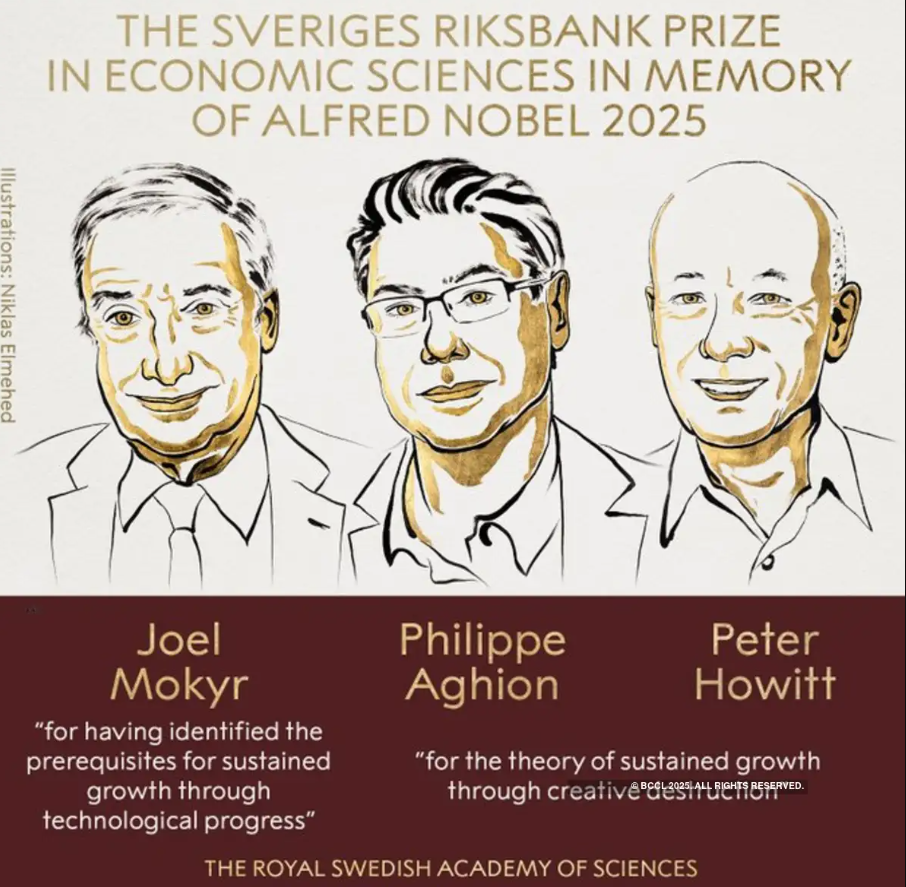
Winners
Joel Mokyr – Northwestern University, USA
Philippe Aghion – Collège de France, INSEAD (Paris), and London School of Economics
Peter Howitt – Brown University, USA
Prize amount: 11 million Swedish Kronor (≈ $1.2 million)
Awarded For
“Explaining innovation-driven economic growth”
Contribution to understanding how technological innovation sustains long-term growth.
Key Contributions
Joel Mokyr
Used historical analysis to explain how the Industrial Revolution enabled sustained economic growth.
Linked culture, institutions, and knowledge accumulation as drivers of technological progress.
Philippe Aghion & Peter Howitt
Developed a mathematical model of “Creative Destruction”, extending Schumpeter’s idea.
Explained how new and better technologies replace older ones, enhancing productivity.
Formed the basis of Endogenous Growth Theory, showing that innovation arises from internal economic incentives (R&D, competition).
Core Ideas
Economic growth is not automatic; it requires continuous innovation.
Creative destruction fuels productivity but also disrupts old industries.
Long-term prosperity depends on institutions, education, and R&D investment.
Innovation must be balanced with social protection and re-skilling to handle disruption.
Theoretical Significance
Built upon:
Schumpeter’s idea of innovation-led capitalism.
Romer’s Endogenous Growth Theory (Nobel 2018).
Integrated historical and mathematical perspectives on technological change.
Joseph Schumpeter – Theory of Innovation and Creative Destruction
Core Idea
Economic development, according to Joseph A. Schumpeter, is driven by entrepreneurial innovation, not merely by capital accumulation or gradual change.
He described capitalism as a dynamic system characterized by “creative destruction” — a process where new innovations continuously destroy old structures, products, and technologies.
Key Concepts
1. Creative Destruction
Refers to the continuous cycle of innovation and obsolescence.
New innovations replace outdated industries and technologies, causing temporary dislocation but ensuring long-term economic growth.
It is the engine of capitalism and a major source of productivity growth.
2. The Entrepreneur as Innovator
The entrepreneur is the central agent of economic change.
Entrepreneurs introduce innovations that disrupt the existing equilibrium and set in motion a new business cycle.
Innovation, not imitation, is the real driver of development.
3. Profit and Risk
Profit is the reward for successful innovation.
As innovations spread and get imitated, profits diminish, prompting new rounds of innovation.
This leads to cyclical fluctuations in the economy — booms when new technologies emerge, recessions when they mature.
Five Types of Innovation
Schumpeter identified five categories through which entrepreneurs bring change:
New Product – Introduction of a new good or a new quality of a good.
New Method of Production – Adoption of a new way of manufacturing not yet tested by experience.
New Market – Opening of a market into which the country’s industry has not previously entered.
New Source of Supply – Discovery of a new source of raw materials or intermediate goods.
New Industry Structure – Creation or destruction of a monopoly situation or reorganization of an industry.
Economic Implications
Innovation → Investment → Growth → Obsolescence → New Innovation.
Ensures dynamic efficiency, though may cause short-term unemployment and structural change.
Explains technological revolutions like the Industrial Revolution, ICT Revolution, and today’s AI-driven transformation.
Criticism
Neglects the role of institutional and social factors.
Assumes innovation is exogenous (driven by individuals) rather than institutionalized (as in endogenous growth theory).
May lead to inequality and instability during the destruction phase.
Relevance Today
Modern economies such as the USA, China, and India thrive on Schumpeterian principles through startups, digital innovation, and R&D ecosystems.
Forms the theoretical foundation for Aghion and Howitt’s model of endogenous growth, which won the 2025 Nobel Prize in Economics.