
2025 Nobel Prize in Medicine: Keeping the Immune System in Check
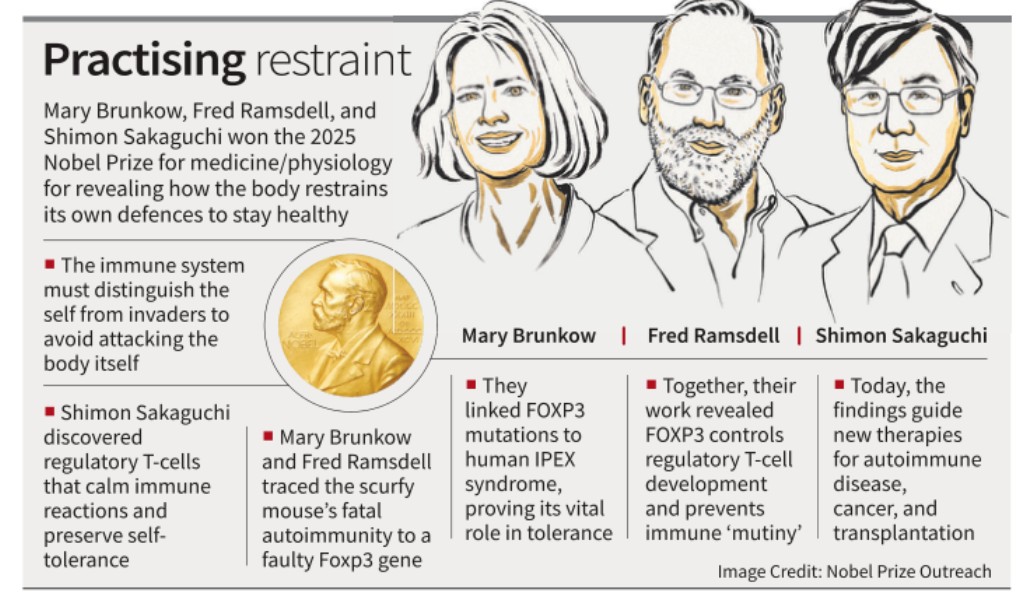
Awardees
Mary E. Brunkow (U.S.)
Fred Ramsdell (U.S.)
Shimon Sakaguchi (Japan)
Awarded For
“Discoveries concerning peripheral immune tolerance - explaining how the immune system is regulated and kept in check through regulatory T cells (Tregs).”
The Problem: Why Doesn’t the Immune System Attack the Body Itself?
The immune system constantly defends against invading pathogens (bacteria, viruses, etc.).
However, it must differentiate between “self” and “non-self” - an imbalance causes autoimmune diseases (like lupus, type 1 diabetes, rheumatoid arthritis).
The 2025 Nobel laureates discovered the mechanism that prevents the immune system from attacking its own tissues, explaining how immune tolerance is maintained.
Historical Context: The Clue from Mice
In the 1980s, experiments showed that removing the thymus (where T cells mature) in newborn mice caused severe autoimmune reactions — their immune systems attacked their own organs.
This suggested the existence of a “suppressor” or “regulatory” mechanism within the immune system.
Sakaguchi’s Discovery
Shimon Sakaguchi discovered a new class of T cells carrying an extra surface protein CD25.
These were named Regulatory T cells (Tregs).
Function: Suppress overactive immune responses and prevent autoimmune attacks.
He hypothesized that these “security guard” cells kept other immune cells (especially effector T cells) in check.
Brunkow & Ramsdell’s Discovery (Foxp3 Gene)
Working independently in the U.S., Mary Brunkow and Fred Ramsdell studied a mouse strain where males died young due to immune attacks on their organs.
They identified a mutant gene — Foxp3 - responsible for the defective immune regulation.
Foxp3 was found to be the master control gene for the development and function of regulatory T cells.
In humans, mutations in Foxp3 cause a fatal autoimmune disorder known as IPEX (Immune dysregulation, Polyendocrinopathy, Enteropathy, X-linked syndrome).
Peripheral Immune Tolerance
Even after central selection in the thymus (central tolerance), some self-reactive T cells escape into circulation.
Regulatory T cells maintain peripheral immune tolerance by:
Suppressing self-reactive immune cells outside the thymus.
Ensuring the immune system “stands down” after fighting infections.
Preventing chronic inflammation and autoimmunity.
Why the Discovery is Important
Area | Relevance of Discovery |
Autoimmune Diseases | Explains why most people don’t develop diseases like lupus or type-1 diabetes despite having reactive T cells. |
Cancer Immunology | Tumors often exploit Tregs to “hide” from immune attack; therapies now aim to block Tregs in cancer. |
Autoimmunity Therapy | Potential treatments seek to enhance Treg activity to calm immune attacks in autoimmune diseases. |
Organ Transplantation | Treg-based modulation could help the body accept transplanted organs without strong immunosuppressants. |
Basic Immunology | Established the foundation for the new field of immune regulation and tolerance biology. |
Mechanism of Regulatory T Cells (Tregs)
Express CD25 (IL-2 receptor alpha chain) and Foxp3 transcription factor.
Function through:
Cytokine release (IL-10, TGF-β) to suppress immune activation.
Cell–cell contact inhibition of effector T cells.
Metabolic control — depriving other T cells of growth factors like IL-2.
Maintain immune homeostasis after infection clearance.
Clinical & Research Applications
Over 200 ongoing trials globally on Treg-based therapies.
In Cancer:
Strategy: Dismantle or inhibit Tregs → immune system attacks tumors more effectively.
In Autoimmune Diseases:
Strategy: Enhance or expand Tregs → reduce self-attack (in diabetes, multiple sclerosis).
In Transplants:
Tregs could be cultured and infused to promote tolerance and avoid organ rejection.
Broader Significance
The discoveries bridged immunology, genetics, and clinical medicine.
Marked a shift from viewing the immune system as purely defensive to one requiring regulatory balance.
Opened pathways for precision immunotherapy and tolerance-inducing medicine.
Practice Mains Question
Q: “Explain the role of regulatory T cells in maintaining immune tolerance. How did the discoveries of the 2025 Nobel Medicine laureates pave the way for novel treatments in cancer and autoimmune diseases?”
(250 words)
Practice Prelims mcq
Q. Consider the following diseases:
Lupus
Type 1 Diabetes
IPEX Syndrome
Deficiency or dysfunction of regulatory T cells or Foxp3 gene is directly associated with which of the above?
A. 1 only
B. 3 only
C. 1 and 2 only
D. 1, 2 and 3
Answer: D
Explanation: All three diseases are autoimmune in nature; IPEX is directly linked to Foxp3 mutation.
Q. Which of the following organs is primarily involved in the maturation of T cells?
A. Spleen
B. Lymph nodes
C. Thymus
D. Bone marrow
Answer: C
Explanation: The thymus is where immature T cells mature and develop central tolerance before entering circulation.