
2030 Commonwealth Games (CWG) & India’s Olympic Ambitions
Context
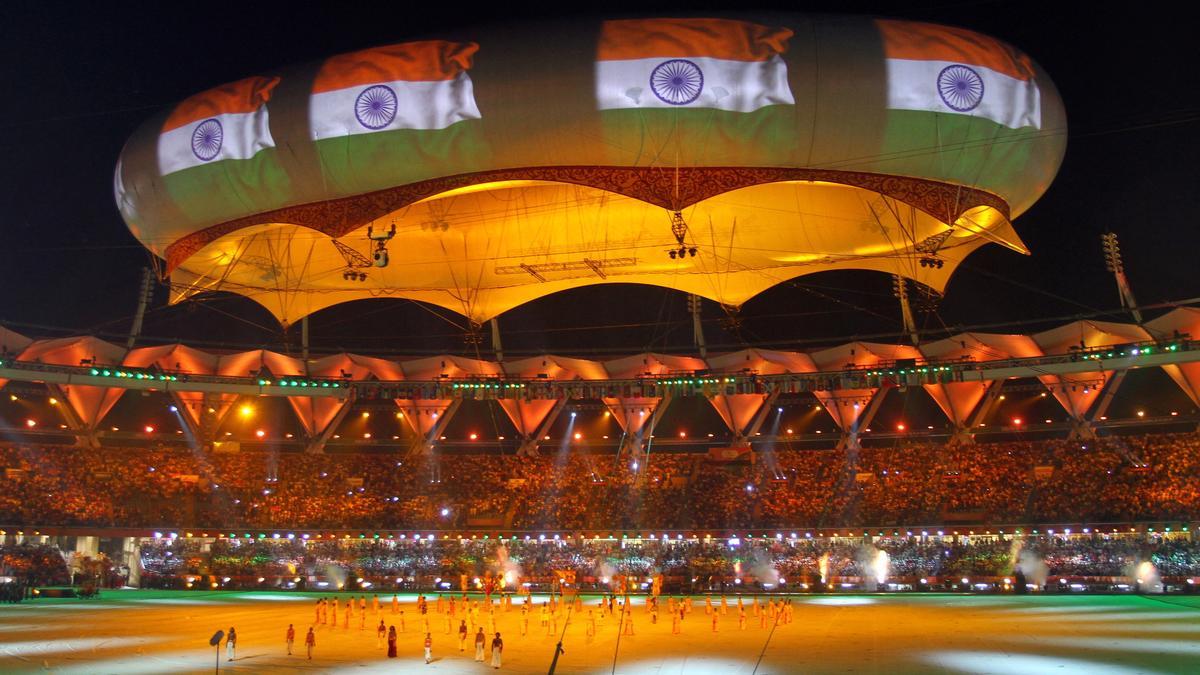
India will host the 2030 Commonwealth Games (CWG), exactly 20 years after Delhi hosted the 2010 edition.
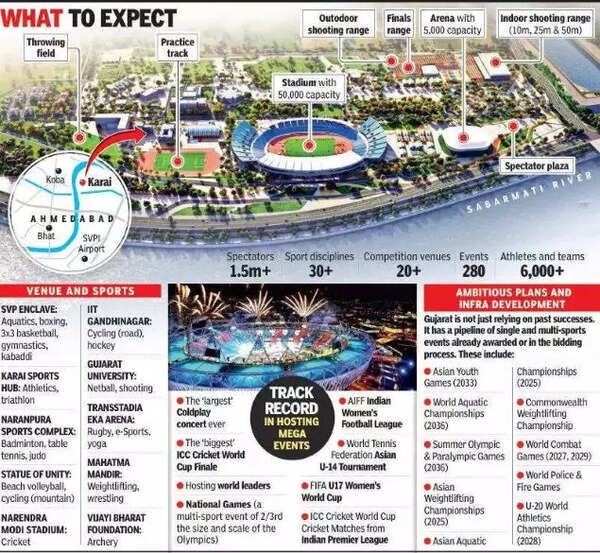
Ahmedabad will be the host city and is also positioned as the front-runner for India’s 2036 Olympic bid (Letter of Intent already submitted).
The move signals India’s intent to project itself as a global sporting destination.
Why Ahmedabad for CWG 2030?
India aims to showcase sporting infrastructure and organisational capability ahead of its Olympics pitch.
The city hosts world-class venues like the Narendra Modi Stadium, upgraded urban infrastructure, and transport links.
Strategic signalling to the International Olympic Committee (IOC) that India can manage mega-events.
CWG’s Declining Relevance
CWG, once showcasing British imperial unity, is losing its relevance in the post-colonial world.
Multiple host withdrawals due to spiralling costs:
Durban (replaced by Birmingham, 2022)
Victoria (withdrawal created vacuum for 2026; Glasgow stepped in)
Alberta (withdrawal led to India stepping in for 2030)
Reasons for decline
Escalating costs of hosting
Stagnation in sporting value
Absence of top sporting nations like USA and China
Shrinking list of disciplines: Glasgow 2026 will have only 10 sports, with badminton, shooting, hockey, cricket removed.
India’s Changing Stance
In 2019, former IOA President Narinder Batra termed CWG “sub-standard”.
Yet India now sees value in hosting due to:
1. Soft Power Projection
Mega sporting events enhance global image, tourism, diplomacy.
2. Growing Sporting Aspirations
Rise of athletes like Neeraj Chopra has boosted India’s sporting confidence.
Hosting events can inspire youth participation.
3. Infrastructure Development
Host cities gain improved transport, stadiums, and public utilities.
Long-term benefits extend beyond sports.
Performance Paradox
India’s CWG medal haul is high but does not translate into Olympic success.
Commonwealth Games (CWG) Year | India’s CWG Medal Tally | Following Summer Olympics (next edition) | India’s Olympic Medal Tally at that Olympics |
2010 (New Delhi) | 101 | 2012 London Olympics | 6 |
2014 (Glasgow) | 64 | 2016 Rio Olympics | 7 |
2018 (Gold Coast) | 66 | 2020 Tokyo Olympics (held 2021) | 7 |
2022 (Birmingham) | 61 | 2024 Paris Olympics | 6 |
CWG success often inflated due to absence of top global competitors.
Olympic performance remains modest.
Key Challenges
1. Doping Concerns
India has increasing doping violations.
Could damage credibility during global events.
2. Financial Burden
CWG hosting costs often exceed estimates.
Must avoid repeating issues faced during Delhi 2010, marked by allegations of:
Corruption
Mismanagement
Delays
3. Limited Sporting Value of CWG
Disciplines shrinking → reduced competitive significance.
Hosting may not contribute strongly to athletic improvement.
4. Preparedness for Mega Events
Olympics require far larger organisational competence than CWG.
Concerns around urban planning, environment, public transport, safety, and regulatory governance.
Opportunities for India
1. Build Global Sports Reputation
CWG 2030 can be a stepping stone to Olympics 2036.
2. Boost Sports Culture
Hosting ignites enthusiasm for diverse sports beyond cricket.
Drives investment in coaching, sports science, grassroots infrastructure.
3. Economic & Urban Gains
Jobs, tourism, hospitality, and urban upgrades.
Public infrastructure legacy long after the event.
4. Diplomatic Leverage
Sports as a medium of international goodwill and engagement.
Way forward
Ahmedabad 2030 is an opportunity — but also a test.
India must:
Maintain financial discipline
Strengthen anti-doping systems
Use the event to showcase modern sports facilities
Build a credible case for the 2036 Olympics
Commonwealth Games
What are the Commonwealth Games?
The Commonwealth Games (CWG) is an international multi-sport event held every four years, involving athletes from the 56 member countries of the Commonwealth of Nations (most are former British colonies).
Often called the “Friendly Games”, the CWG promotes sportsmanship, cultural exchange, and cooperation among member countries.
History
First held: 1930, Hamilton (Canada)
Originally called the British Empire Games.
Became the British Empire and Commonwealth Games (1954–1966),
then British Commonwealth Games (1970–1974),
and finally Commonwealth Games (from 1978).
The CWG symbolises the historical ties among Commonwealth nations.
Organising Body
Commonwealth Games Federation (CGF)
Headquarters: London, UKResponsible for:
Selecting host cities
Ensuring compliance with rules
Promoting youth and inclusivity
Frequency
Held once every four years.
Last held: Birmingham 2022
Next editions:
Glasgow 2026 (after Victoria’s withdrawal)
Ahmedabad 2030 (India)
Key Features
Multi-sport event with a unique mix of sports like:
Athletics
Swimming
Weightlifting
Badminton
Boxing
Wrestling
Table tennis
Special additions:
Para-sports as a fully integrated component (CGF is a pioneer in this).
Introduction of sports reflecting local culture (e.g., cricket in 2022).
Prelims Practice MCQs
Q. Consider the following statements regarding the Commonwealth Games:
The Commonwealth Games were first held in 1930 under the name British Empire Games.
All member countries of the Commonwealth participate mandatorily in every edition.
The Commonwealth Games include athletes from nations that were formerly part of the British Empire only.
Which of the above statements is/are correct?
A. 1 only
B. 1 and 3 only
C. 2 and 3 only
D. 1, 2 and 3
Answer: B
Explanation:
S1 correct → The first CWG was held in Hamilton, Canada (1930).
S2 incorrect → Participation is not mandatory; several nations skip editions.
S3 correct → Although many are former colonies, some members (like Mozambique, Rwanda, Gabon, Togo) were not part of the British Empire, but they voluntarily joined the Commonwealth. However, the Games are restricted to Commonwealth member states only.
Q. With reference to the organisation of the Commonwealth Games, consider the following statements:
The Commonwealth Games Federation (CGF) is the apex body responsible for the direction and control of the Games.
The CGF headquarters is located in London.
The Queen’s Baton Relay is organised before every edition of the Commonwealth Games.
Which of the above statements is/are correct?
A. 1 and 3 only
B. 1 and 2 only
C. 2 and 3 only
D. 1, 2 and 3
Answer: A
Explanation:
S1 correct → CGF governs the Games.
S2 incorrect → CGF is headquartered in London earlier, but is currently headquartered in Birmingham.
S3 correct → Baton Relay is a tradition since 1958.
Q. Consider the following statements regarding India and the Commonwealth Games:
India first participated in the Commonwealth Games in 1958.
India has hosted the Commonwealth Games once.
India’s highest-ever medal tally at the CWG was 101 medals.
Which of the statements given above is/are correct?
A. 2 and 3 only
B. 1 and 2 only
C. 1 and 3 only
D. 1, 2 and 3
Answer: A
Explanation:
S1 incorrect → India first participated in 1934, not 1958.
S2 correct → India hosted CWG once, in 2010 (Delhi).
S3 correct → India’s best performance = 101 medals in the 2010 Delhi Games.