
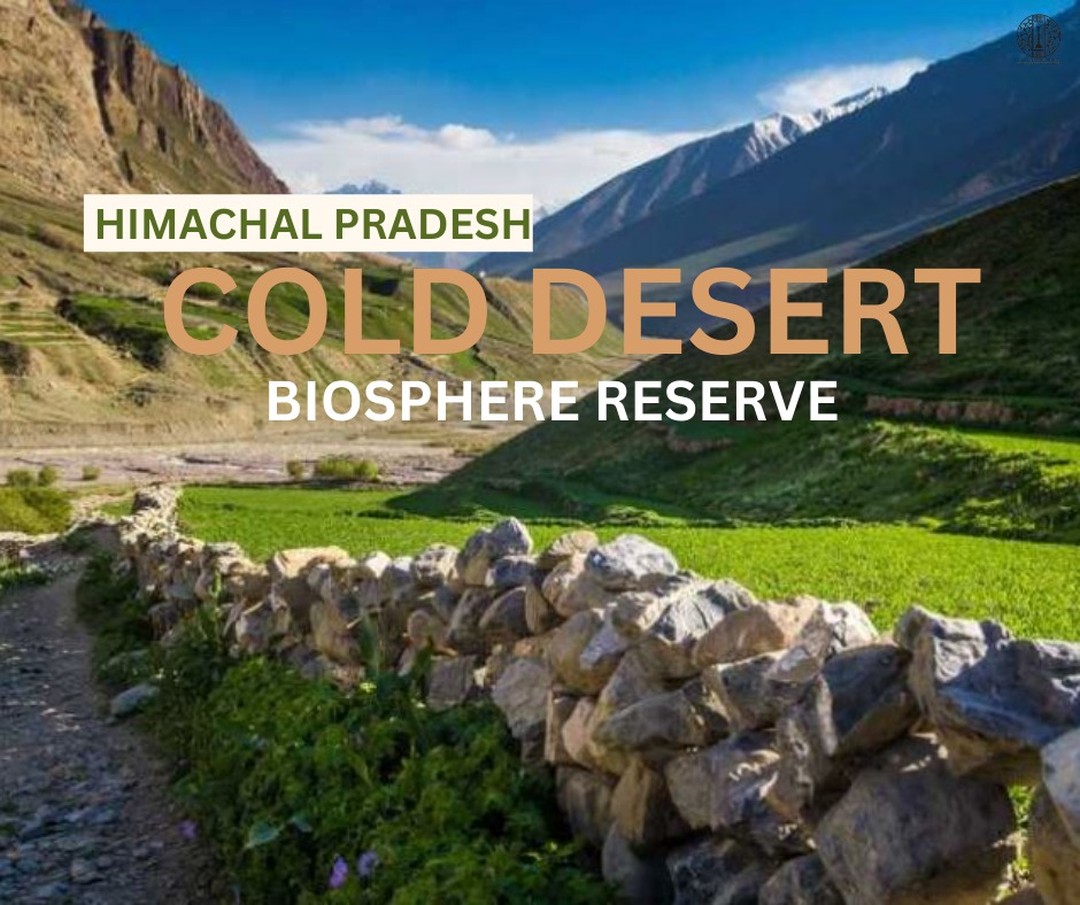
5th WCBR Designates Cold Desert as India’s 13th UNESCO Biosphere Reserve
Context:
5th World Congress of Biosphere Reserves (WCBR), Hangzhou, China.
India’s Cold Desert Biosphere Reserve designated as part of UNESCO’s World Network of Biosphere Reserves (WNBR).
India’s tally: 13 biosphere reserves in WNBR (out of 18 notified in India).
Global tally: 785 sites across 142 countries.
Cold Desert Biosphere Reserve
Location: Lahaul-Spiti, Himachal Pradesh (Trans-Himalaya).
Area: ~7,770 km².
Altitude: 3,300 m – 6,600 m.
Ecosystem: One of the coldest & driest ecosystems in WNBR; first high-altitude cold desert site of India.
Protected Areas Covered:
Pin Valley National Park.
Chandratal Wildlife Sanctuary.
Kibber Wildlife Sanctuary.
Sarchu (plateau region).
Biodiversity
Flora:
732 vascular plant species.
30 endemic & 157 near-endemic to Indian Himalayas.
Alpine grasses, Tibetan herbal medicinal plants, sea-buckthorn, Himalayan birch, Persian juniper.
Fauna (Flagship species):
Snow Leopard (Panthera uncia).
Himalayan Ibex (Capra sibirica).
Blue Sheep (Pseudois nayaur).
Himalayan Wolf (Canis lupus chanco).
Birds: Himalayan Snowcock, Golden Eagle.
India’s UNESCO Biosphere Reserves (13 in WNBR)
Nilgiri (2000)
Gulf of Mannar (2001)
Sundarbans (2001)
Nanda Devi (2004)
Nokrek (2009)
Pachmarhi (2009)
Similipal (2009)
Achanakmar–Amarkantak (2012)
Great Nicobar (2013)
Agasthyamalai (2016)
Kanchenjunga (2018)
Panna (2020)
Cold Desert, Himachal Pradesh (2025)
Significance
India has 18 notified biosphere reserves, of which 13 are part of UNESCO WNBR (Cold Desert is the latest).
Cold Desert is India’s first high-altitude cold desert reserve in the global network.
Combines conservation of biodiversity + preservation of traditional knowledge + sustainable development.
UNESCO’s MAB Programme
Launched: 1971 (celebrating 50 years in 2025).
Objective: Establish scientific basis to improve relations between people & environment.
Approach: Combines natural + social sciences for sustainable development.
Functions of Biosphere Reserves:
Conservation of biodiversity & cultural diversity.
Development that is socio-culturally appropriate & environmentally sustainable.
Logistic support – research, monitoring, education, training.
Role: “Learning places for sustainable development.”
Coverage: Terrestrial, marine, and coastal ecosystems.
Key points
India’s Cold Desert BR vs Ladakh’s Cold Desert Wildlife Sanctuary → often confused, but different.
India’s 13 UNESCO BRs → Nilgiri, Gulf of Mannar, Sundarbans, Nanda Devi, Nokrek, Pachmarhi, Similipal, Achanakmar–Amarkantak, Great Nicobar, Agasthyamalai, Kanchenjunga, Panna, Cold Desert (2025).
WNBR Milestone (2025) → 26 new designations, largest in 20 years, now protecting ~5% of planet’s surface.
First time WCBR held in Asia (Hangzhou, 2025) → >3,000 participants, 100+ countries.
Additional information:
The main cold desert wildlife sanctuary in Ladakh is the Changthang Wildlife Sanctuary, known for its high-altitude lakes like Tso Moriri and Pangong Tso, and wildlife such as the snow leopard, Tibetan argali, and wild yak.
The Hanle valley in eastern Ladakh near the Indo-China border is one such eco-sensitive region. It is bestowed with a variety of unique and threatened wild animals such as the Pallas’s cat, Tibetan sand fox, snow leopard, and black-necked crane, among others. It is part of the Changthang Wildlife Sanctuary.
In 2001, the Indian Institute of Astrophysics (IIA) set up an astronomical observatory in Hanle to survey celestial bodies.
Over the years, IIA expanded its project, and several other institutes, including the Bhabha Atomic Research Centre, installed telescopes to study gamma rays. Given the potential of the valley as a star-gazing site, it has also been declared a Dark Sky Reserve, a site where the nocturnal environment is exceptional — the first of its kind in India.
Another significant cold high-altitude wildlife area is the Karakoram Wildlife Sanctuary, home to the Tibetan antelope (Chiru).