
Adyar River
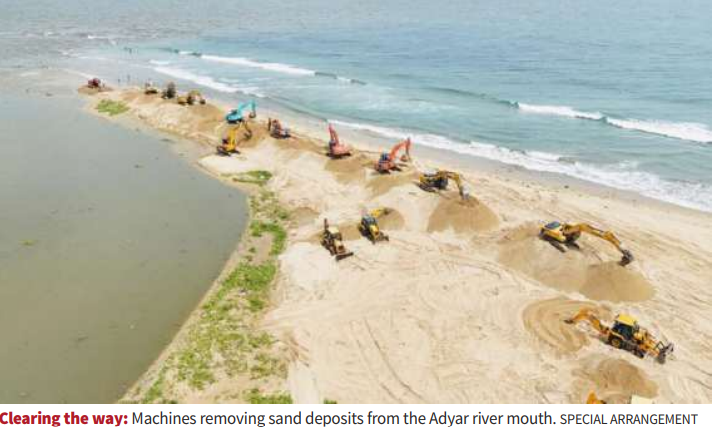
Context: Deployed machinery to clear Sedimentation in the Adyar river mouth to enable fLoodwater to drain smoothly during the Northeast monsoon.
Basic Facts
Location: Tamil Nadu, India
Origin: Near Chembarambakkam Lake, Kanchipuram district
Length: ~42.5 km (26.4 miles)
Terminus: Bay of Bengal at the Adyar Estuary, Chennai
Other Chennai Rivers: Along with Cooum and Kosasthalaiya
Ecological Importance
Forms the Adyar Estuary, a significant estuarine ecosystem supporting mangroves, aquatic birds, and biodiversity.
Adyar Eco Park (Tholkappia Poonga) established to restore the estuary ecosystem.

Prelims Practice MCQ
Q. Which of the following statements about the Adyar River is/are correct?
It originates near Chembarambakkam Lake in the Kanchipuram district.
It forms an estuary before joining the Bay of Bengal.
It is a tributary of the Cooum River.
Select the correct answer using the code below:
(a) 1 and 2 only
(b) 2 and 3 only
(c) 1 and 3 only
(d) 1, 2 and 3
✅ Answer: (a)
Explanation: Adyar and Cooum are independent rivers; Adyar is not a tributary of Cooum.
Q. With reference to Chennai’s hydrological system, which of the following rivers flows entirely within the city and joins the Bay of Bengal?
(a) Adyar River
(b) Dakshina Pinakini River
(c) Palar River
(d) Bhavani River
✅ Answer: (a)
Explanation: The Adyar River flows through Chennai and empties into the Bay of Bengal at Adyar estuary.
The rivers that flow entirely through Chennai are the Kosasthalaiyar, Cooum, and Adyar rivers, all of which meander through the city before emptying into the Bay of Bengal.
Dakshina Pinakini flows through karnataka and tamilnadu.
Note: Dakshina Pinakini, which finds its origin in the silent Nandi Hills of Chikkaballapura district of Karnataka. The non-perennial river with a catchment area of 3,690 km2 passes through major Karnataka districts before entering into Tamil Nadu and finally emptying into the Bay Of Bengal.
Once upon a time, Dakshina Pinakini was highly revered with several temples consecrated in its bank and has been described as a rich river with lush vegetation in ancient Tamil Literature called Sangam. Today, the river is a focal point of several industrial activities resulting in water pollution.