
Aravalli Range
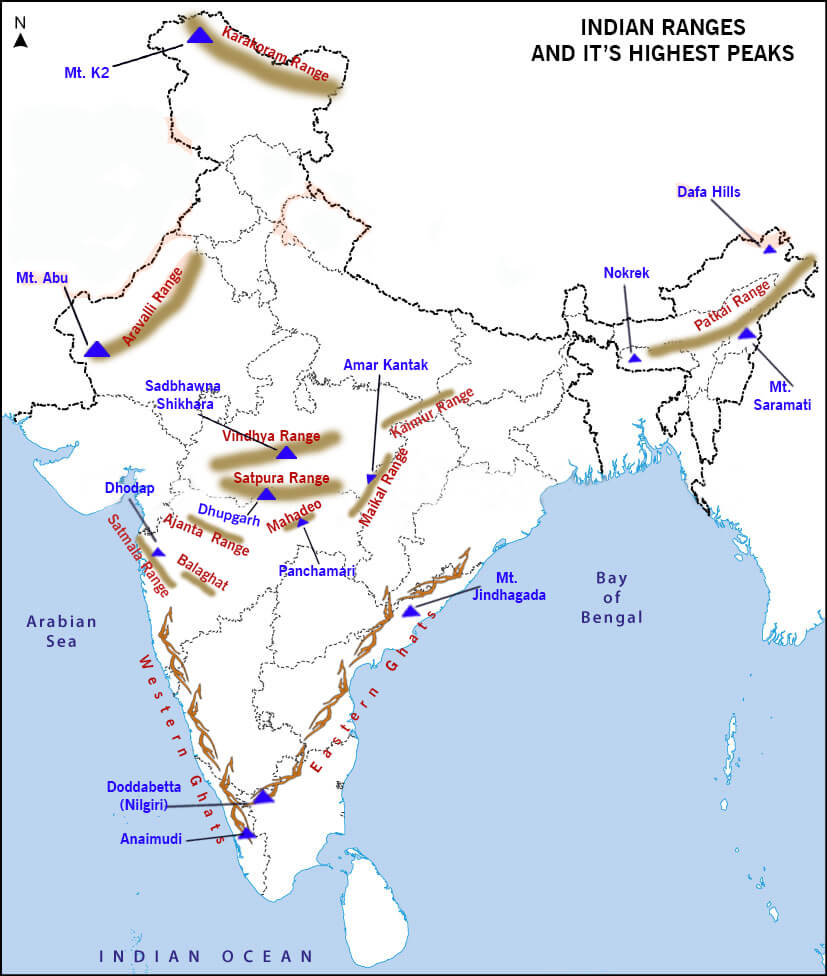
Why in news
Centre clarified that the revised definition of the Aravalli Range will not open doors to large-scale mining.
Over 90% of the Aravalli region will remain under protected status.
A Supreme Court–ordered freeze on new mining leases continues until a comprehensive management plan is finalised.

What is the Aravalli Range?
Basic description
One of the world’s oldest fold mountain systems.
Formed nearly 2 billion years ago.
Extends 670–700 km in a south-west direction.
Runs from Delhi → Haryana → Rajasthan → Gujarat, ending near Ahmedabad.
Physical characteristics
Width varies between 10 km and 100 km.
Average elevation: 600–900 m.
Highest peak: Guru Shikhar (1,722 m) in Mount Abu, Rajasthan.
Composed of discontinuous and highly eroded hills.
Regional physiography
Begins as isolated rocky ridges in:
Southern Delhi (Asola Bhatti Wildlife Sanctuary)
Southern Haryana
In Rajasthan, the range:
Divides the state into:
Arid north-western Thar Desert plateau
Fertile south-eastern plains
Structural divisions
Sambhar–Sirohi section:
Southern part
Taller and more rugged
Sambhar–Khetri section:
Northern part
Highly eroded ridges
Major features:
Steep escarpments
Deep valleys (up to 550 m)
Mineral-rich quartzite formations
Subsurface extension
Possesses an underground extension up to Haridwar.
Acts as a geological divide between:
Ganga river basin
Indus river basin
What is it made up of?
Core geological composition
The Aravalli Supergroup forms a key part of the ancient crust of north-western India.
Preserves nearly 2.5 billion years of Earth’s geological history.
Represents some of the earliest solid crustal formations on the planet.
Rock types and age
Dominant rocks:
Gneisses
Granites
Age:
Archaean age (when Earth’s first solid crust formed).
Rocks occur as a linear belt across the region.
Regional geological structure
South-western Chittorgarh region:
Among the oldest landmasses in the Indian peninsula.
Basement rocks: Archaean gneisses and granites.
Younger Aravalli rocks rest above this basement.
Bhadesar area (Rajasthan):
Rocks arranged in long, north–south-trending belts.
Indicates strong tectonic control and ancient deformation patterns.
Quartzite layer (key feature)
Quartzite forms the lowest layer of the younger Aravalli rocks.
Shows:
Slow deformation
Effects of immense pressure acting deep within the Earth over long geological time.
Reflects deep-time tectonic processes, not sudden mountain building.
Why is it important?
1. Importance for Delhi and NCR
Acts as the “lungs of Delhi”:
Filters air pollution
Moderates urban heat
Enables groundwater recharge through seasonal streams
Bandhwari ridges prevent desert encroachment from Rajasthan.
Maintains NCR microclimate amid rapid urbanisation.
2. National-scale ecological role
Serves as a natural barrier blocking Thar Desert sands from advancing into the Indo-Gangetic plains.
Protects agricultural productivity in Haryana and Uttar Pradesh.
Plays a stabilising role in north-west India’s climate system.
3. Hydrological significance
Sustains key watersheds feeding:
Chambal
Luni
Sabarmati
Critical for water security in drought-prone regions of:
Rajasthan
Gujarat
Supports flood moderation and groundwater replenishment.
4. Biodiversity value
Major biodiversity hotspot:
Leopard habitats
Over 300 bird species
Endemic flora
Provides ecological corridors essential for wildlife movement.
5. Economic importance
Rich mineral base:
Copper
Zinc
Marble
Lead
Contributes significantly to India’s mining economy.
Balances resource extraction with ecological sensitivity.
6. Cultural and heritage value
Home to:
Kumbhalgarh Fort
Ancient cave art and historical landscapes
Represents a long continuum of human–environment interaction.
7. Environmental governance and threats
Threats highlighted by Supreme Court interventions:
Illegal mining
Deforestation
Need for:
Clear ecological boundary definitions
Long-term conservation planning
Aim: prevent biodiversity loss and climate vulnerability.
Prelims Practice MCQs
Q. With reference to the Aravalli Range, consider the following statements:
It is one of the oldest fold mountain systems in the world.
It was formed during the Cenozoic era.
Its highest peak is located in Rajasthan.
Which of the statements given above are correct?
(a) 1 and 3 only
(b) 1 and 2 only
(c) 2 and 3 only
(d) 1, 2 and 3
Answer: (a)
Explanation
-
Statement 1 is correct
The Aravalli Range is among the oldest fold mountain systems on Earth. -
Statement 2 is incorrect
The Aravalli mountain-building event occurred during the Paleoproterozoic Era of the Proterozoic Eon, which is part of the Precambrian Supereon. -
Statement 3 is correct
The highest peak of the Aravalli Range, Guru Shikhar, lies in Rajasthan.

Q. Consider the following statements regarding the ecological role of the Aravalli Range:
It acts as a barrier against the eastward expansion of the Thar Desert.
It contributes to groundwater recharge in the National Capital Region.
It is the primary source of perennial rivers in north-west India.
Which of the statements given above are correct?
(a) 1 and 2 only
(b) 2 and 3 only
(c) 1 and 3 only
(d) 1, 2 and 3
Answer: (a)
Explanation:
Aravallis block desertification and recharge groundwater.
Rivers are mostly seasonal, not perennial.
Q. With reference to the geology of the Aravalli Range, consider the following statements:
The Aravalli Supergroup preserves nearly 2.5 billion years of Earth’s history.
Gneisses and granites of Archaean age form its basement rocks.
Quartzite forms the youngest layer of the Aravalli rock sequence.
Which of the statements given above are correct?
(a) 1 and 2 only
(b) 2 and 3 only
(c) 1 and 3 only
(d) 1, 2 and 3
Answer: (a)
Explanation:
Quartzite forms the lowest layer of younger rocks, not the youngest.