
Ash cloud from Ethiopia volcano reaching India
Context:
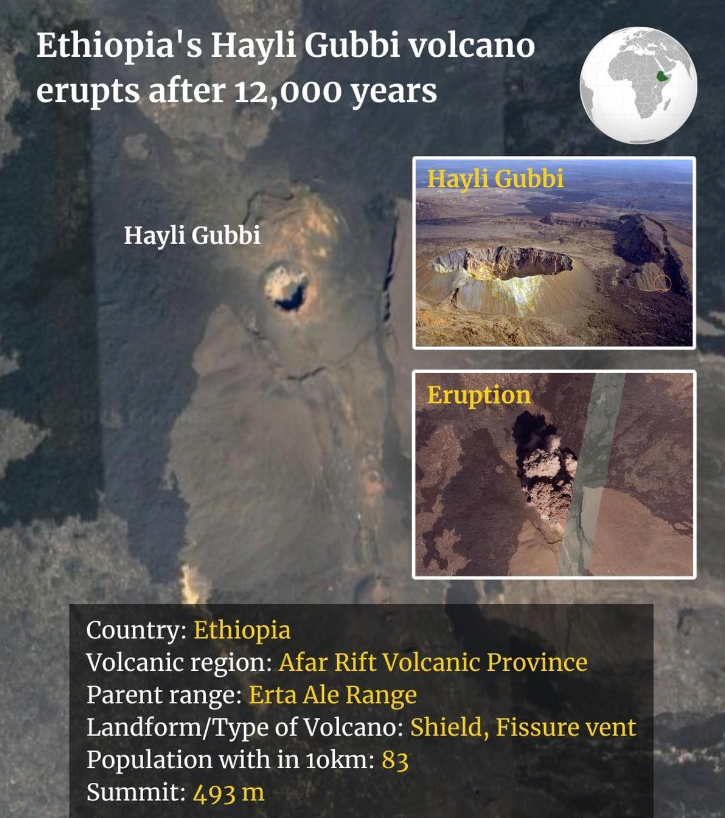
The Hayli Gubbi volcano in Ethiopia’s Afar region erupted on Sunday.
This was the first known eruption in around 12,000 years.
The eruption produced high-altitude volcanic ash clouds rather than lava.
Plume consisted of:
Fine rock particles
Silica-rich ash
Sulphur dioxide and other gases
Some larger debris in heavier areas

Why ash clouds reached India
a) Atmospheric wind patterns
Volcanic plumes rose 15–40 km into the atmosphere.
At these heights, air currents are very strong and move west–east.
The ash travelled:
From Ethiopia
Over Yemen, Oman and Pakistan
Entered India through Gujarat and Rajasthan
Then moved towards Delhi and Uttar Pradesh
Continued northeast towards China
This is a common atmospheric pathway for high-altitude aerosols.
b) Eastward journey specifics
Plumes followed upper-level westerly winds, not surface winds.
Their movement is not long-term; they disperse in a few days.
Why volcanic ash is dangerous for aviation
a) Damage to aircraft engines
Jet engines operate at 1,400–1,500°C.
Volcanic ash contains silica, which melts into glass-like material inside engines.
This molten glass sticks to turbine blades → blocks air flow → engine stall.
Can cause complete engine shutdown at high altitudes.
b) Danger to aircraft systems
Ash can:
Scratch cockpit windows
Clog air sensors and pitot tubes
Contaminate cabin air
Damage navigation systems
Reduce pilot visibility
c) Historical incidents
1982: British Airways Boeing 747 flew into ash from Indonesia’s Mt. Galunggung → all 4 engines failed → restarted after descent.
1989: KLM Boeing 747 encountered ash from Alaska’s Mt. Redoubt → engine failure and $80 million in damage.
DGCA advisory
Directorate General of Civil Aviation (DGCA) issued an urgent operational advisory:
Directing all airlines to avoid volcanic ash-affected altitudes.
Mandatory reporting of:
Engine anomalies
Smoke or odour in cabin
Inspection of runways, taxiways, aprons for ash contamination.
Was it dangerous?
High-altitude ash posed a risk to long-distance international flights, not to people on the ground.
But the ash quantity was not high enough to significantly alter:
Air quality
Carbon dioxide concentration
Atmospheric chemistry
Science of volcanic eruptions
Volcanoes erupt because of heat-driven magma movement under Earth’s crust.
Lighter magma rises to the surface when pressure builds.
When pressure is released, the magma escapes as lava or ash plume.
Ash eruptions occur when:
Magma interacts with water
Magma shatters into fine particles
Gases expand explosively
Prelims Practice MCQs
Q. The ash cloud from Ethiopia’s Hayli Gubbi volcano was able to reach India primarily because:
(a) Surface winds carried the ash across the Arabian Sea
(b) High-altitude westerly air currents transported the plume eastward
(c) Cyclonic circulation pulled the ash into the Indian subcontinent
(d) Jet streams over Africa moved southward
Answer: (b)
Explanation:
The volcanic ash rose up to 15–40 km and was carried by upper-level westerlies, which move from west to east, transporting the ash across West Asia into India.
Q. Why is volcanic ash considered extremely dangerous for commercial aircraft engines?
It melts inside engines and forms glass-like coatings on turbine blades
It contains corrosive gases that damage engine metals
It blocks cockpit sensors and reduces pilot visibility
It increases cabin oxygen levels and risks fire
Select the correct answer:
(a) 1, 2 and 3 only
(b) 1 and 3 only
(c) 2 and 4 only
(d) 1, 2, 3 and 4
Answer: (a)
Explanation:
Volcanic ash melts into glass, sticks to blades, blocks sensors, and contains corrosive gases.
It does not increase oxygen levels; thus, statement 4 is incorrect.