
Asia Pacific Malaria Elimination Network (APMEN)
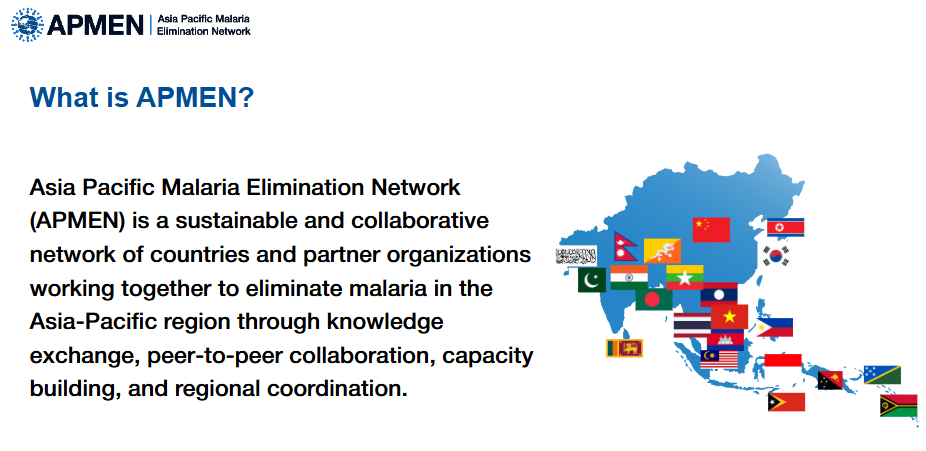
Context
The World Malaria Report 2025 (released December 2025 by World Health Organization) presents mixed progress five years before the 2030 elimination deadline.
Asia-Pacific has shown encouraging declines, but drug resistance and funding shortfalls threaten gains.
The World Malaria Report 2025 (released December 2025 by World Health Organization) presents mixed progress five years before the 2030 elimination deadline.
Asia-Pacific has shown encouraging declines, but drug resistance and funding shortfalls threaten gains.
Establishment and launch
Asia Pacific Malaria Elimination Network (APMEN) was officially launched in February 2009.
Launch venue: Brisbane, Australia.
Objective: Malaria-free Asia-Pacific region.
Political genesis
Formal political commitment came on 25 September 2008.
Kevin Rudd, then Prime Minister of Australia, addressed the MDG Malaria Summit at the United Nations General Assembly, New York.
The first APMEN meeting held in Brisbane (February 2009).
Founding members (2009)
APMEN was established with 10 founding countries:
Bhutan
China
DPR Korea
Indonesia
Malaysia
Philippines
Republic of Korea
Solomon Islands
Sri Lanka
Vanuatu
India was not a founding member of APMEN (Asia Pacific Malaria Elimination Network) when it launched in 2009 with 10 countries, but joined later in 2015 as a crucial partner, significantly bolstering the network's efforts to eliminate malaria in the region.
India has set itself the target of achieving zero indigenous cases of malaria by 2027.
Institutional structure
APMEN functioned as a country-led technical platform.
It brought together:
National malaria programmes
Academic institutions
Technical experts
Regional partners
Technical contributions
Establishment of technical working groups, including:
Vivax malaria
Vector control
Surveillance and response (added later)
Integration with APLMA
In 2017, APMEN was formally integrated with the Asia Pacific Leaders Malaria Alliance (APLMA).
Joint Secretariat established in Singapore.
Significance:
Linked political advocacy (APLMA) with technical expertise (APMEN).
Strengthened coordination between policymakers and implementers.
Supported the regional goal of malaria elimination by 2030.
Secretariat and institutional hosts
APMEN Joint Secretariat was hosted by:
School of Population Health, University of Queensland
UCSF Global Health Group
Location: Brisbane, Australia (initially).
Recent milestone
Timor-Leste certified malaria-free in 2025, strengthening regional elimination momentum.
Countries that have already achieved malaria-free status:
Sri Lanka
China
Timor-Leste
Asia Pacific Leaders Malaria Alliance (APLMA)
Overview
Asia Pacific Leaders Malaria Alliance (APLMA) is a regional coalition of political and health leaders.
Objective: Eliminate malaria in the Asia–Pacific region by 2030.
Emphasises high-level political commitment, regional coordination, and policy alignment.
APLMA was launched following the East Asia Summit (2013).
Key facts
Founded: 2013
Headquarters: Singapore
Focus areas:
Malaria elimination
Regional health security
Target: Malaria-free Asia–Pacific by 2030
Partners
APLMA works with:
National governments
World Health Organization
Asia Pacific Malaria Elimination Network (APMEN)
Private sector partners
Prelims Practice MCQs
Q. Which of the following was NOT a founding member of APMEN?
a) Sri Lanka
b) Bhutan
c) India
d) Vanuatu
Answer: c
Explanation: India was not among the 10 founding countries of APMEN.