
Astronomical Causes of Climate Change
-
Milankovitch Cycles
-
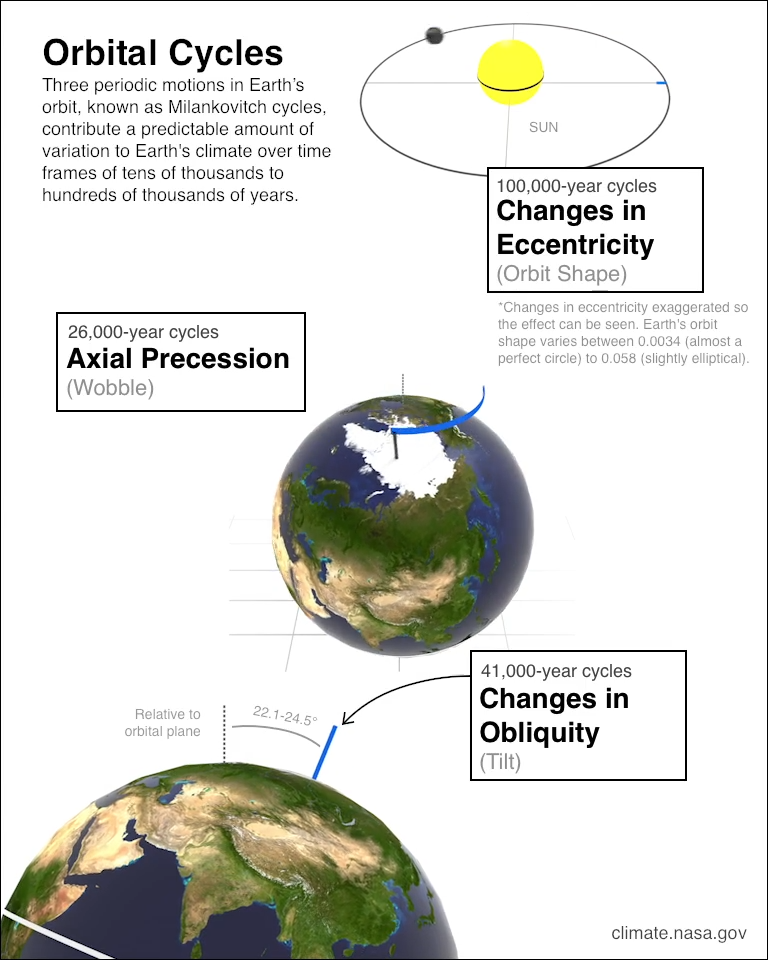
Proposed by Milutin Milankovitch, these cycles explain periodic variations in Earth’s climate due to orbital changes.
-
Eccentricity (100,000 years): Changes in Earth’s orbit shape (circular to elliptical) alter solar energy received.
-
Obliquity (41,000 years): Variations in Earth’s axial tilt (22.1°–24.5°) influence seasonal intensity.
-
Precession (26,000 years): Wobble in Earth’s axis shifts seasonal contrasts.
→ These cycles explain the Ice Age cycles and interglacial warming phases


-
-
Solar Variability
-
Fluctuations in solar radiation output, including sunspot cycles (~11 years), affect Earth’s temperature.
-
Example: The Maunder Minimum (1645–1715) coincided with the “Little Ice Age” in Europe.
-
-
Cosmic Dust & Astronomical Events
-
Meteorite impacts and interstellar dust can reduce solar radiation reaching Earth.
-
Example: The Chicxulub impact (65 million years ago) drastically altered climate, contributing to dinosaur extinction.
Astronomical Grand Cycles:
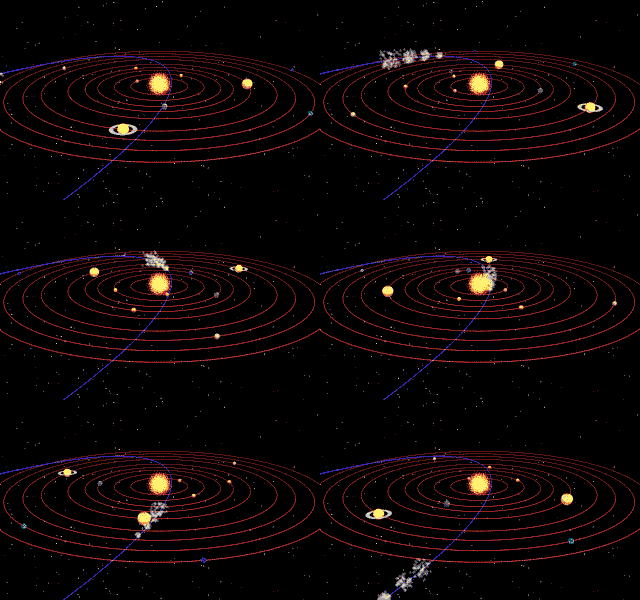
Geological sedimentary evidence in the deep sea has revealed a newly discovered 2.4-million-year cycle, known as "astronomical grand cycles," linked with the orbits of Earth and Mars.
The cycle influences global warming or cooling trends and has been detected through erosion patterns in deep-sea sedimentary data.
Connection Between Mars' Orbit and Earth's Climate:
The gravity fields of planets in the solar system interfere with each other, leading to changes in their orbital eccentricity (how circular their orbits are).
The interaction between Earth and Mars' orbits causes variations in the amount of solar radiation received by Earth, resulting in cycles of warming and cooling over 2.4 million years.
Limitations of Astronomical Causes in Contemporary Climate Change
-
Current global warming is happening too rapidly to be explained by astronomical cycles.
-
Studies (IPCC AR6, 2021) show that >90% of observed warming since the mid-20th century is due to human-induced greenhouse gas emissions.
-
Astronomical factors operate on millennial timescales, while today’s warming is unfolding within decades.
-
Historically, astronomical causes were the primary drivers of climate variations (glaciation–interglacial cycles).
-
In the current era (Anthropocene), human activities—industrialization, fossil fuel burning, deforestation—are overriding astronomical influences.
-
Yet, interactions exist: ongoing warming may be amplified or modulated by long-term astronomical cycles in the future.
Astronomical causes provide the background rhythm of Earth’s climate system, explaining long-term glaciations and natural variability. However, the present trajectory of climate change is overwhelmingly anthropogenic, as evidenced by its unprecedented pace and scale. Thus, while astronomical factors remain scientifically significant, policy and mitigation must focus on human-induced drivers of climate change.