
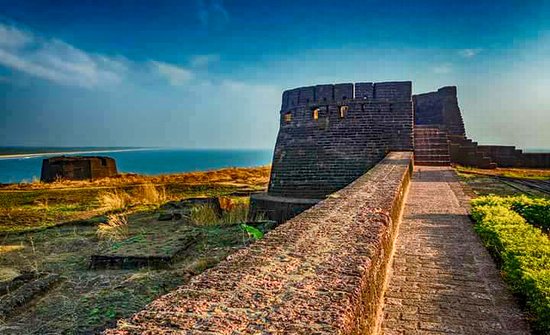
Bekal Fort
Context
Kerala Promoting bekal fort as cine tourism hub
Location
Bekal Fort
Located in Kasargod district, Kerala
Region: North Malabar (Kolathnadu)
Built on the Arabian Sea coast
Largest fort in Kerala
Area: About 40 acres
Builder and chronology
Construction initiated by Hiriya Venkatappa Nayaka
Completed in 1650 AD by Shivappa Nayaka of Keladi
Built during the period when Keladi Nayakas (Ikkeri Nayaks) were rising as a regional power after the Battle of Talikota (1565)
Structural and architectural features
Fort appears to emerge from the sea
Nearly three-fourths of its outer wall is in contact with water
Primarily a military fort, not an administrative centre
No palaces or royal residences inside
Zigzag entrance and trenches indicate advanced defensive planning
Multiple tiers of gun holes:
Upper holes: long-range targets
Middle holes: medium-range
Lower holes: close-range defence
Designed to counter naval attacks
Construction style similar to:
Thalassery Fort
St. Angelo (Kannur) Fort
Important internal features
Central observation tower built by Tipu Sultan
Water tank, magazine, and stone staircases
Historical phases
Perumal Age
Bekal part of Mahodayapuram
Kolathiri rule (12th century onwards)
Under Mushika / Kolathiri / Chirakkal Royal Family
Bekal gained maritime importance
Keladi Nayaka period
Fortification due to strategic port value
Mysore period
Conquered by Hyder Ali
Used extensively by Tipu Sultan
It was an important military station for Tipu Sultan when he led a military expedition to capture Malabar.
Tipu Sultan's death during the Fourth Anglo-Mysore War ended Mysorean control in 1799.
British period
Came under British East India Company control after 1799
Became headquarters of Bekal Taluk under Bombay Presidency
Decline in political and economic importance
Modern significance and tourism
Declared a special tourism area in 1992
Bekal Tourism Development Corporation set up in 1995
Popular cultural site
Prelims Practice MCQs
Q. With reference to Bekal Fort, consider the following statements:
It is the largest fort in Kerala.
It was primarily an administrative centre during medieval times.
A major portion of its outer walls is in contact with the sea.
Which of the statements given above is/are correct?
A. 1 and 2 only
B. 1 and 3 only
C. 2 and 3 only
D. 1, 2 and 3
Correct answer: B
Explanation:
Statement 1 is correct.
Statement 2 is incorrect; it was a military fort, not an administrative centre.
Statement 3 is correct; nearly three-fourths of the fort faces the sea.
Q. Bekal Fort was completed in 1650 AD by:
A. Hyder Ali
B. Tipu Sultan
C. Shivappa Nayaka
D. Krishnadevaraya
Correct answer: C
Explanation:
Construction was completed by Shivappa Nayaka of Keladi.