
Biopharma SHAKTI and non-animal models in biologics
Context
Biologics are increasingly used worldwide to treat chronic diseases.
However, animal models often fail to reliably predict human safety and efficacy.
This has led to a shift towards human-relevant, non-animal methodologies (NAMs).
Why animal models are unreliable
Example: Northwick Park Tragedy (2006)
Drug: theralizumab, a monoclonal antibody (mAb) designed to treat rheumatoid arthritis
Result: Severe immune reaction → multiple organ failure in humans
Reason: Human immune response differed from rhesus monkeys
Example: Semorinemab (2022)
Worked in mouse models
Failed in Phase II human trials (Alzheimer’s disease)
Key issue:
Biologics target specific human receptors
These receptors may be absent or function differently in animals
What are biologics
Large, complex molecules produced by living cells
Examples:
Monoclonal antibodies (mAbs)
Vaccines
Insulin
Shift towards non-animal methodologies (NAMs)
Types of NAMs
Organoids
Organ-on-a-chip
3D bioprinting
Features
Derived from human cells
Replicate human biology more accurately
Reduce dependence on animal testing
Global and Indian initiatives
U.K.: Roadmap to phase out animal experiments
India:
New Drugs and Clinical Trials (Amendment) Rules, 2023 promote NAMs
Yet, adoption in biologics remains limited
Example of NAM application
Breast cancer-on-chip model (2024 study)
Used to test CAR T-cell therapy
Simulated tumour environment
Allowed testing of:
Drug effectiveness
Safety risks
Advantage: No animal testing required
Advantages of NAMs
Better prediction of human responses
Reduced drug development costs (10–26%)
Faster lead optimisation (~19% reduction in time)
Challenges in India
Limited accessibility compared to animal systems
Gap between academic research and industry adoption
Lack of:
Standardised protocols
Regulatory clarity
Commercialisation support
Need for:
Funding
Infrastructure
Entrepreneurship ecosystem
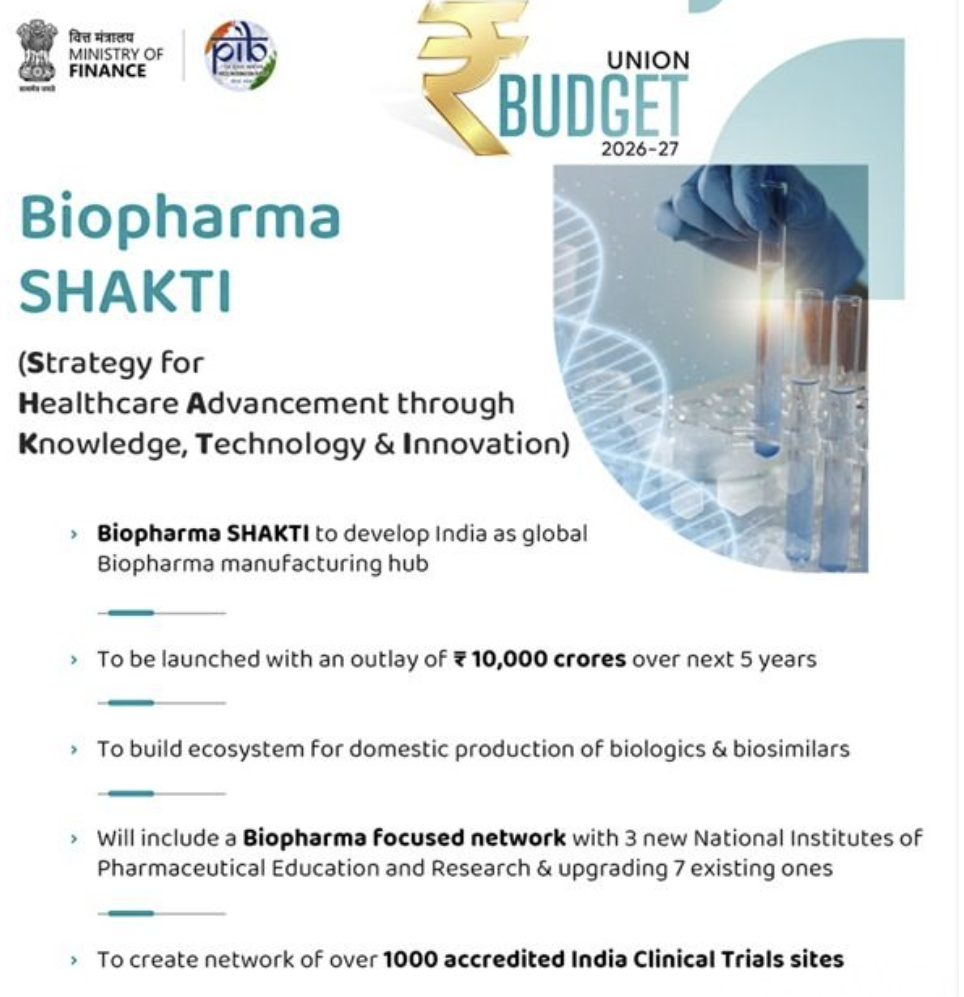
Biopharma SHAKTI initiative
Announcement
Union Budget 2026
Objective
Boost domestic production of:
Biologics
Biosimilars
Financial outlay
₹10,000 crore
Focus areas
Support innovation ecosystems
Strengthen industry capabilities
Promote advanced testing models (NAMs)
Biosimilars
Definition
Generic versions of biologics
Produced after patent expiry
Challenges
Patent evergreening
Example: Trastuzumab
IV version (2000)
New subcutaneous version extended patent
Delayed biosimilars until 2018
Regulatory hurdles
Approval required from CDSCO
Updated guidelines still in draft stage
Key issues
Slow regulatory acceptance of NAMs
Investor hesitation
Weak supply chain ecosystem
Limited industry awareness
Way forward
Strengthen regulatory clarity for NAMs
Align policies with industry needs
Increase funding and infrastructure
Promote commercialisation and startups
Build scalable systems rather than isolated products
Prelims Practice MCQs
Q. With reference to biologics, consider the following statements:
They are small chemical molecules synthesized artificially.
They are produced using living cells.
They include vaccines and monoclonal antibodies.
Which of the statements given above is/are correct?
A. 1 only
B. 2 and 3 only
C. 1 and 3 only
D. 1, 2 and 3
Answer: B
Explanation:
Statement 1 is incorrect → Biologics are large, complex molecules, not small chemicals.
Statement 2 is correct → Produced using living cells.
Statement 3 is correct → Includes vaccines, insulin, monoclonal antibodies.
Q. The “Northwick Park Tragedy” is often cited in scientific discussions because:
A. It demonstrated the success of animal testing
B. It highlighted failure of animal models in predicting human responses
C. It led to banning of biologics worldwide
D. It proved safety of monoclonal antibodies
Answer: B
Explanation:
The tragedy showed that animal models (monkeys) failed to predict severe immune reactions in humans.
It is a key example of limitations of animal testing.
Q. Which of the following best describes “Non-Animal Methodologies (NAMs)”?
A. Use of genetically modified animals for testing
B. Computer simulations only
C. Human-relevant bioengineered systems for testing drugs
D. Traditional in-vitro plant-based testing
Answer: C
Explanation:
NAMs include organoids, organ-on-chip, 3D bioprinting.
They replicate human biology more accurately than animal models.
Q. Which of the following are examples of NAMs?
Organoids
Organ-on-a-chip
3D bioprinting
Animal tissue grafting
Select the correct answer:
A. 1, 2 and 3 only
B. 2 and 4 only
C. 1 and 4 only
D. 1, 2, 3 and 4
Answer: A
Explanation:
1, 2, 3 → Correct (NAMs)
4 → Involves animals, hence not NAM