
Blackbuck Returns to Chhattisgarh after 50 Years
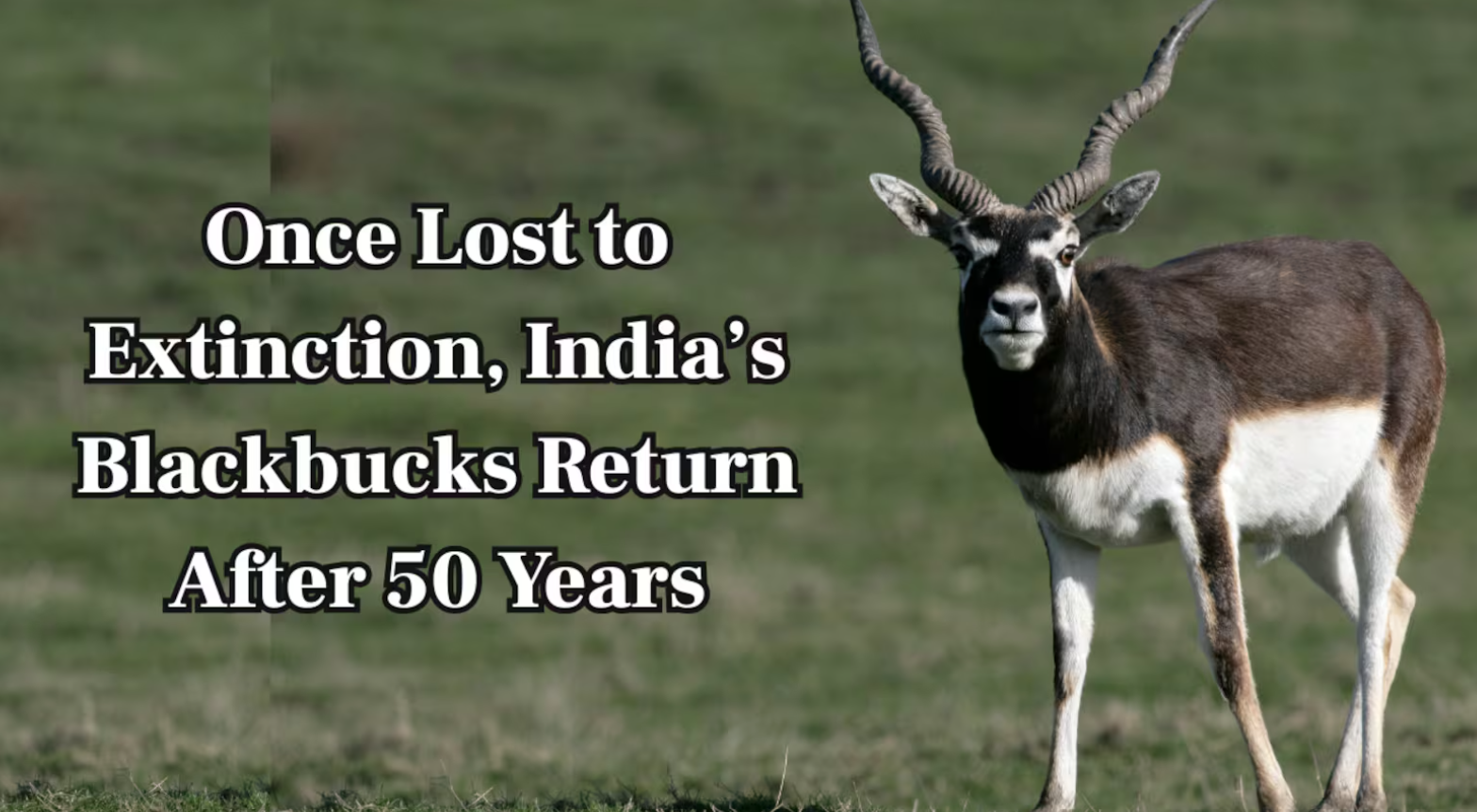
Location: Barnawapara Wildlife Sanctuary, Balodabazar District, Chhattisgarh
Successful reintroduction of Blackbuck (Antilope cervicapra) after nearly five decades of local extinction.
Background
Aspect | Details |
Species name | Antilope cervicapra |
Common name | Blackbuck |
Status in India | Protected under Schedule I, Wildlife (Protection) Act, 1972 |
IUCN Red List | Least Concern, but locally endangered in some states |
Distribution | Native to India and Nepal; found in grasslands and open plains |
Cultural significance | State animal of Andhra Pradesh, Haryana, and Punjab |
Historical Context
Once common in Chhattisgarh’s grasslands, blackbuck populations vanished by the 1970s due to:
Poaching for meat and skin
Habitat loss from agriculture and encroachment
Human–wildlife conflict
Reintroduction Project (2021–2025)
Phase | Details |
Launch Year | 2021 |
Lead Agency | Chhattisgarh Forest Department |
Initial Stock | 77 blackbucks (50 from Delhi Zoo, 27 from Kanan Pendari Zoo, Bilaspur) |
Site | Barnawapara Wildlife Sanctuary (Balodabazar district) |
Project Phases
Acclimatization Phase:
Animals kept in enclosures to adapt to local climate and vegetation.
Early challenges included deaths from pneumonia and stress.
Adaptive Management:
Improved habitat conditions sand flooring, veterinary supervision, and better nutrition.
Release & Monitoring:
Gradual release into open grasslands under continuous monitoring.
Population Growth:
By 2025, population rose to ~190 individuals — one of the most successful reintroductions in central India.
Expansion to: Gomardha Wildlife Sanctuary (next phase).
Ecological Significance
Ecosystem engineers:
Grazing controls invasive weeds and promotes native grass regeneration.
Biodiversity restoration:
Improves prey base for predators and supports grassland ecosystem recovery.
Indicator species:
Reflects health of open scrub–grassland ecosystems.
Prelims Practice MCQ
Q. Consider the following statements about the blackbuck (Antilope cervicapra):
It is listed under Schedule I of the Wildlife (Protection) Act, 1972.
It is endemic to India and Sri Lanka.
It is classified as Vulnerable in the IUCN Red List.
Which of the above statements are correct?
(a) 1 only
(b) 1 and 2 only
(c) 1 and 3 only
(d) 1, 2, and 3
✅ Answer: (a)
Explanation: Blackbuck is Schedule I protected and found mainly in India and Nepal (not Sri Lanka). It is Least Concern, not Vulnerable, as per IUCN.
Q. The Barnawapara Wildlife Sanctuary, recently in news, is located in which Indian state?
(a) Madhya Pradesh
(b) Maharashtra
(c) Chhattisgarh
(d) Jharkhand
✅ Answer: (c)
Explanation: The Barnawapara WLS is in Balodabazar district, Chhattisgarh, known for successful blackbuck reintroduction.
Q. Which of the following statements best describes the ecological role of blackbuck?
(a) Top predator controlling herbivore populations
(b) Keystone scavenger maintaining carcass balance
(c) Grazing herbivore maintaining grassland ecosystems
(d) Arboreal browser aiding seed dispersal
✅ Answer: (c)
Explanation: Blackbucks are grassland grazers that help control invasive vegetation and promote native plant diversity.