
Budget and India’s space–astronomy ecosystem
Context
The Union Budget 2026–27 has earmarked ₹13,416.20 crore for the Department of Space, giving a boost to domestic space research and astronomy, even as experts flag concerns over underutilisation of funds and execution bottlenecks.
Key budget announcements
Financial allocation
₹13,416.20 crore allocated to the Department of Space for 2026–27.
Significant share directed towards:
Deep-space exploration
Astrophysics and frontier astronomy
Major projects announced
National Large Optical-Infrared Telescope (30-m class) – Ladakh
National Large Solar Telescope near Pangong Lake, Ladakh
COSMOS-2 Planetarium, Amaravati (Andhra Pradesh)
Upgradation of control systems at the Himalayan Chandra Telescope, Hanle (Ladakh)
Why this matters for India’s astronomy
Only a few large observatories worldwide can conduct frontier research.
Countries like the US, China, Japan, and the EU consistently invest in upgrading telescopes, giving their scientists priority access.
Indian astronomers often face restricted access to overseas facilities, limiting cutting-edge research output.
Structural concerns highlighted by experts
Underutilisation of funds
Actual expenditure has often fallen below budgetary estimates.
Leads to:
Delays in mission approvals
Bottlenecks in execution of large projects
Governance and administrative issues
Resistance to innovative practices like:
Buying fractional observation time on foreign telescopes
Such arrangements are widely used globally as:
Stop-gap solutions
Tools for international collaboration
Dependence on overseas facilities
India still relies heavily on foreign observatories for:
High-resolution optical data
High-frequency radio astronomy
Sub-millimetre wavelength observations
This dependence weakens India’s autonomy in space science and astrophysics.
Existing strengths and ongoing progress
Domestic infrastructure
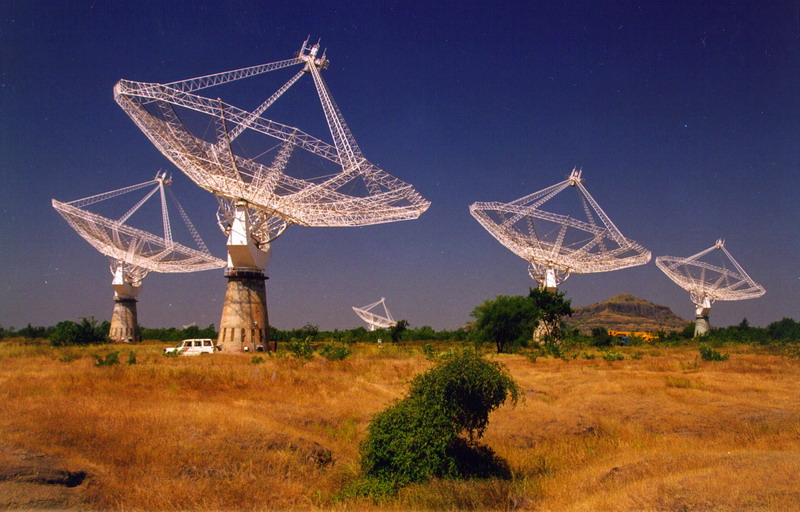
Giant Metrewave Radio Telescope:
World’s largest low-frequency radio telescope array
Attracts global researchers
Growth of:
Optical and radio telescopes
AI-driven data processing centres
Institutional support
Indian Space Research Organisation working closely with startups
Establishment of Indian National Space Promotion and Authorisation Centre in 2020 to:
Promote public–private partnerships
Enable private investment and innovation
Strategic gaps
Absence of:
A large optical telescope comparable to global peers
Any telescope operating in sub-millimetre wavelengths
Sub-millimetre astronomy is critical for:
Studying proto-stellar disks
Dusty galaxies
Early universe structure
Proposal under Astronomy & Astrophysics Mega Science Vision 2035 aims to address this gap.
Way forward
Adequate funding alone is insufficient without:
Efficient utilisation
Streamlined governance
Checks and balances
Need for:
Strategic international collaboration
Domestic industry partnerships with regulation
Long-term benefits:
Reduced dependence on foreign facilities
Arresting brain drain
Strengthening India’s position in global space science
Prelims practice MCQs
Q. With reference to the Union Budget 2026–27, consider the following statements:
₹13,416.20 crore was allocated to the Department of Space.
The allocation includes funding for large optical and solar telescopes in Ladakh.
Which of the statements is/are correct?
A. 1 only
B. 2 only
C. Both 1 and 2
D. Neither 1 nor 2
Correct answer: C
Explanation: The Budget earmarked ₹13,416.20 crore and explicitly prioritised large telescope projects in Ladakh.
Q. Which of the following correctly describes the Giant Metrewave Radio Telescope (GMRT)?
A. World’s largest optical telescope
B. World’s largest low-frequency radio telescope array
C. India’s only space-based observatory
D. A solar telescope near Pangong Lake
Correct answer: B
Explanation: GMRT near Pune is the world’s largest low-frequency radio telescope array.