
Bulgaria adopts the euro
Context
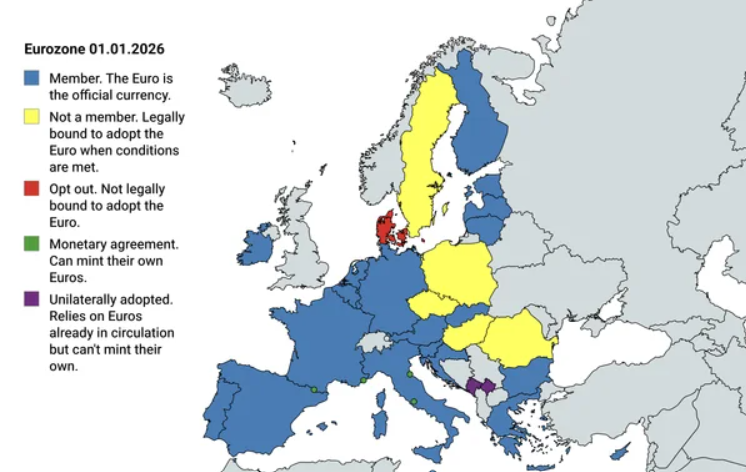
Bulgaria has officially adopted the euro, becoming the 21st member of the eurozone.
The switch happened nearly 20 years after Bulgaria joined the European Union (EU).
Bulgaria replaced its national currency, the lev, which had been in use since the late 19th century.

Key facts
New currency: Euro (€)
Old currency: Bulgarian lev
Eurozone member number: 21st
Capital: Sofia
Population: ~6.4 million
EU membership: Since 2007
EU membership vs eurozone membership
1. European Union (EU) membership
The European Union is a political and economic union of European countries.
EU members:
Participate in the single market (free movement of goods, services, capital, people)
Follow common EU policies on trade, agriculture, competition, etc.
Currency:
EU members may or may not use the euro.
They can keep their national currency.
Example:
Poland, Hungary, Czech Republic → EU members but not in eurozone.
2. Eurozone membership
The Eurozone consists of EU countries that have adopted the euro (€) as their official currency.
Eurozone members:
Share a common currency (euro)
Follow a common monetary policy decided by the European Central Bank (ECB)
Countries must meet convergence (Maastricht) criteria:
Low inflation
Fiscal deficit ≤ 3% of GDP
Public debt ≤ 60% of GDP
Exchange rate stability
As of now, the European Union has 27 members, while the eurozone has 21 members.
Therefore, 6 EU countries do not use the euro and retain their national currencies.
List of EU members outside the eurozone
Denmark
Has a formal opt-out from adopting the euro
Uses the Danish krone
Sweden
No formal opt-out, but rejected the euro in a 2003 referendum
Uses the Swedish krona
Poland
Has not yet met political/economic consensus
Uses the Polish zloty
Hungary
Retains monetary sovereignty
Uses the Hungarian forint
Czech Republic
Euro adoption postponed
Uses the Czech koruna
Romania
Plans euro adoption in the future
Uses the Romanian leu
EU and eurozone European Union (EU)
EU officially began in 1993 Eurozone
Eurozone effectively started in 1999 | ||
Prelims Practice MCQs
Q. With reference to the European Union (EU), consider the following statements:
The EU formally came into existence in 1993.
The Maastricht Treaty provided the legal foundation for the EU.
The European Union replaced the European Economic Community in 1957.
Which of the statements given above are correct?
(a) 1 and 2 only
(b) 2 and 3 only
(c) 1 and 3 only
(d) 1, 2 and 3
Answer: (a)
Explanation:
Statements 1 and 2 are correct.
Statement 3 is incorrect; the EEC was established in 1957, but the EU replaced it only in 1993.
Q. Consider the following statements regarding the eurozone:
All members of the eurozone are members of the European Union.
All members of the European Union are members of the eurozone.
The eurozone began before the formal establishment of the European Union.
Which of the statements given above is/are correct?
(a) 1 only
(b) 1 and 2 only
(c) 2 and 3 only
(d) 1, 2 and 3
Answer: (a)
Explanation:
Statement 1 is correct.
Statement 2 is incorrect (not all EU members use the euro).
Statement 3 is incorrect (eurozone began in 1999, EU in 1993).