
Cabinet Approves MERITE Scheme
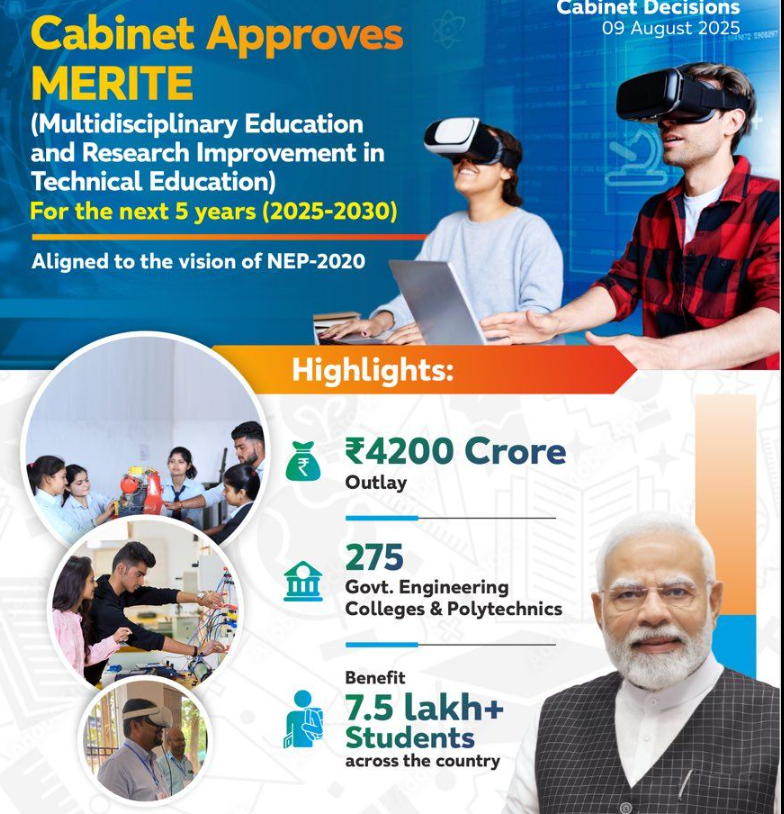
Context: The Union Cabinet, chaired by Prime Minister Shri Narendra Modi, has approved the implementation of the Multidisciplinary Education and Research Improvement in Technical Education (MERITE) Scheme in 275 technical institutions — 175 engineering institutions and 100 polytechnics — across all States and Union Territories.
-
Type: Central Sector Scheme
-
Outlay: ₹4,200 crore (2025–26 to 2029–30)
-
Funding: ₹2,100 crore loan from the World Bank
Objectives:
Aligned with National Education Policy 2020 (NEP-2020), the scheme aims to improve quality, equity, and governance in technical education.
Coverage & Beneficiaries:
-
Government/Government-aided institutions: NITs, State Engineering Colleges, Polytechnics, Affiliating Technical Universities (ATUs)
-
State/UT technical education departments
-
Around 7.5 lakh students to benefit
Key Expected Outcomes:
-
Digitalisation strategies in States/UTs
-
Guidelines for multidisciplinary technical programs
-
Improved learning, employability, and transition rates
-
Strengthened research and innovation ecosystem
-
Enhanced quality assurance and accreditation
-
Labour market–aligned curricula and blended learning
-
Development of future academic administrators, with emphasis on women faculty
Implementation Strategy:
-
Implemented in government engineering institutions/polytechnics nationwide
-
Funds transferred via a Central Nodal Agency
-
Collaboration with IITs, IIMs, AICTE, NBA and other regulatory bodies
Employment Generation Measures:
-
Internships and industry-aligned curricula
-
Faculty development programs
-
Research hubs, incubation centres, skill labs, maker labs, and language workshops
-
Focus on improving graduate employability and placement rates
Background:
Formulated with World Bank collaboration, the scheme addresses NEP-2020 reforms, including curriculum revamp, pedagogy improvement, research strengthening, gender gap reduction, faculty skill upgradation, and bridging the digital divide.