
Canada’s uranium deal with India
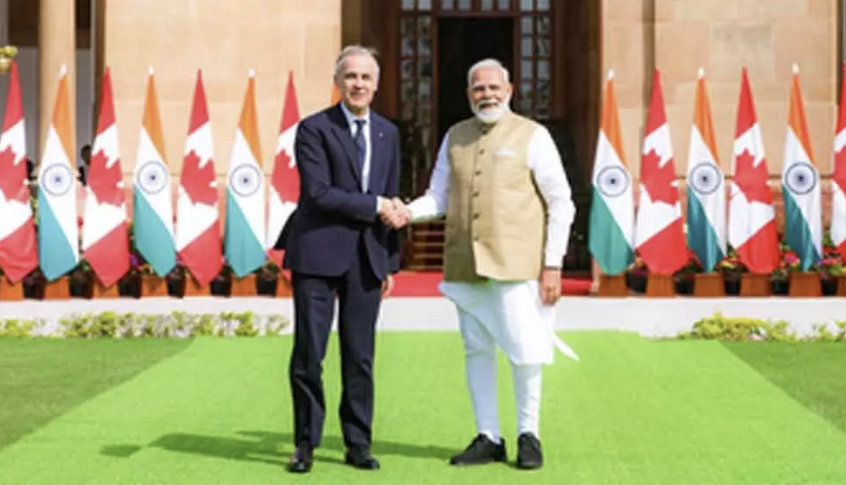
1. What is the Canada–India uranium deal?
India signed a $2.6-billion uranium supply agreement with the Canadian company Cameco.
Supply: About 10,000 tonnes of uranium
Period: 2027–2035
Objective: Strengthen India’s long-term nuclear fuel security
Cameco is one of the world’s top three uranium producers, and Canada has some of the highest-grade uranium deposits globally.
How it helps India
Ensures stable fuel supply for nuclear reactors.
Reduces risk from global supply disruptions.
Supports India’s plan to expand nuclear power capacity to 100 GW by 2047.
Frees up domestic uranium for strategic purposes.
2. What uranium stocks does India currently have?
Domestic uranium reserves
India has low-grade uranium deposits.
Major mining areas
Jaduguda Uranium Mine , Jharkhand
Turamdih Uranium Mine , Jharkhand
Tummalapalle Uranium Mine , AP
Estimated reserves
Ore: ~4.2–4.3 lakh tonnes
Extractable uranium metal: ~76,000–92,000 tonnes
Reason for low output
Indian uranium ore contains only 0.02–0.45% uranium.
Canadian ore can be 10–100 times richer.
Imported uranium sources
India imports uranium from:
Kazatomprom (Kazakhstan)
Uzbekistan
Russia
Canada (Cameco deal)
Currently, around 75% of India’s civilian nuclear fuel needs are met through imports.
India is also building a strategic uranium reserve capable of running reactors for five years.
3. Does the deal fall under the 2010 nuclear agreement?
Yes. The deal operates under the India–Canada Civil Nuclear Cooperation Agreement.
This agreement became possible after:
Nuclear Suppliers Group granted India a special waiver in 2008
Following the India–United States Civil Nuclear Agreement
Key condition
India must provide fissionable material accounting to Canada to ensure imported uranium is used only for civilian purposes.
Strategic implication
Imported uranium fuels civilian reactors
Domestic uranium can then be diverted for strategic or defence use
4. How does India use uranium?
(A) Electricity generation
India operates 24 nuclear reactors with about 9 GW capacity.
Major reactors are Pressurised Heavy Water Reactors (PHWRs) using natural uranium fuel.
Contribution:
Around 3% of India’s electricity generation
(B) Research and medical isotopes
For example:
Dhruva Reactor
Produces medical isotopes such as:
Technetium-99m
Iodine-131
Used in diagnostic imaging and cancer treatment.
(C) Strategic defence purposes
Domestic uranium is also used for:
Nuclear warheads (approx. 170 estimated)
Nuclear propulsion in submarines like
INS Arihant
(D) Future small modular reactors
In Union Budget 2025-26, India allocated ₹20,000 crore for Small Modular Reactors (SMRs).
These reactors typically use 3–5% enriched uranium.
5. Status of India’s nuclear power programme
India follows the three-stage nuclear programme envisioned by
Homi J. Bhabha.
Stage 1 – Pressurised Heavy Water Reactors (current stage)
Fuel:
Natural uranium (U-235)
Output:
Electricity
Plutonium-239 (by-product)
Stage 2 – Fast Breeder Reactors
Fuel:
Plutonium-239 + Uranium-238
Example:
Prototype Fast Breeder Reactor
The prototype fast breeder reactor (PFBR) in Kalpakkam is currently in an advanced stage of commissioning.
These reactors produce more fuel than they consume.
Stage 3 – Thorium-based reactors
Fuel:
Thorium-232 + Uranium-233
Importance:
India holds 20–25% of global thorium reserves, making this stage strategically important.
However, large-scale thorium deployment may only occur after 2060 due to technological and fuel cycle delays.
Former Department of Atomic Energy Chairman has explained that the doubling time — the time taken for one fast breeder reactor to produce enough fuel to start a second — is 15-20 years. To generate 100 GW, then, India has to go through several doubling cycles, which could explain the multiple deals now to secure the supply of uranium.
6. Challenges in India’s nuclear programme
Major issues include:
Project delays
Cost overruns
Land acquisition problems
Local protests
Long fuel breeding cycles (15–20 years)
For example, the PFBR project cost increased from ₹3,492 crore to over ₹6,800 crore.
7. Why the Canada deal matters strategically
The deal helps India:
Ensure long-term uranium supply
Support nuclear energy expansion
Reduce energy import dependence
Strengthen strategic nuclear autonomy
Advance the three-stage nuclear programme
Prelims practice MCQs
Q. With reference to India’s uranium resources, consider the following statements:
India’s uranium ore is generally low grade compared to major producers like Canada.
The major uranium mines of India are located in Jharkhand and Andhra Pradesh.
The uranium concentration in Indian ore is typically above 5%.
Which of the statements given above is/are correct?
A. 1 and 2 only
B. 2 only
C. 1 and 3 only
D. 1, 2 and 3
Answer: A
Explanation:
Statement 1 is correct: Indian uranium ore has low concentration (0.02–0.45%), much lower than Canadian ore.
Statement 2 is correct: Major mines include Jaduguda and Turamdih (Jharkhand) and Tummalapalle (Andhra Pradesh).
Statement 3 is incorrect: Indian uranium concentration is well below 1%, not above 5%.