
Carbon capture and utilisation (CCU) technologies
What is CCU?
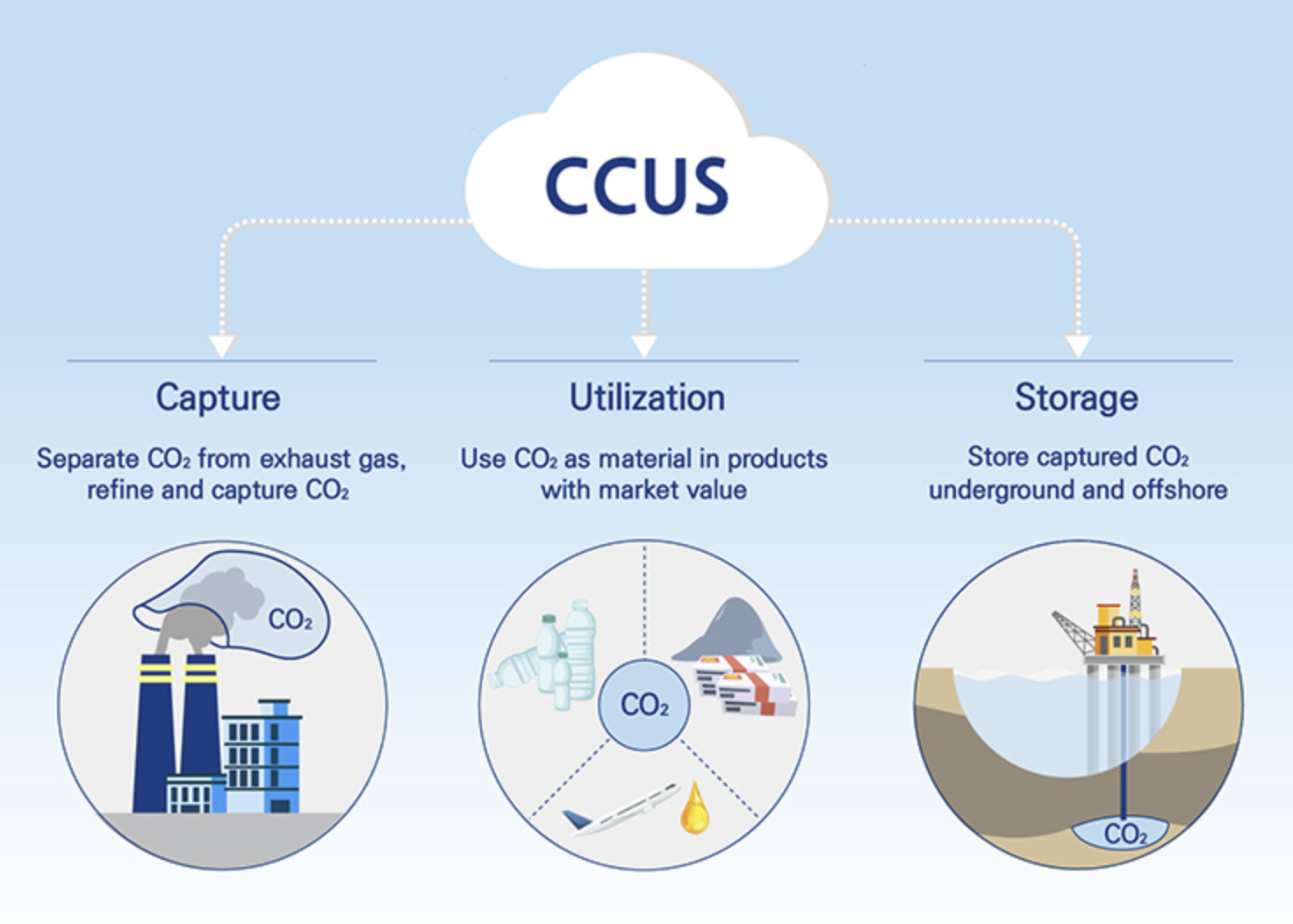
Carbon Capture and Utilisation (CCU) refers to technologies that:
Capture carbon dioxide (CO₂) from:
Industrial sources (cement, steel, power plants, chemicals)
Or directly from the atmosphere (Direct Air Capture)
Convert the captured CO₂ into useful products such as:
Synthetic fuels
Chemicals (methanol, olefins)
Polymers and plastics
Building materials (carbonated concrete)
Unlike Carbon Capture and Storage (CCS), where CO₂ is permanently stored underground, CCU reuses carbon in economic value chains.

How can CCU reduce CO₂ emissions?
CCU contributes in three major ways:
1. Decarbonising hard-to-abate sectors
Industries like:
Cement
Steel
Chemicals
produce process emissions that are difficult to eliminate through renewables alone. CCU reduces net emissions from these sectors.
2. Displacing fossil feedstocks
If captured CO₂ replaces fossil-based carbon in:
Fuels
Petrochemicals
Construction materials
it reduces demand for fresh fossil extraction.
3. Supporting circular carbon economy
Carbon is:
Captured
Converted
Reused
instead of being emitted into the atmosphere.
However, climate benefit depends on:
Source of energy used for conversion (renewable vs fossil)
Lifecycle emissions accounting
Why does India need CCU?
India is the world’s third-largest CO₂ emitter. Emissions are driven by:
Coal-based power generation
Cement manufacturing
Steel production
Chemical industries
CCU helps India:
Move toward its Net Zero 2070 target
Build new green industrial value chains
Reduce emissions from hard-to-abate sectors
Align with circular economy goals
Where does India stand?
Policy initiatives
Department of Science and Technology (DST) – CCU R&D roadmap
Draft 2030 CCUS roadmap by Ministry of Petroleum and Natural Gas
Industry pilots
Ambuja Cements (Adani Group) with IIT Bombay – CO₂-to-fuels/materials pilot
JK Cement – CO₂ use in lightweight concrete and olefins
Organic Recycling Systems Limited (ORSL) – Bio-CCU using CO₂ from biogas
India is currently in the pilot and early demonstration stage.
EU Bioeconomy Strategy and Circular Economy Action Plan
1. European Commission – EU Bioeconomy Strategy
The EU Bioeconomy Strategy:
Promotes use of renewable biological resources
Encourages conversion of waste and CO₂ into bio-based products
Links carbon reuse with sustainability and climate targets
It integrates CCU into a broader bio-based industrial transformation.
2. EU Circular Economy Action Plan
Part of the European Green Deal, it aims to:
Reduce waste generation
Promote product reuse and recycling
Support carbon reuse technologies
Strengthen sustainable industrial ecosystems
CCU fits as a tool to close carbon loops in industry.
What are other countries doing?
U.S.: Tax credits (e.g., 45Q) to incentivise carbon capture
UAE: CO₂-to-chemicals hubs with green hydrogen
Europe: Steel and cement sector CCU pilots
Example:
ArcelorMittal collaborating in Belgium to convert captured CO₂ into carbon monoxide for reuse in steel and chemical production.
Risks and challenges for India
1. Cost competitiveness
Capture and conversion are energy-intensive
Fossil-based products remain cheaper
2. Infrastructure gaps
Need industrial clusters
CO₂ transport pipelines
Integration with hydrogen infrastructure
3. Regulatory uncertainty
Lack of certification standards
No clear carbon pricing
Weak market demand signals
How can India scale up CCU?
1. Policy incentives
Carbon pricing mechanisms
Production-linked incentives for CO₂-derived products
Tax credits similar to U.S. models
2. Green hydrogen integration
CO₂ + Green Hydrogen → Synthetic fuels and chemicals
3. Cluster-based development
Develop CCU hubs near:
Cement clusters
Steel belts
Refinery zones
4. Public procurement
Government use of:
Low-carbon cement
Green fuels
to create initial demand.
5. Standards and certification
Lifecycle carbon accounting framework is essential.
Conclusion
CCU is not a silver bullet, but it is a strategic tool for:
Industrial decarbonisation
Circular carbon economy
Net Zero transition
For India, scaling CCU requires coordinated policy, infrastructure investment, and market creation mechanisms.
Prelims Practice MCQs
Q. With reference to Carbon Capture and Utilisation (CCU), consider the following statements:
CCU involves capturing carbon dioxide and permanently storing it in geological formations.
CCU can convert captured carbon dioxide into fuels, chemicals and building materials.
The climate benefit of CCU depends on the energy source used for converting CO₂.
Which of the statements given above is/are correct?
A. 2 only
B. 2 and 3 only
C. 1 and 3 only
D. 1, 2 and 3
Answer: B
Explanation:
Statement 1 is incorrect: Permanent underground storage refers to Carbon Capture and Storage (CCS), not CCU.
Statement 2 is correct: CCU converts CO₂ into useful products such as fuels and materials.
Statement 3 is correct: If fossil energy is used for conversion, net emissions may remain high; renewable energy improves climate benefit.
2. Which of the following sectors are considered “hard-to-abate” and may benefit significantly from CCU technologies?
Cement manufacturing
Steel production
Fertiliser and chemical industries
Solar photovoltaic manufacturing
Select the correct answer using the code below:
A. 1 and 2 only
B. 1, 2 and 3 only
C. 2, 3 and 4 only
D. 1, 2, 3 and 4
Answer: B
Explanation:
Cement, steel and chemical sectors generate process emissions that are difficult to eliminate. Solar PV manufacturing is not typically classified as a major hard-to-abate emission source compared to heavy industry.
3. With reference to the EU Bioeconomy Strategy, consider the following statements:
It promotes the use of renewable biological resources to replace fossil-based materials.
It supports converting waste and carbon dioxide into bio-based products.
It mandates compulsory carbon capture in all EU industries.
Which of the statements given above is/are correct?
A. 1 and 2 only
B. 2 only
C. 1 and 3 only
D. 1, 2 and 3
Answer: A
Explanation:
The EU Bioeconomy Strategy, framed by the European Commission, promotes renewable biological resources and circular carbon use. It does not mandate compulsory carbon capture across all industries.