
China Commissions Third Aircraft Carrier — Fujian
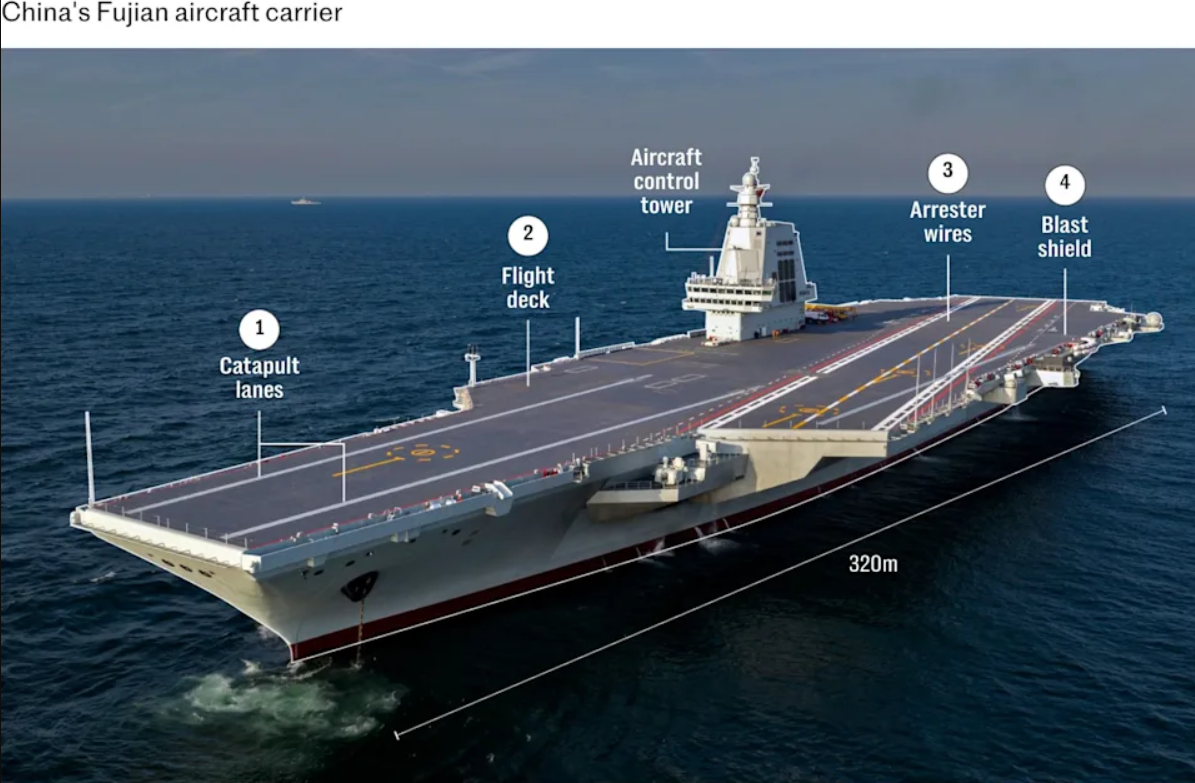
In News
China officially commissioned its third aircraft carrier, Fujian, after extensive sea trials.
Location: Hainan Island Naval Base, South China Sea
The carrier marks a major step in China’s effort to build a “world-class navy” by 2050, under Xi’s military modernization plan.

Key Features of Aircraft Carrier Fujian
Parameter | Details |
Name | Fujian (Type 003-class aircraft carrier) |
Commissioned | November 2025 |
Shipyard | Jiangnan Shipyard, Shanghai |
Class / Type | Type 003 — China’s first fully indigenously designed and built aircraft carrier |
Displacement | Approx. 80,000–85,000 tonnes (comparable to U.S. Nimitz-class) |
Propulsion | Conventional (non-nuclear), steam turbine |
Launch System | EMALS (Electromagnetic Aircraft Launch System) — first for China |
Flight Deck | Flat deck — catapult-launch system replaces older “ski-jump” model |
Aircraft Capacity | ~60 aircraft (fighters, AEW, and helicopters) |
Carrier Air Wing | Expected to operate J-35 stealth fighter jets, KJ-600 early warning aircraft, and Z-20 helicopters |
Home Port | Sanya, Hainan Island |
Comparison with Previous Chinese Carriers
Carrier | Origin / Design | Launch System | Displacement | Status |
Liaoning | Soviet-made (ex-Varyag, refurbished) | Ski-jump | ~60,000 tonnes | Commissioned 2012 |
Shandong | Indigenous (based on Soviet Kuznetsov-class) | Ski-jump | ~65,000 tonnes | Commissioned 2019 |
Fujian (Type 003) | Fully indigenous, new design | EMALS (flat deck) | ~80,000–85,000 tonnes | Commissioned 2025 |
Fujian is a technological leap — comparable to U.S. Navy supercarriers, especially due to its EMALS launch capability.
Geopolitical Implications
1. Regional Power Shift in Indo-Pacific
China now operates three carriers, while India operates two (INS Vikramaditya & INS Vikrant).
Japan and South Korea are also enhancing their carrier and F-35B capabilities — signaling an arms competition in the Indo-Pacific.
2. South China Sea Militarization
Hainan — Fujian’s home base — sits strategically near disputed maritime territories.
Could embolden assertive patrols around Taiwan, the Paracel, and Spratly Islands.
3. U.S.–China Maritime Rivalry
Fujian is seen as Beijing’s direct challenge to U.S. Navy’s dominance in the Pacific.
The U.S. 7th Fleet, headquartered in Japan, and bases in Guam and the Philippines, now face more sophisticated Chinese projection capability.
Technological Leap: EMALS Launch System
Specification | Description |
Full form | Electromagnetic Aircraft Launch System |
Function | Uses electromagnetic force (instead of steam) to catapult aircraft from deck |
Advantage | Allows launch of heavier aircraft with less deck stress; improves sortie rate |
Users | Only the U.S. Navy (Ford-class carriers) and now China (Fujian) |
Significance | Key indicator of next-generation carrier capability |
Global Context
China’s naval fleet is already the world’s largest (~370 ships, surpassing the U.S. in number, though not tonnage).
Fujian marks a transition from “coastal defence” to “global sea control”.
The PLA Navy (PLAN) is also expanding its logistics bases abroad, e.g. in Djibouti, Pakistan (Gwadar), and Cambodia (Ream).
Prelims Practice MCQs
Q. With reference to China’s aircraft carrier Fujian, consider the following statements:
It is China’s first indigenously designed and built aircraft carrier.
It uses a ski-jump style launch system similar to earlier Chinese carriers.
It is equipped with an Electromagnetic Aircraft Launch System (EMALS).
Which of the statements given above is/are correct?
A. 1 and 3 only
B. 2 and 3 only
C. 1 only
D. 1, 2 and 3
✅ Answer: A. 1 and 3 only
Explanation:
Fujian is China’s first fully indigenous carrier.
It uses EMALS, not the ski-jump system (used in Liaoning and Shandong).
Q. The “First Island Chain” often mentioned in Indo-Pacific geopolitics refers to:
A. A series of U.S. military bases in the Western Pacific.
B. The arc of islands from Japan through Taiwan to the Philippines that acts as a strategic maritime barrier to China.
C. The chain of islands in the Indian Ocean connecting Andaman to Mauritius.
D. The Chinese Belt and Road maritime infrastructure network.
✅ Answer: B.


