
Dark Stars: Discovery and Significance
Context:
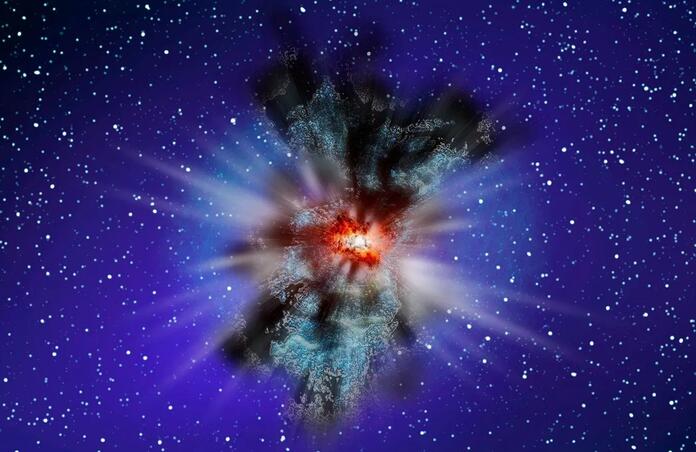
Astronomers using data from the James Webb Space Telescope (JWST) have identified four candidates that may represent “dark stars” — a hypothetical early-universe class of stars powered not by nuclear fusion but by dark matter annihilation.
Key Points:
1. What are Dark Stars?
Predicted by cosmologists as first-generation stars that formed about 100–250 million years after the Big Bang.
Unlike normal stars powered by hydrogen fusion, dark stars derive energy from the annihilation of dark matter particles, such as WIMPs (Weakly Interacting Massive Particles).
Despite their name, they emit light — possibly making them millions of times brighter than the Sun.
2. Discovery by JWST:
JWST observed four unusually bright early-universe objects.
Their light spectra (energy signatures) match theoretical models for supermassive dark stars rather than galaxies or typical stars.
The findings could redefine early star formation models and offer clues about dark matter distribution in the young universe.
3. Scientific Significance:
Could explain mysteries of the early universe, such as:
Why the earliest luminous objects were so bright.
How the first supermassive black holes (billions of solar masses) formed rapidly after the Big Bang.
If verified, this discovery would link cosmology and particle physics, showing that dark matter influenced stellar evolution.
4. About the James Webb Space Telescope (JWST):
Launched: 2021 by NASA, ESA, and CSA.
Main goal: To study the formation of first galaxies and stars, and detect infrared light from the early universe.
Instruments: NIRCam, NIRSpec, MIRI, and FGS/NIRISS.