
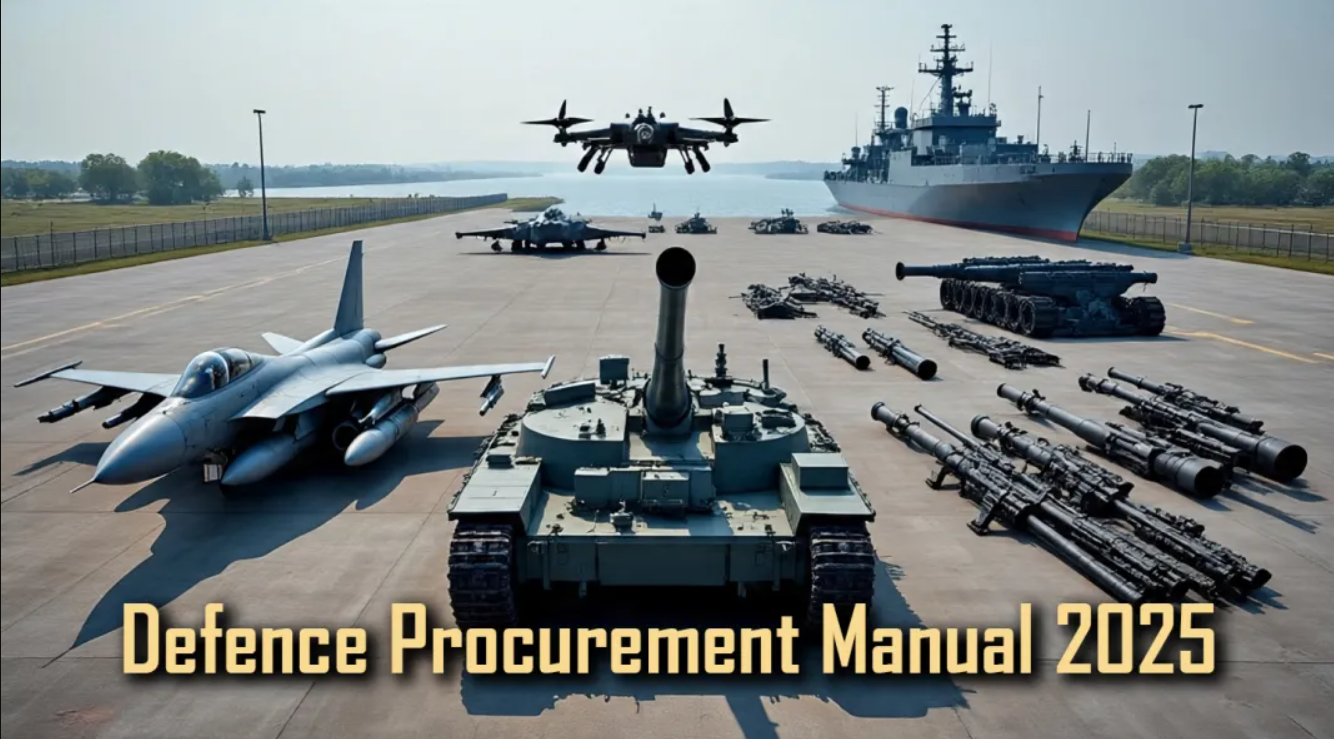
Defence Procurement Manual (DPM) 2025
Background
-
Approved by: Raksha Mantri Shri Rajnath Singh .
-
Scope: Revenue Procurement under the Ministry of Defence (Operations & Sustenance).
-
Replaces: DPM 2009 (last revision).
-
Value of procurement: ~₹1 lakh crore in FY 2025–26.
-
Goal: Streamline, simplify, enable, and rationalise procurement to meet modern warfare needs.
Objectives
-
Ensure timely availability of resources at appropriate cost.
-
Foster jointness among Army, Navy, Air Force for readiness.
-
Promote Aatmanirbharta in defence manufacturing and technology.
-
Boost Ease of Doing Business in defence sector.
-
Facilitate private players, MSMEs, start-ups, academia alongside DPSUs.
-
Enhance fairness, transparency, accountability using technology.
Key Features
a) Industry & Innovation
-
New chapter to promote indigenisation & innovation.
-
Collaboration with industry, DPSUs, academia, IITs, IISc & other institutions.
-
Encouragement to young talent & start-ups in defence R&D.
b) Contract & Penalties
No Liquidated Damages (LD) during development phase:When a company is still in the research and development stage (designing, testing, making the first version), they won’t be fined if there are delays. This gives them flexibility to innovate without fear of penalty.
After a working prototype is made and approved, if the company delays supply, a very small penalty of 0.1% of the contract value per week (or as applicable) will be charged.
Earlier, the maximum penalty could go up to 10% of the contract value for delays. Now, it is reduced to 5% in most cases, and 10% will be charged only in very extreme, prolonged delays.
-
Incentivises genuine suppliers who face minor delays.
c) Industry Support
-
Assured guarantee of orders: up to 5 years (+5 years in special cases).
-
Handholding by Services: technical knowhow, access to equipment.
-
Supportive financing options to ease working capital issues.
d) Procurement Process Reforms
-
Competent Financial Authorities (CFAs):
-
Empowered at field/lower level for faster decisions.
-
Can extend delivery periods without higher approvals.
-
Can extend bid opening dates to increase participation.
-
-
Collegiate decision-making: Strengthened, as in capital acquisitions.
-
Limited Tendering:
-
Allowed up to ₹50 lakh (routine cases).
-
Beyond that only in exceptional circumstances.
-
-
Proprietary items: Procurement allowed on Proprietary Article Certificate, but parallel search for alternatives mandated.
-
Government-to-Government procurement: Dedicated streamlined provisions.
-
Level playing field: No requirement of NOC from DPSUs before open bidding.
e) Maintenance & Availability
15% upfront provision for growth of work in repair/refit/maintenance of aerial & naval platforms.When the armed forces give a contract for repair, refit, or maintenance of aircraft and naval platforms, they will now set aside 15% extra money in advance.
This is because during repair/maintenance, unexpected additional work often comes up. The 15% upfront provision ensures that there is enough budget to handle such growth in work without delays or asking for fresh approvals.
-
Reduces downtime and ensures operational availability.
Expected Impact
-
Faster decision-making & reduced bureaucratic delays.
-
Greater participation from private sector & start-ups.
-
Reduced import-dependency & promotion of Make in India.
-
Improved operational readiness through quick turnaround in repairs & maintenance.
-
Boost to self-reliance, innovation, and indigenisation in defence sector.