
Degradation of Soil Organic Carbon in India: ICAR Study (2025)
In News
A six-year-long study (2017–2023) by eight scientists of the Indian Council of Agricultural Research (ICAR), has found that:
Unscientific fertilizer use and climate change are major causes of the decline in soil organic carbon (SOC) in India’s arable lands.
The study provides a nationwide soil carbon map, with implications for land degradation, carbon credit policy, and climate resilience.
Major Findings
1. Organic Carbon Dynamics
Soil organic carbon (SOC) influences all physical, chemical, and biological properties of soil.
It is the foundation of soil fertility, improving:
Nutrient retention and availability,
Water-holding capacity, and
Microbial activity.
2. Relation Between Organic Carbon and Micronutrients
Inverse correlation found between SOC and micronutrient deficiency:
Low SOC → High micronutrient deficiency.
High SOC → Low deficiency.
3. Climatic and Geographical Correlations
Rainfall and temperature are key determinants of SOC.
Elevation correlation:
High-elevation areas → High organic carbon (cooler climate, slower decomposition).
Low-lying plains → Low organic carbon.
Temperature correlation:
SOC is negatively correlated with temperature.
Hotter regions (e.g., Rajasthan, Telangana) have lower SOC.
4. Impact of Fertilizer Use
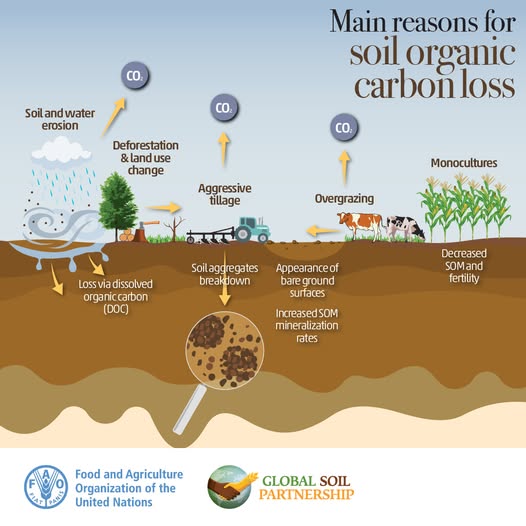
Imbalanced and excessive use of fertilizers, especially urea and phosphorus, leads to SOC decline.
Examples:
Haryana, Punjab, Western UP — areas of intensive fertilizer application — showed marked reduction in SOC.
Imbalanced N:P:K ratios disrupt microbial activity and organic matter recycling.
5. Role of Climate Change
Rising temperatures accelerate soil organic matter decomposition, reducing SOC stocks.
Future risk:
Further SOC decline →
Lower soil fertility, greater emissions of soil CO₂, and reduced carbon sequestration potential.
6. Agri-Ecological Mapping
Scientists created an Agri-Ecological Base Map:
Assesses SOC variations across different cropping systems and fertilizer use patterns.
Can be used for:
Carbon credit schemes,
Monitoring land degradation neutrality (LDN), and
Climate-smart agriculture policy planning.
Scientific Insights
Factor | Effect on Soil Organic Carbon |
Temperature (↑) | Decomposition rate ↑ → SOC ↓ |
Rainfall (↑) | Biomass production ↑ → SOC ↑ (up to saturation) |
Elevation (↑) | Cooler, wetter → SOC ↑ |
Unbalanced Fertilizer Use | Soil biology disrupted → SOC ↓ |
Organic Matter Addition (compost, residue retention) | SOC ↑ |
Climate Change | Long-term SOC decline risk |
Implications
1. Soil Health and Productivity
SOC decline → reduced fertility, soil compaction, poor water retention.
Affects crop yields and sustainability of Green Revolution regions.
2. Carbon Credit and Climate Policy
SOC acts as a major carbon sink.
Loss reduces India’s carbon sequestration potential, impacting:
Nationally Determined Contributions (NDCs),
Soil carbon credit markets,
Sustainable Land Management (SLM) goals.
3. Food Security
Declining SOC threatens nutrient security (especially micronutrients like Zn, Fe).
Impacts soil resilience under erratic monsoon and temperature extremes.
Recommendations
Promote Integrated Nutrient Management (INM):
Combine organic manures, crop residues, biofertilizers, and judicious chemical fertilizer use.
Adopt Climate-Smart Agriculture:
Use conservation tillage, cover cropping, crop rotation, and mulching.
Encourage Balanced Fertilizer Use:
Ensure proper N:P:K ratio (4:2:1) and reduce overuse of urea.
Incentivize Carbon-Rich Practices:
Develop carbon credit programs for farmers maintaining or improving SOC.
Policy Integration:
Link findings to Soil Health Card Scheme, National Mission on Sustainable Agriculture (NMSA), and Bharatiya Prakritik Krishi Paddhati (BPKP).
Key Terms for Prelims
Term | Meaning |
Soil Organic Carbon (SOC) | Carbon component of organic compounds in soil, derived from plant & animal residues. |
Carbon Sequestration | Process of capturing and storing atmospheric CO₂ in plants, soils, and oceans. |
Agro-Ecological Zoning | Division of land based on climate, soil, and crop characteristics. |
Carbon Credit | Tradable certificate representing reduction of one tonne of CO₂-equivalent emissions. |
Land Degradation Neutrality (LDN) | UN goal to balance land degradation with restoration by 2030. |
Global Soil Partnership (GSP) :
The Global Soil Partnership (GSP) is a globally recognized mechanism established in 2012 with the mission to position soils in the Global Agenda and to promote sustainable soil management.
Launched by the Food and Agriculture Organization of the United Nations in Rome on 7 September 2011, the Partnership aims to implement the provisions of the 1982 World Soil Charter, and to raise awareness and motivate action by decision-makers on the importance of soils for food security and climate change adaptation and mitigation.
The IAEA is also participating in the Global Soil Partnership because nuclear science and technology have an important role to play in efficient soil and water management. For example, isotopic techniques are used to assess and gather data about various elements in soil, water and plants
World Soil Day is an annual observance on December 5th that promotes the importance of healthy soils for food security and ecosystems. Established by the UN General Assembly, it raises awareness about sustainable soil management and the critical role soil plays in human well-being and agriculture
Prelims Practice MCQs
Q.With reference to Soil Organic Carbon (SOC), consider the following statements:
SOC influences the physical, chemical, and biological properties of soil.
Increasing temperature leads to higher soil organic carbon accumulation.
Balanced fertilizer use enhances soil organic carbon levels.
Which of the statements given above are correct?
A. 1 and 2 only
B. 1 and 3 only
C. 2 and 3 only
D. 1, 2, and 3
✅ Answer: B
Explanation: High temperatures increase decomposition, reducing SOC; balanced fertilization supports carbon retention.
Q. According to the ICAR study (2025), which of the following factors contribute to the decline in soil organic carbon in India?
Unscientific fertilizer use
Rising temperatures due to climate change
Reduced elevation of cultivated lands
Decrease in rainfall variability
Select the correct answer using the code below:
A. 1, 2, and 3 only
B. 1, 2, and 4 only
C. 1 and 2 only
D. 2 and 3 only
✅ Answer: A
Q. In the context of India’s agricultural sustainability, why is the decline in soil organic carbon a cause for concern?
It reduces soil fertility and water retention.
It lowers the potential for carbon sequestration.
It enhances micronutrient deficiencies in soil.
Select the correct answer using the code below:
A. 1 and 2 only
B. 2 and 3 only
C. 1, 2, and 3
D. 1 only
✅ Answer: C
Mains Practice Question
Q. “Soil organic carbon is the backbone of sustainable agriculture. Discuss the implications of its decline in India and suggest policy measures to address it.”
Answer Outline:
Define SOC and its functions.
ICAR findings: fertilizer misuse, climate impacts, low SOC in plains.
Consequences: soil degradation, reduced productivity, emission rise.
Solutions: INM, organic farming, crop residue management, carbon credit systems.