
Delhi Assembly to Host First All India Speakers’ Conference
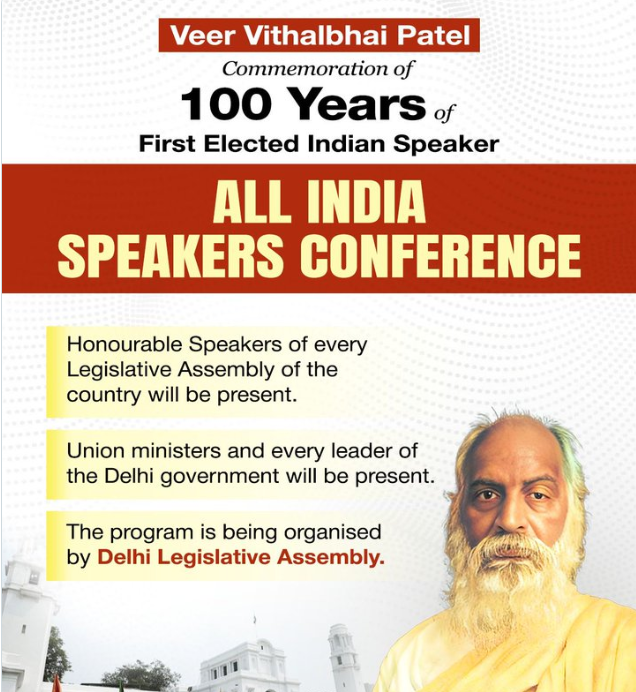
Occasion: First-ever All India Speakers’ Conference hosted by the Delhi Assembly.
-
Date: August 23 (two-day event).
-
Inauguration: By Union Home Minister Amit Shah.
-
Participants:
-
29 State Assembly Speakers
-
Chairmen & Deputy Chairmen of 6 Legislative Councils
-
Senior Union Ministers and Rajya Sabha Chairman
-
-
Key Highlights:
-
Release of a commemorative stamp to mark 100 years of Vitthalbhai Patel, the first elected Indian Speaker (1925).
-
Inauguration of an exhibition on legislative history.
-
-
Significance:
-
One of the largest gatherings of presiding officers in recent history.
-
Strengthens parliamentary traditions, cooperative federalism, and legislative reforms.
-
Provides a forum for exchange of best practices among legislatures.
Vithalbhai Patel: Legal and Parliamentary Contributions
-
Early Legislative Role (Bombay Council)
-
In 1912, introduced an amendment to the Bombay Medical Act to regulate doctors and check malpractice (excluded Ayurvedic physicians).
-
In 1914, played a significant role in the Bombay District Municipal Act Amendment Bill and Town Planning Bill.
-
In 1917, championed the extension of primary education to municipal districts of the Bombay Presidency (outside Bombay city), a reform passed after prolonged debate and modifications.
Role in Swaraj Party
-
After Gandhi suspended the Non-Cooperation Movement in 1922 (post-Chauri Chaura), Patel, with Motilal Nehru and C.R. Das, co-founded the Swaraj Party.
-
Objective: enter councils, obstruct colonial governance from within, and demand constitutional reforms.
-
The party soon became the largest single party in the Central Legislative Assembly and in several provinces.
-
Patel emerged as a strong parliamentarian, noted for his legal expertise and strategic opposition to colonial policies.
Served as Deputy Leader of the Swaraj Party.
-
-
Political Base:
-
Supported by Swaraj Party in the 1925 elections, which gave him a solid political foundation.
-
-
Significant Victory (1925):
-
On 22 August 1925, Patel defeated the British government’s candidate.
-
Symbolic achievement: proved that Indians could carve space in British-controlled institutions and use them to challenge colonial policies.
-
-
Legacy:
-
Among the early Indian leaders to demonstrate how legislatures could be used as instruments of constitutional resistance.
-
His victory marked a significant shift in asserting Indian voices within British parliamentary structures.
-
All India Presiding Officers’ Conference (AIPOC) – 85th Session
-
Date & Venue: 20–21 January 2025, Patna, Bihar.
-
Significance: Apex body of legislatures in India; platform for sharing best practices, innovations, and legislative strengthening.
-
Hosted by: Bihar Legislature (after 43 years, last in 1982).
Bihar last hosted AIPOC in 1982 and before that in 1964.
-
Chair: Lok Sabha Speaker Om Birla.
-
Co-host: Bihar Legislative Assembly Speaker Nand Kishore Yadav.
-
Special Attendee: Deputy Chairman of Rajya Sabha Harivansh.
Theme
-
“75th Glorious Journey of the Indian Constitution”
-
Focus on:
-
Contribution of Parliament and State Legislatures in empowering constitutional values.
-
Reflections on the 75th anniversary of adoption of the Constitution (26 Nov 1949 – 26 Nov 2024).
-
Importance
-
Symbolises cooperative federalism and dialogue among legislatures.
-
Promotes parliamentary democracy, procedural reforms, and innovations.
-
Special in 2025 as it coincides with Amrit Kaal and the Constitution’s 75th year.
-
Third time Bihar is hosting (previous: 1961, 1982).