
Delhi’s Ancient Roots - Indraprastha, Painted Grey Ware (PGW)
Context
MP Praveen Khandelwal wrote a letter to Union Home Minister Amit Shah requesting that Delhi be renamed “Indraprastha”, citing its ancient and civilizational roots linked to the Mahabharata era.
The demand is based on archaeological excavations and historical narratives connecting Delhi’s Purana Qila area to the ancient city of Indraprastha, believed to have been established by the Pandavas.
Archaeological Background
Archaeological Survey of India (ASI) Excavations:
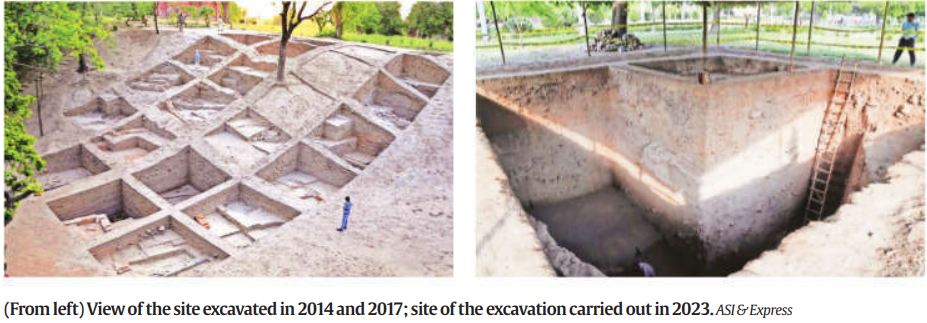
Excavations carried out over the past seven decades at Purana Qila (Old Fort, Delhi).
Excavation years:
1954–55 – First by B. B. Lal.
2014 – Led by Vasant Swarnkar.
2023 – Latest excavation.
Objective: To establish a link between Delhi and ancient Indraprastha (c. 1000 BCE).
Findings:
Artifacts belonging to Painted Grey Ware (PGW) culture found.
PGW typically represents Iron Age Indo-Aryan culture of 1000 BCE – 400 BCE.
Found layers of PGW sherds, ancient pottery, and other material cultural remains.
PGW and Mahabharata Connection
PGW culture sites have been found in:
Hastinapur, Tilpat, Kurukshetra, Mathura, and Purana Qila (Delhi).
PGW is associated with Mahabharata-period settlements.
According to Vasant Swarnkar (ASI 2014 excavation lead):
PGW provides evidence of habitation in Delhi since 1200 BCE.
Some activities of Mahabharata age are proved to have happened in Purana Qila area.
B. B. Lal’s excavations also indicated layers connected with Mahabharata-related material culture.
Scholarly and Archaeological Opinions
Supporting View (Swarnkar, Khandelwal):
The PGW findings and settlement layers correspond with Mahabharata-era.
Delhi’s link with Indraprastha and Pandavas is historically and archaeologically plausible.
Cautious/Neutral View (R. S. Bisht, V. Srawan):
Evidence supports ancient habitation, but direct correlation with Mahabharata events not conclusively proven.
“It is hard to connect PGW with Mahabharata events.”
PGW indicates habitation from early Iron Age but not necessarily Mahabharata-specific.
Historical Background of Indraprastha
Believed to have been the capital city established by the Pandavas on the banks of River Yamuna.
Later renamed and rebuilt by Mughal Emperor Humayun as Dinpanah, and then by Sher Shah Suri as the current Purana Qila (Old Fort).
Mahabharata describes Indraprastha as a grand, prosperous city built under the supervision of Vishwakarma.
PAINTED GREY WARE (PGW) CULTURE
Chronology and Geography
Period: c. 1200 BCE – 500 BCE
Cultural Phase: Early Iron Age (post-Late Harappan, pre-Northern Black Polished Ware).
Region: Western Gangetic Plain and Ghaggar-Hakra valley (Haryana, western Uttar Pradesh, parts of Punjab, Rajasthan, and Delhi).
Major Sites: Hastinapur, Atranjikhera, Purana Qila (Delhi), Kurukshetra, Mathura, Ahichhatra, Noh, Bhagwanpura, Jakhera, etc.

Material Culture and Pottery Features
Defining trait: Fine grey pottery painted in black geometric patterns.
Fabric: Well levigated clay, wheel-thrown (some handmade types exist).
Surface: Generally grey, occasionally red surface due to firing conditions.
Designs:
Geometric motifs (lines, circles, dots).
Floral and faunal representations.
Some perforated pots (possibly strainers or ritual use).
Finish: Polished, fine, thin-walled, showing high craftsmanship.
Shape: Usually flat-based bowls, dishes, and beakers.
Polychrome pottery (multi-coloured) is rare but found in select sites.
Uniformity: Indicates mass production under organized supervision, suggesting social hierarchy or state control over artisans.
Cultural and Economic Aspects
Settlements: Well-organized village and small-town settlements with mud-brick structures.
Subsistence: Mixed economy agriculture, animal domestication (notably horses), and craft specialization (ivory-working, pottery-making).
Technology: Introduction and use of iron metallurgy tools, weapons, and agricultural implements.
Trade & Stratification:
Luxury pottery and ornament findings indicate economic differentiation.
Control over pottery production reflects centralized or hierarchical social structure.
OCP vs PGW vs NBPW
Feature | OCP (Ochre Coloured Pottery) | PGW (Painted Grey Ware) | NBPW (Northern Black Polished Ware) |
Time Period | c. 2000–1500 BCE | c. 1200–600 BCE (or up to 500 BCE) | c. 700–200 BCE |
Cultural Phase | Late Harappan / Chalcolithic–Early Iron Age transition | Iron Age culture | Later Iron Age / Early Historic Period |
Geographical Distribution | Western UP, Haryana, Rajasthan (Upper Ganga–Yamuna Doab region) | Western UP, Haryana, Punjab, parts of Rajasthan and Delhi (Western Ganga Plain and Ghaggar–Hakra valley) | Ganga Valley — Bihar, Eastern UP, parts of MP and Bengal |
Main Sites | Jodhpura, Atranjikhera, Ahichchhatra, Lal Qila | Bhagwanpura, Hastinapur, Ahichchhatra, Atranjikhera, Noh, Purana Qila (Delhi) | Kaushambi, Rajghat, Sravasti, Patna, Ujjain, Chandraketugarh |
Type of Pottery | Ochre-coloured pottery with red slip, often flaky; handmade or wheel-thrown | Fine grey pottery, painted with black geometric designs | Highly lustrous, glossy black pottery with metallic sheen (made by advanced firing) |
Material / Technique | Clay mixed with ochre pigment; low-fired | Well-fired clay; polished surface; fine fabric | Advanced firing in reducing atmosphere; very fine and thin |
Decoration / Design | Usually plain or red-slipped; sometimes painted in black | Painted with geometric and floral motifs in black; uniform designs | Black lustre with mirror-like polish; plain or rarely decorated |
Associated Metal | Copper; limited iron | Iron widely used (Iron Age culture) | Iron fully established; also copper, lead, silver |
Economic Base | Agrarian with some pastoralism; early metal use | Mixed economy – agriculture, crafts, trade; domestication of horses | Urban, trade-based economy; monetized exchanges; advanced agriculture |
Associated Sites / Civilisation Link | Late Harappan connection (continuity of Harappan traits in pottery and settlement) | Associated with Mahabharata-era sites; early Vedic culture | Associated with 16 Mahajanapadas and Second Urbanisation |
Settlement Pattern | Small villages, semi-nomadic | Village–town complexes; fortified settlements | Urban centres with fortifications, drains, and brick houses |
Important Archaeological Finds | Copper hoards, stone tools, limited ceramics | Iron tools, ivory objects, horse remains, bone arrowheads | Coins, punch-marked coins, iron implements, terracotta figurines |
Cultural Significance | Transitional phase from Chalcolithic to Iron Age | Early historic cultural phase; associated with Kuru–Panchala and Mahabharata | Peak of early historic civilisation; rise of urbanism and Buddhism |
Decline / Transition | Evolved into PGW culture | Transitioned into NBPW culture | Transitioned into early historic kingdoms (Mauryan period) |
Prelims Practice MCQ
Q. With reference to the Painted Grey Ware (PGW) culture, consider the following statements:
PGW culture represents an early Iron Age phase of the western Gangetic plain and Ghaggar-Hakra valley.
The pottery of this culture is handmade, thick, and usually coarse with limited decoration.
PGW culture shows evidence of domesticated horses and the use of iron implements.
Pottery found at PGW sites is uniform, suggesting centralized control over production.
Which of the above statements are correct?
A) 1, 3, and 4 only
B) 1 and 2 only
C) 2 and 4 only
D) 1, 2, 3, and 4
Answer: ✅ A) 1, 3, and 4 only
Explanation:
Statement 1: Correct – PGW belongs to the Iron Age culture (1200–600 BCE) of the western Gangetic plain and Ghaggar-Hakra region.
Statement 2: Incorrect – PGW pottery is fine, thin, and wheel-thrown, not coarse or purely handmade.
Statement 3: Correct – Evidence of domesticated horses and iron metallurgy is a hallmark of this culture.
Statement 4: Correct – Uniform mass-produced pottery indicates centralized supervision and early economic stratification.
Q. Which of the following pairs are correctly matched?
Feature | Associated Culture |
1. Polished red pottery with geometric black paintings | Painted Grey Ware |
2. Fine, black lustrous pottery with high gloss | Northern Black Polished Ware |
3. Handmade thick pottery, often ochre-washed | Ochre Coloured Pottery |
Select the correct code:
A) 1 and 2 only
B) 2 and 3 only
C) 1, 2, and 3
D) 1 and 3 only
Answer: ✅ B) 2 and 3 only
Explanation:
1 → Incorrect: PGW is grey pottery, not red.
2 → Correct: NBPW is fine black-lustrous ware of later Iron Age.
3 → Correct: OCP is thick, ochre-washed handmade ware, belonging to the Late Harappan phase.
Q. Which of the following best explains the archaeological importance of PGW culture?
A) It marks the introduction of iron technology and early state formation in the Ganga plains.
B) It represents the peak of urbanization during the Harappan Civilization.
C) It denotes the beginning of agriculture in the Indian subcontinent.
D) It shows the spread of Buddhism in the Ganga plains.
Answer: ✅ A) It marks the introduction of iron technology and early state formation in the Ganga plains.
Explanation:
PGW bridges the protohistoric to early historic transition, introducing iron metallurgy, complex society, and organized settlements, paving the way for Mahajanapadas.