
Devon Island: Earth’s closest natural laboratory for Mars exploration
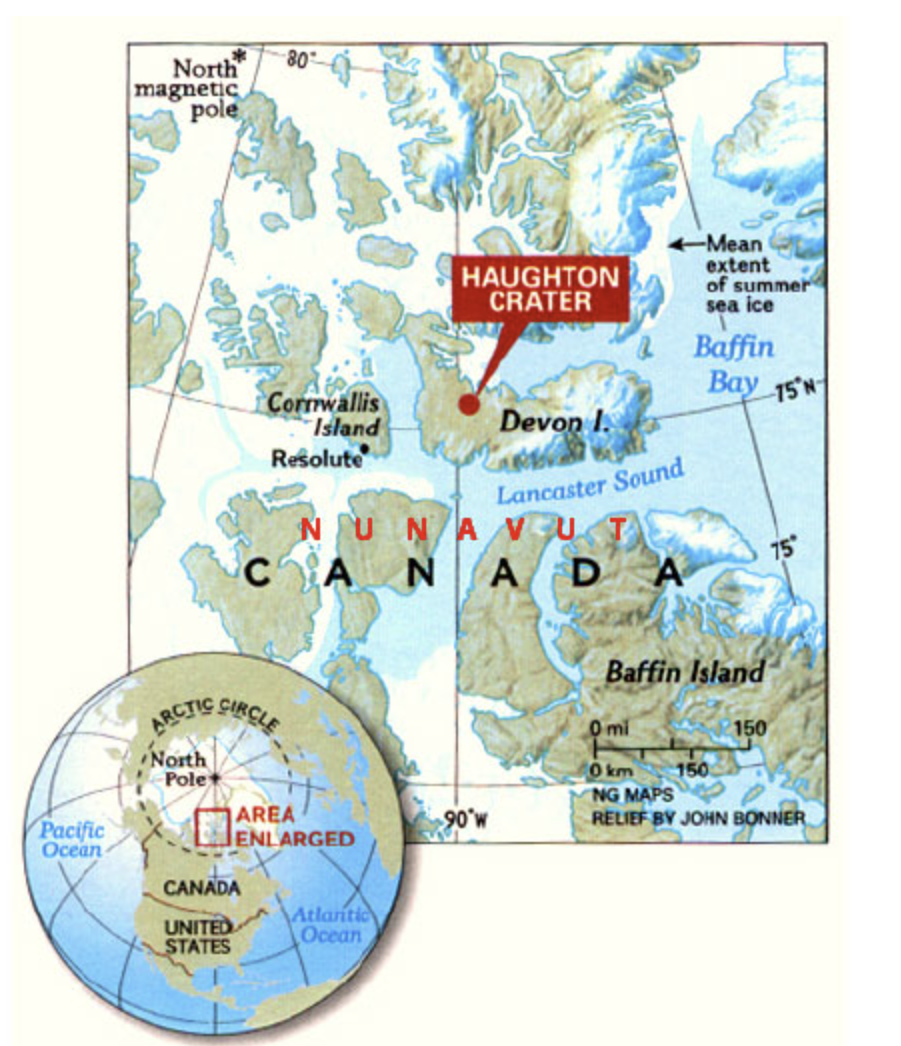
Location
Devon Island is located in Nunavut, Canada, in the Canadian Arctic Archipelago.
It is the world’s largest uninhabited island and is widely used by scientists as a Mars analogue environment.
Why Devon Island resembles Mars
Several environmental features make Devon Island similar to Mars:
Polar desert climate with extremely low temperatures
Very low precipitation
Almost no vegetation
Rocky barren terrain
Haughton impact crater
A major feature of the island is the Haughton Impact Crater.
Formed by a meteorite impact
Diameter: about 20 km
Terrain resembles Martian impact craters
Because of these characteristics, the island provides conditions very similar to Martian surface environments.
Use in Mars exploration research
Scientists and space agencies use Devon Island to test technologies needed for future Mars missions.
Technologies tested
Next-generation rovers
Autonomous drones
Deep drilling systems to search for underground water ice
Life-support systems
The harsh Arctic environment allows engineers to check whether equipment can operate reliably in extreme conditions similar to Mars.
Research on human survival on Mars
Devon Island is also used for simulated Mars missions.
Key experiments
Arthur Clarke Mars Greenhouse project
Experiments on growing plants in Mars-like soil
Researchers study:
Food production systems
Habitat design
Psychological effects of isolation and confinement during long-duration missions.
Astrobiology and extreme life
Scientists also investigate how life survives in harsh environments.
In the Haughton crater, researchers found:
Microorganisms living inside rocks
This process is called endolithic colonisation
These organisms survive by protecting themselves from extreme ultraviolet radiation.
Such studies help scientists understand:
How life might survive on Mars or other planets
Where to search for evidence of past microbial life on Mars
Prelims Practice MCQs
Q. Devon Island, recently in the news for Mars research, is located in:
A. Greenland
B. Norway
C. Canada
D. Iceland
Answer: C
Explanation:
Devon Island lies in Nunavut, Canada, within the Canadian Arctic Archipelago.