
DRDO Military Combat Parachute System (MCPS)
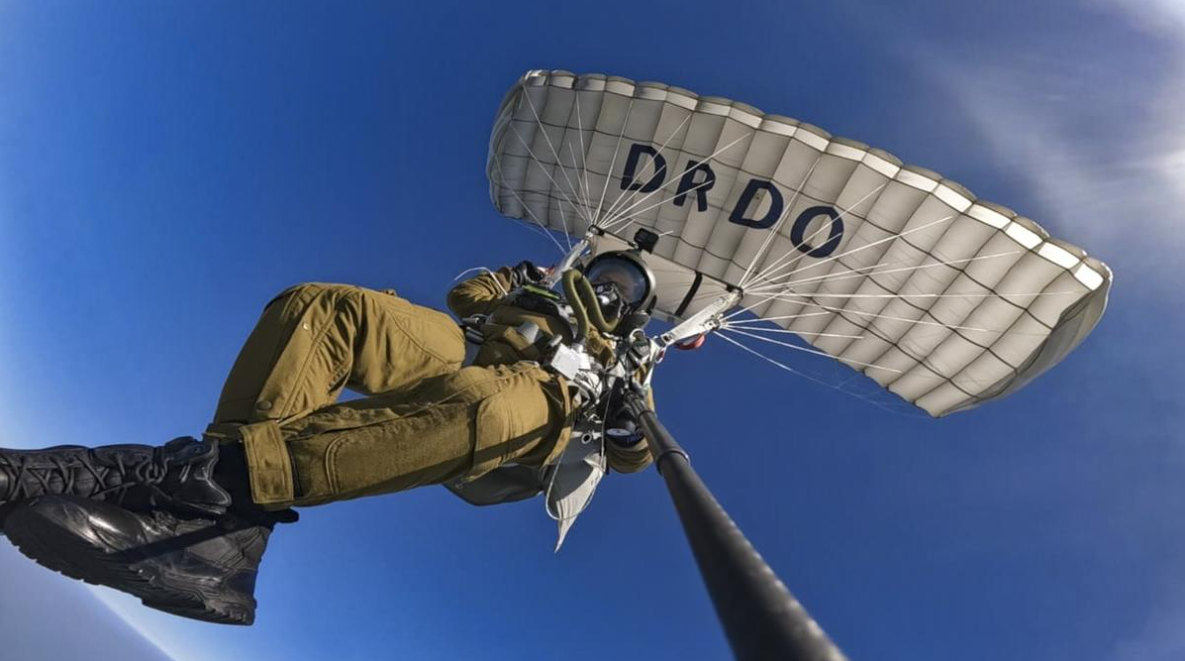
Overview
Developed by:
Aerial Delivery Research and Development Establishment (ADRDE), Agra
Defence Bioengineering and Electromedical Laboratory (DEBEL), Bengaluru
Both under DRDO (Defence Research and Development Organisation).
Tested at: Altitude of 32,000 ft (October 2025).
Executed by: Test jumpers of the Indian Air Force.
Significance: The only parachute system currently in operational use by the Indian armed forces capable of deployment above 25,000 ft.
Key Achievements
Altitude record: Successfully demonstrated a combat freefall jump at 32,000 ft — a high-altitude operational environment.
Operational first: Makes India self-reliant in high-altitude parachute systems — previously imported.
Indigenous breakthrough: Opens the way for induction of indigenous parachute systems across the armed forces.
Technical and Tactical Features
Enhanced Tactical Capabilities:
Lower rate of descent for improved landing safety.
Superior steering control for precise navigation and target landing.
Enables paratroopers to deploy at predetermined altitudes and land in designated drop zones with high accuracy.
Integration with NavIC:
Compatible with India’s indigenous satellite navigation system (NavIC).
Ensures secure, interference-free navigation.
Provides freedom of operation without reliance on foreign GPS systems.
Operational Efficiency:
Minimal maintenance and turnaround time compared to imported systems.
Higher serviceability during conflict or war.
Reduces foreign dependence for repair or spares.
Strategic Importance
Boosts Atmanirbhar Bharat: Marks a major step toward self-reliance in aerial delivery and special operations equipment.
Enhances Special Forces Capability: Allows safe, stealthy high-altitude insertions during operations in mountainous or hostile terrains (e.g., Ladakh, Northeast, or cross-border zones).
Improves Defence Readiness: Ensures uninterrupted availability of critical parachute systems during wartime contingencies.
Prelims Practice MCQ
Which of the following DRDO laboratories were involved in developing the MCPS?
Aerial Delivery Research and Development Establishment (ADRDE), Agra
Defence Bioengineering and Electromedical Laboratory (DEBEL), Bengaluru
Defence Avionics Research Establishment (DARE), Bengaluru
Armament Research and Development Establishment (ARDE), Pune
Select the correct answer:
A. 1 and 2 only
B. 2 and 3 only
C. 1 and 4 only
D. 1, 2, and 3
Answer: A. 1 and 2 only
Explanation: MCPS was developed jointly by ADRDE (Agra) and DEBEL (Bengaluru), both DRDO labs.