
Durand Line: The Afghanistan–Pakistan Border
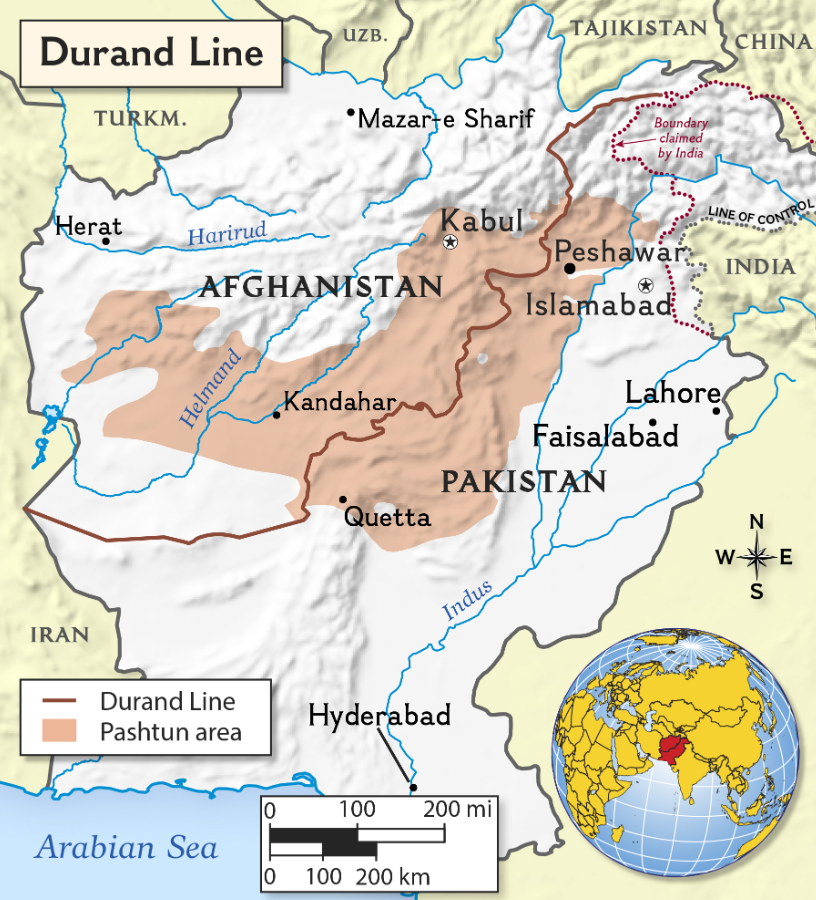
Context: Pakistan and Afghanistan clash along Durand Line
Overview
The Durand Line is a 2,640 km (1,640 mi) long international border between Afghanistan and Pakistan.
It was established on 12 November 1893 under the Durand Line Agreement between:
Sir Mortimer Durand, representing British India, and
Amir Abdur Rahman Khan, the Emir of Afghanistan.
The line demarcates the limit of the spheres of influence of British India and Afghanistan.
It runs from Iran in the west to China in the east, cutting across the Pashtun tribal belt and Baloch regions.
Historical Background
Created during the “Great Game” (British–Russian rivalry) to establish Afghanistan as a buffer state between the two empires.
The Durand Line Agreement (1893) contained 7 articles ensuring non-interference beyond the boundary.
The Anglo-Afghan Treaty of 1919 (after the Third Anglo-Afghan War) ratified the border.
When Pakistan was formed in 1947, it inherited the border as part of the British legacy.
Geographical Features
Passes through rugged terrain south of the Hindu Kush and Karakoram ranges.
Major rivers crossing the border: Kunar, Kabul, Kurram, and Gomal.
The Spīn Ghar (White Mountains) and Registan Desert dominate the landscape.
Border provinces:
Afghanistan: Nimroz, Helmand, Kandahar, Zabul, Paktika, Khost, Paktia, Logar, Nangarhar, Kunar, Nuristan, Badakhshan.
Pakistan: Khyber Pakhtunkhwa, Balochistan, and Gilgit-Baltistan.
Dispute and Recognition
Pakistan: Recognizes the Durand Line as the official international border.
Afghanistan: Does not recognise it; claims it was imposed under colonial duress and expired after British withdrawal in 1947.
Afghan governments (including Daoud Khan, PDPA regime, and Hamid Karzai) have periodically rejected the border.
Afghanistan historically claims areas up to the Indus River, encompassing parts of present-day Khyber Pakhtunkhwa and Balochistan.
Political and Strategic Significance
The border divides ethnic Pashtun tribes, many of whom share cross-border kinship ties.
The unrecognized status has made it a hotspot for insurgency, terrorism, and smuggling.
It is described as one of the world’s most dangerous borders, due to:
Taliban movements
Cross-border militancy
Refugee inflows and illicit trade
The Pashtunistan issue has historically strained Afghanistan–Pakistan relations.
Current Dynamics
Pakistan has undertaken border fencing and surveillance along most of the Durand Line to curb illegal crossings.
Afghanistan (under the Taliban, 2021–present) remains ambiguous on official recognition but disputes Pakistan’s fencing efforts.
Regional security dynamics: The border plays a central role in counterterrorism, refugee management, and India–Pakistan–Afghanistan geopolitics.
Treaties Linked to the Border
Treaty | Year | Significance |
Treaty of Gandamak | 1879 | Ended Second Anglo-Afghan War; British gained control over Afghan foreign policy. |
Durand Line Agreement | 1893 | Fixed border between British India and Afghanistan. |
Treaty of Rawalpindi (Anglo-Afghan Treaty) | 1919 | Ratified Durand Line after Third Anglo-Afghan War; recognized Afghan independence. |
Anglo–Afghan Wars (1839–1919)
War | Period | Main Causes | Key Events / Figures | Treaty / Outcome | Significance |
First Anglo-Afghan War | 1839–1842 | British fear of Russian influence in Afghanistan (part of the “Great Game”); attempt to replace Dost Mohammad Khan with a pro-British ruler, Shah Shuja. | British invasion from India; capture of Kabul (1839); Afghan uprising (1841); massacre of retreating British troops in the Khyber Pass (1842). | Treaty of 1842 (no formal name); British withdrew; Dost Mohammad restored to throne. | Exposed limits of British imperial power; disastrous for British prestige in Central Asia. |
Second Anglo-Afghan War | 1878–1880 | Russia sent a mission to Kabul; Amir Sher Ali’s refusal to accept British mission; British invasion to counter Russian influence. | British victories at Kandahar, Peiwar Kotal; death of Sher Ali; accession of Yakub Khan; later rebellion in Kabul. | Treaty of Gandamak (1879) – Afghanistan ceded frontier districts and accepted British control over foreign affairs. | Made Afghanistan a British protectorate in foreign policy; deepened British influence. |
Third Anglo-Afghan War | 1919 | Amir Amanullah Khan sought full independence after WWI; took advantage of British weakness post-war. | Afghan invasion of British India’s North-West Frontier; brief but intense fighting; both sides agreed to peace. | Treaty of Rawalpindi (1919) – Britain recognized Afghanistan’s independence in foreign affairs. |