
El Niño, La Niña and the recent temperature spike
Context
Recent research highlights how the natural El Niño–La Niña cycle is interacting with human-induced climate change, contributing to the sharp rise in global temperatures since early 2023.
What is changing in El Niño labelling?
The National Oceanic and Atmospheric Administration (NOAA) has updated the way it calculates when an El Niño or La Niña event begins.
Why the change?
Global ocean waters are becoming warmer due to long-term climate change.
Traditional baseline averages (used to classify warming or cooling events) are shifting.
As background temperatures rise, fewer events meet the relative threshold for El Niño.
More events may now qualify as La Niña under revised calculations.
This reflects a broader scientific challenge: natural variability is now occurring on top of a warmer baseline climate.
Understanding El Niño and La Niña
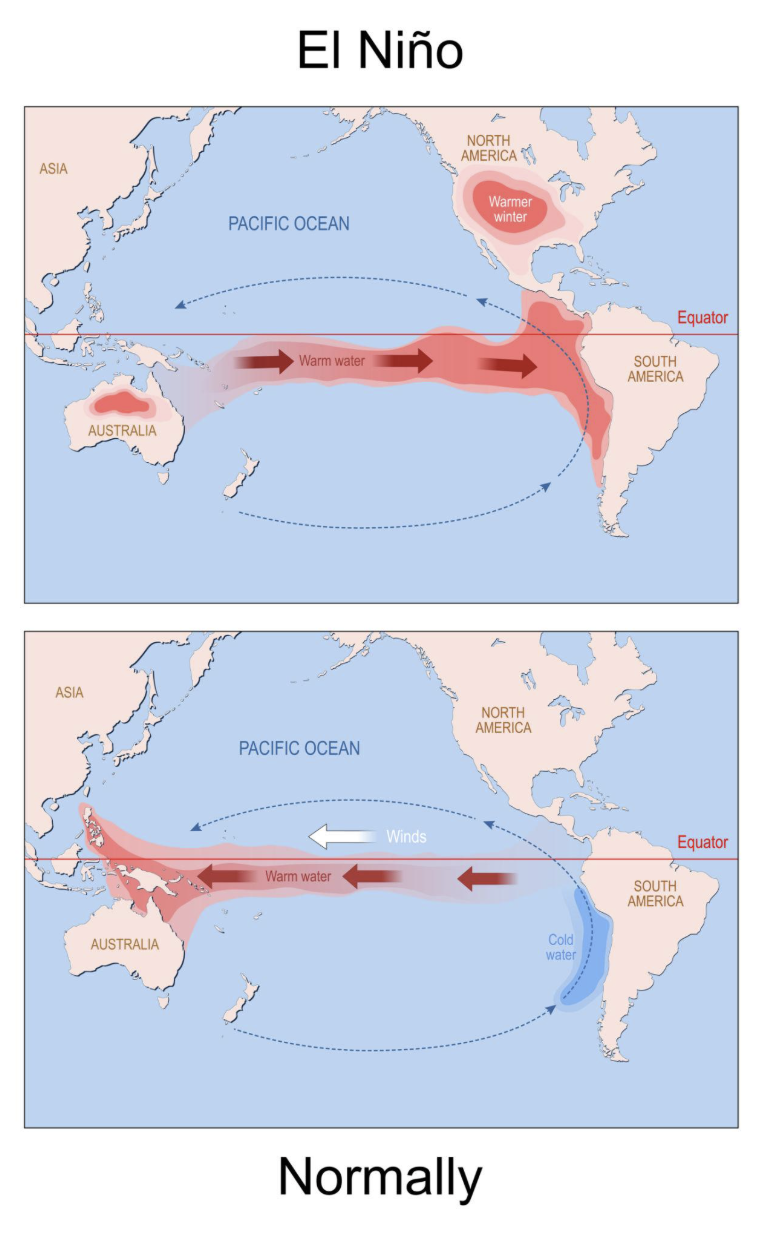
El Niño
Periodic warming of equatorial Pacific waters.
Raises global average temperatures.
Alters rainfall, monsoon, drought and cyclone patterns.
La Niña
Cooling of equatorial Pacific surface waters.
Temporarily suppresses global average temperature rise.
Often linked to stronger monsoons in India and increased Atlantic hurricanes.

The “Triple Dip” La Niña (2020–2023)
From 2020 to 2023, the world experienced an unusual three-year La Niña — called a “triple dip.”
Normally:
La Niña reduces surface warming.
Heat is stored deeper in the ocean.
But this prolonged cooling phase contributed to changes in Earth’s energy imbalance.
Earth’s energy imbalance:
Earth’s energy imbalance refers to:
The difference between energy received from the Sun and energy radiated back into space.
If more energy is retained than released:
Global temperatures rise.
According to a study in Nature Geoscience:
About three-fourths of the recent increase in energy imbalance is due to:
Long-term human-caused greenhouse gas emissions
Transition from prolonged La Niña to El Niño
Break-up of causes:
Slightly more than half: Greenhouse gases (coal, oil, gas burning)
About 23%: Triple-dip La Niña pattern
Remaining: Other factors (solar output, reduced aerosols, volcanic activity)
Why did temperatures spike in 2023?
Earth’s average monthly temperature sharply jumped above the long-term warming trend in early 2023 and continued rising through 2025.
Possible contributing factors:
Shift from La Niña to El Niño
Reduced cooling effect from shipping pollution (aerosols)
Underwater volcanic activity
Slight increase in solar output
Accelerating greenhouse gas accumulation
Prelims Practice MCQs
Q. With reference to El Niño and La Niña, consider the following statements:
El Niño refers to periodic warming of sea surface temperatures in the equatorial Pacific Ocean.
La Niña events generally increase global average surface temperatures.
Both El Niño and La Niña are components of the El Niño–Southern Oscillation (ENSO) cycle.
Which of the statements given above is/are correct?
A. 1 and 3 only
B. 1 only
C. 2 and 3 only
D. 1, 2 and 3
Answer: A
Explanation:
Statement 1 is correct: El Niño is associated with warming of the central and eastern equatorial Pacific.
Statement 2 is incorrect: La Niña generally has a temporary cooling influence on global average temperatures.
Statement 3 is correct: Both are opposite phases of ENSO.
Q. Consider the following statements regarding Earth’s energy imbalance:
It refers to the difference between solar radiation absorbed by the Earth and infrared radiation emitted back to space.
A positive energy imbalance leads to global cooling.
Greenhouse gases contribute to an increase in Earth’s energy imbalance.
Which of the statements given above is/are correct?
A. 1 only
B. 1 and 3 only
C. 2 and 3 only
D. 1, 2 and 3
Answer: B
Explanation:
Statement 1 is correct: Energy imbalance measures incoming vs outgoing energy.
Statement 2 is incorrect: A positive imbalance (more energy retained) causes warming, not cooling.
Statement 3 is correct: Greenhouse gases trap outgoing infrared radiation, increasing imbalance.
Q. With reference to the recent “triple dip” La Niña (2020–2023), consider the following statements:
It refers to three consecutive years of La Niña conditions.
During La Niña, warm surface waters spread eastward across the Pacific.
Prolonged La Niña can influence global temperature trends.
Which of the statements given above is/are correct?
A. 1 and 3 only
B. 2 only
C. 1 only
D. 1, 2 and 3
Answer: A
Explanation:
Statement 1 is correct: Triple dip indicates three successive La Niña years.
Statement 2 is incorrect: Eastward spread of warm water characterises El Niño, not La Niña.
Statement 3 is correct: Extended La Niña affects global heat distribution and temperature trends.