
Electronics Components Manufacturing Scheme (ECMS)
Context
The Government of India approved seven projects worth ₹5,532 crore under the Electronics Components Manufacturing Scheme (ECMS).
Total investment generated: ₹36,559 crore.
Employment creation: Over 5,100 direct jobs.
Notified on: 8 April 2025
Total outlay: ₹22,919 crore (~USD 2.7 billion)
Tenure: 6 years + optional 1-year gestation period
Nodal Ministry: Ministry of Electronics and Information Technology (MeitY)
Geographic Spread
Approved Units:
Tamil Nadu – 5 projects
Andhra Pradesh – 1 project
Madhya Pradesh – 1 project
Products to be Manufactured
Multilayer Printed Circuit Boards (PCBs)
HDI PCBs (High-Density Interconnect)
Camera Modules
Copper Clad Laminates
Polypropylene Films
Domestic Demand & Export Potential
ECMS aims to meet:
20% of domestic PCB demand
15% of domestic camera module sub-assembly demand
100% of domestic copper clad laminate demand
60% of total production from approved plants will be exported.
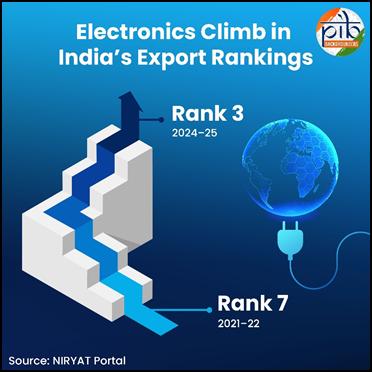
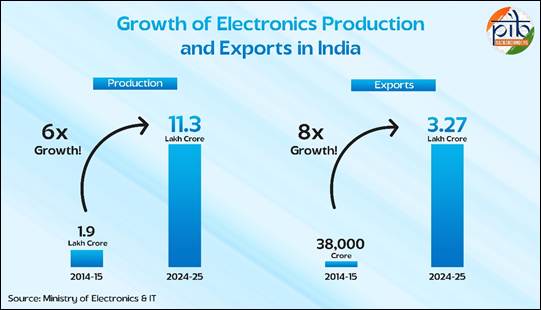
Electronics is India’s 3rd largest export category in 2024–25.
Incentives Structure
Incentives linked to turnover and capital expenditure (capex).
Companies must meet incremental sales and investment targets annually.
Failure to meet:
Employment target: 1% deduction in incentives.
Capex-linked incentive: 5% deduction if capital investment not completed in 3 years.
Eligibility
Companies must meet revenue thresholds in either:
Electronics System Design and Manufacturing (ESDM), or
Pure manufacturing of selected electronic components.
Prelims Practice MCQ
Q. Which of the following products are planned for production under ECMS?
Copper clad laminates
High-density interconnect (HDI) PCBs
Camera modules
Polypropylene films
A. 1 and 3 only
B. 2 and 4 only
C. 1, 2, 3 and 4
D. 1, 3 and 4 only
✅ Answer: C. 1, 2, 3 and 4
Explanation:
All listed products are part of the approved manufacturing list under ECMS projects.
Q. Consider the following statements regarding the Electronics Components Manufacturing Scheme (ECMS):
The ECMS is implemented by the Ministry of Electronics and Information Technology (MeitY).
The scheme aims to meet the entire domestic demand of multilayer printed circuit boards (PCBs) within India by 2028.
ECMS was notified in April 2025 and has a total outlay of ₹22,919 crore.
Which of the above statements is/are correct?
A. 1 and 2 only
B. 1 and 3 only
C. 2 and 3 only
D. 1, 2 and 3
✅ Answer: B. 1 and 3 only
Explanation:
Statement 1 – Correct: ECMS is implemented by MeitY.
Statement 2 – Incorrect: ECMS aims to meet 20% of PCB demand domestically, not 100%.
Statement 3 – Correct: Scheme notified on April 8, 2025 with ₹22,919 crore outlay.
Q. Under the ECMS, which of the following statements is/are correct?
Projects under ECMS are required to meet annual incremental sales and investment targets.
Failure to meet employment generation targets leads to a 5% deduction in incentives.
Capex-linked incentives are based on capital expenditure incurred within three years.
A. 1 only
B. 1 and 3 only
C. 2 and 3 only
D. 1, 2 and 3
✅ Answer: B. 1 and 3 only
Explanation:
Statement 1 – Correct: Companies must meet both incremental sales and investment targets annually.
Statement 2 – Incorrect: Failure to meet employment targets results in 1% deduction, not 5%.
Statement 3 – Correct: Capex-linked incentives depend on capital expenditure within 3 years.