
Essential Commodities Act and India’s LPG supply crisis
Why in news
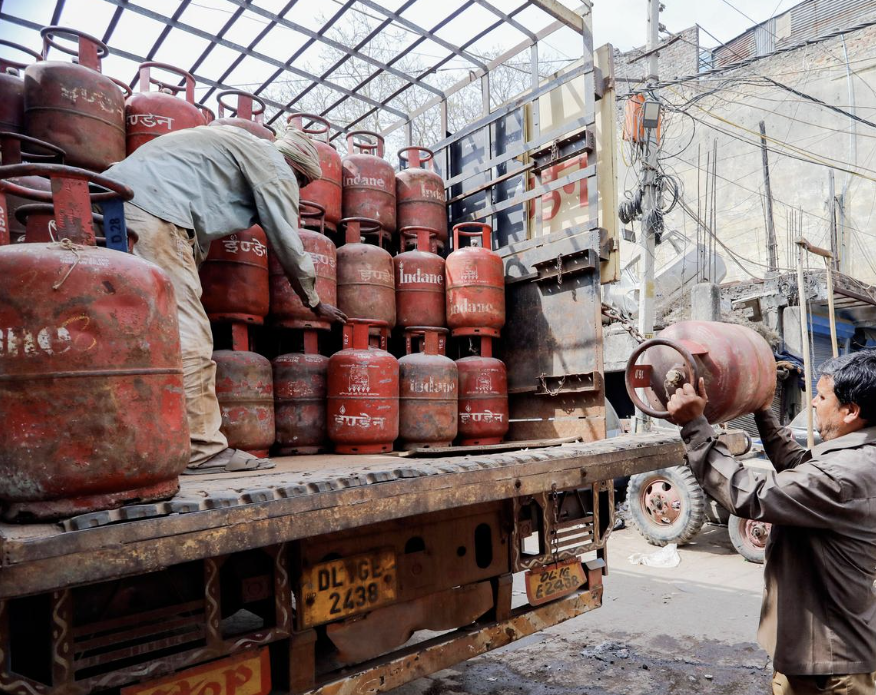
Due to disruption in energy shipments through the Strait of Hormuz, the Government of India invoked the Essential Commodities Act, 1955 to manage shortages of Liquefied Petroleum Gas (LPG) and natural gas.
The blockade highlighted India’s heavy dependence on imports for cooking gas and triggered emergency regulatory measures.
What is the Essential Commodities Act (ECA), 1955?
The Essential Commodities Act, 1955 empowers the Union Government to regulate production, supply, distribution and pricing of essential goods.
Commodities covered
The Act allows regulation of items such as:
foodstuffs
drugs and medicines
fertilisers
edible oils
fuels (including LPG and natural gas)
seeds and agricultural inputs
Powers under Section 3
Under Section 3, the government can:
control production and supply
ensure equitable distribution
regulate prices
impose stock limits
control storage, transport and distribution
prevent hoarding and black marketing
The law is often used during shortages, inflation, or emergencies.
Why the Act was invoked now
The immediate trigger is energy supply disruption linked to conflict in the Persian Gulf.
Key vulnerabilities:
About 90% of India’s LPG imports pass through the Strait of Hormuz.
Domestic production cannot meet demand.
LPG supply gap in India
Indicator | Value |
Annual LPG consumption | ~31.3 million tonnes |
Domestic production | ~12.8 million tonnes |
Share of demand met domestically | ~41% |
The expansion of the Pradhan Mantri Ujjwala Yojana increased LPG coverage from ~62% (2016) to nearly universal coverage, sharply raising demand.
How the order boosts LPG production
The government directed all refineries to divert specific hydrocarbons toward LPG production.
Key directives
Propane and butane streams must be used for LPG instead of petrochemicals.
Petrochemical feedstock such as propylene and butene (C3 and C4 streams) must also be diverted to LPG.
Refineries affected
The order applies to:
Public sector refiners
Indian Oil Corporation
Bharat Petroleum
Hindustan Petroleum
Other refiners
Oil and Natural Gas Corporation
Reliance Industries
Nayara Energy
Impact
Domestic LPG production has reportedly increased by about 25%, though imports are still needed.
Allocation rules for LPG supply
All LPG produced domestically will be supplied only to:
Indian Oil
Bharat Petroleum
Hindustan Petroleum
These companies must prioritise household LPG cylinders.
Consequence
Commercial consumers are deprioritised:
restaurants
hotels
hostels
commercial kitchens
Some establishments have reduced operations or shut temporarily.
Regulation of natural gas supply
The government has also introduced priority-based allocation of natural gas, overriding existing contracts.
Petrochemical plants run by ONGC, GAIL and Reliance may face partial LNG supply cuts.
Sectors affected
Benefiting sectors
household LPG consumers
public distribution networks
transport sector using CNG
Adversely affected sectors
petrochemicals
commercial kitchens
manufacturing industries
oil refineries using natural gas
LPG and LNG
Component | LPG (Liquefied Petroleum Gas) | LNG (Liquefied Natural Gas) |
Basic nature | Mixture of propane and butane | Mainly methane |
Source | By-product of crude oil refining and natural gas processing | Produced from natural gas fields |
Liquefaction condition | Liquefied under moderate pressure | Liquefied by cooling to about −162°C |
Storage | Stored in pressurised cylinders | Stored in cryogenic tanks |
Main use | Domestic cooking fuel | Power generation, industry, transport fuel |
Transport | Cylinders, tankers | Special LNG ships and cryogenic pipelines |
Energy density | Lower than LNG | Higher energy density |
Prelims Practice MCQs
Q. With reference to the Essential Commodities Act, 1955, consider the following statements:
The Act allows the government to impose stock limits and regulate prices of essential commodities.
It empowers only State Governments to regulate production and distribution of essential commodities.
The Act may be invoked during shortages to prevent hoarding and black marketing.
Which of the statements given above is/are correct?
A. 1 and 3 only
B. 1 only
C. 2 and 3 only
D. 1, 2 and 3
Answer: A
Explanation:
The Union Government primarily exercises powers under the Act (not only states), including price control, stock limits and anti-hoarding measures.
Q. With reference to LPG and LNG, consider the following statements:
LPG mainly consists of propane and butane.
LNG is primarily methane.
LNG is stored under high pressure like LPG cylinders.
Which of the statements given above are correct?
A. 1 and 2 only
B. 2 and 3 only
C. 1 and 3 only
D. 1, 2 and 3
Answer: A
Explanation:
LNG is stored in cryogenic conditions, not under pressure like LPG.
Q. Which one of the following correctly explains why LNG is easier to transport than natural gas?
A. LNG has higher calorific value
B. LNG occupies about 1/600th of the volume of natural gas
C. LNG is chemically inert
D. LNG does not require special containers
Answer: B