
Ethanol Blending in India – Current Debate and Policy
Background
-
Ethanol Blending Programme (EBP) launched in 2003, with major push under the National Policy on Biofuels (2018).
-
Objective: Reduce crude oil import dependency, cut carbon emissions, boost farmers’ income by using sugarcane, damaged foodgrains, and agricultural residue for ethanol production.
-
Targets:
-
20% blending by 2025–26 (advanced from 2030).
-
Achieved 12% blending in 2023–24.
- Like ethanol, India will adopt a phased approach to SAF adoption. A blending mandate has already been initiated, with a target of 1% blending for international flights by 2027, increasing to 2% by 2028, and scaling further as supply stabilizes.
-
Claim: Ethanol-blended petrol may reduce vehicular efficiency (fuel economy) and could harm engines.
-
Government Response:
-
Petroleum Minister Hardeep Singh Puri termed it a "vilification campaign" driven by vested economic interests.
-
Drew parallel to earlier skepticism when Compressed Biogas (CBG) was introduced.
-
Called for trust in Indian farmers and biomass-based energy sources.
-
-
Industry Backing: Indian Sugar and Bio-Energy Manufacturers Association says ethanol blending is:
-
Scientifically validated and globally proven.
-
Strategically important for energy security.
-
A driver for farmers’ welfare.
-
-
Fuel Efficiency Impact: Studies by ARAI & global benchmarks (US, Brazil) show only marginal reduction (1–2%) in mileage with 20% blending, often offset by cleaner combustion and lower maintenance.
-
Emission Reduction:
-
Ethanol burns cleaner, reducing CO, hydrocarbons, and particulate matter.
-
Lifecycle GHG emissions can be up to 50–60% lower compared to petrol.
-
-
Economic Benefits:
-
Saves ₹40,000 crore annually in oil import bills at 20% blending.
-
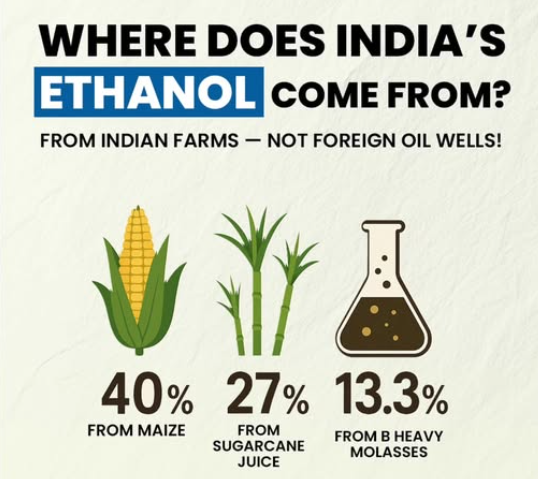
Boosts rural economy via purchase of surplus sugarcane, maize, damaged grains.
-
Feedstock Dependence: Heavy reliance on sugarcane raises water-use concerns.
-
Price & Supply Stability: Fluctuations in agricultural output affect ethanol supply.
-
Technology Upgradation: Vehicles must be optimised for E20 and higher blends to avoid corrosion or reduced efficiency.
-
Food vs Fuel Debate: Diversion of foodgrains in drought years could cause price spikes.
-
Brazil: Over 85% of new cars are flex-fuel compatible; ethanol blending >27%.
-
US: E10 and E15 blends are common; incentivised through Renewable Fuel Standard (RFS).
-
Thailand & Philippines: Actively pursuing E20–E85 blends.