
Evolution of Deception in Modern Warfare
-
Shift from traditional trickery to digital-age decoys: Modern deception has adapted to precision-guided weapons, using advanced decoys and countermeasures to confuse sensors, waste munitions, and protect actual assets.
-
Strategic role: Deception now functions as a vital defensive and offensive asset, comparable to firepower itself.
Airborne Decoys – India’s Case
-
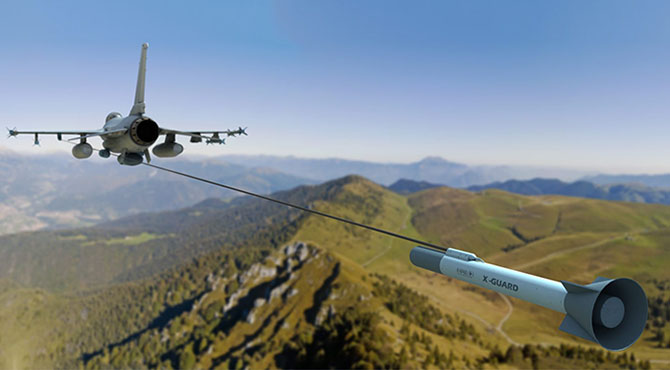
X-Guard Fibre-Optic Towed Decoy (FOTD):
-
AI-enabled, used on Rafale fighters (believed during Operation Sindoor).
-
Function: Mimics the aircraft’s radar cross-section, Doppler velocity, and spectral signature; trails ~100 m behind; confuses enemy missiles.
-
Integration: Works with Rafale’s SPECTRA EW suite, creating a multi-tiered defense.
-
Impact: Reportedly misled Pakistan Air Force J-10C fighters, diverting PL-15E missiles onto decoys instead of actual Rafales.
-
Comparable Systems:
-
Leonardo’s BriteCloud (used on Eurofighter Typhoon, Gripen-E, F-16 variants).
-
Raytheon/BAE’s AN/ALE-50/55 (on F/A-18E/F Super Hornet).
-
Some adaptable to UAVs (Israeli Herons, U.S. MQ-9 Reapers).
SPECTRA:
The Système de Protection et d'Évitement des Conduites de Tir du Rafale (literally: System of Protection and Fire Lines Avoidance of the Rafale) or
SPECTRA is a fully internal electronic warfare system jointly developed by Thales Group and MBDA France for the Dassault Rafale.
The full SPECTRA integrated electronic warfare suite provides long-range detection, identification, and accurate localisation of infrared homing, radio frequency, and laser threats.
The system incorporates radar warning, laser warning, and missile approach warning for threat detection, plus a phased array radar jammer and a decoy dispenser for threat countering. It also includes a dedicated management unit for data fusion and reaction decision.
Land-Based Decoys
-
Types: Inflatable, radar-reflective, heat-emitting dummies (tanks, artillery, missile sites).
-
Global Use:
-
Gulf War: Early examples of decoy deployments.
-
Ukraine: Wooden & 3D-printed decoys tricking Russian drones/missiles.
-
Russia: Inflatech decoys simulate entire formations.
-
U.S.: Decoy vehicles tested against Javelin ATGMs.
-
China: Heavy investment in deception technologies.
-
The Indian Army has issued a Request for Information (RFI) for mock-ups of T-90 S/SK main battle tanks as part of its Make in India initiative to enhance defense against drone threats.

These decoys will replicate the tanks’ acoustic, thermal, and dimensional signatures to mislead enemy sensors and protect actual assets.
The specifications mandate realistic replication, including external features and durability across varied terrains.
Naval Decoys
-
Systems: Chaff, acoustic decoys, offboard active deception devices.
-
Key Example: Nulka active missile decoy (Australia–U.S. collaboration) — self-propelled, mimics radar signature of larger ships, lures missiles away.
Ukraine’s Use
-
Extensive reliance on wooden and 3D-printed decoys to exhaust Russia’s precision munitions and drones.
-
Helps stretch out Russian resources while protecting real assets.
India’s Position
-
Air domain: Operational use of X-Guard FOTD on Rafales, reportedly very effective.
-
Land domain: Moving toward indigenous decoys for tanks and assets.
-
Naval domain: Employs multi-layered countermeasures similar to advanced navies.
1. The AI-enabled X-Guard Fibre-Optic Towed Decoy system deployed by the Indian Air Force is primarily used for which purpose?
Answer: Confusing enemy radar and missile tracking systems
Explanation: The X-Guard mimics the radar and velocity signatures of the aircraft, emitting jamming signals to fool enemy radars and missile seekers to target the decoy instead of the actual fighter jet, thus protecting it from missile attacks.
2. What is the key technological feature of the X-Guard decoy that allows it to mimic the aircraft it protects?
Answer: Copies the radar cross-section (RCS), Doppler velocity, and spectral signature of the aircraft
Explanation: The decoy replicates the actual fighter’s radar signatures and Doppler effects while trailing the aircraft on a fiber-optic cable, creating a convincing false target to enemy tracking systems.
3. During which operation did the Indian Air Force reportedly deploy the X-Guard decoy system to successfully mislead enemy missiles?
Answer: Operation Sindoor
Explanation: Operation Sindoor (May 2025) was when the Rafale jets, equipped with X-Guard, conducted missile strikes. The decoy system successfully confused Pakistani missile systems, reportedly causing missiles and radar to lock onto the decoys instead of real aircraft.
4. Which of these nations manufactures the X-Guard Fibre-Optic Towed Decoy system?
Answer: Israel
Explanation: Developed by Rafael Advanced Defense Systems, an Israeli defense company, the X-Guard system is used by the Indian Air Force on its Rafale fighters.
5. Apart from the AI-enabled X-Guard, which similar fibre-optic towed decoy system is used by Eurofighter Typhoons and Saab Gripen aircraft?
Answer: BriteCloud
Explanation: Leonardo’s BriteCloud is a fibre-optic towed decoy with comparable capabilities deployed on Eurofighter Typhoons, Saab Gripen-E, and F-16 variants, providing radar jamming and deception similar to X-Guard.