
First direct evidence of planet formation
 Click to view full image
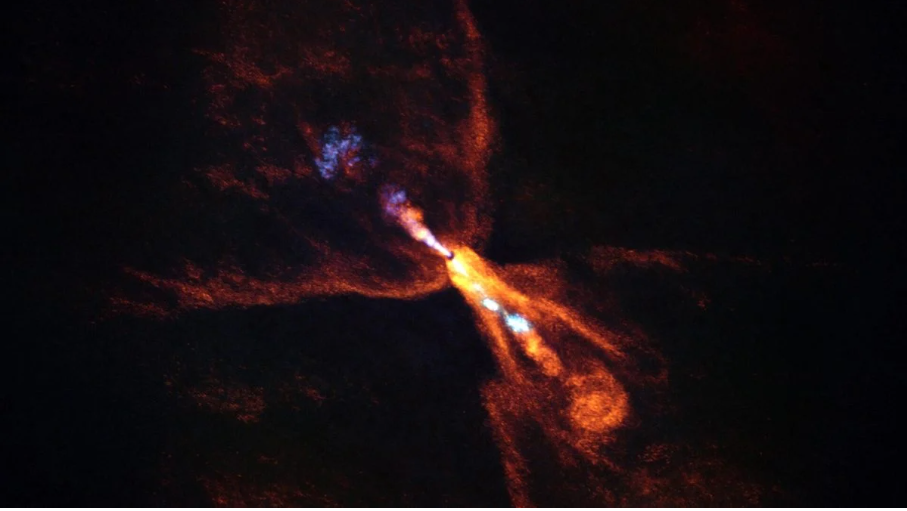
Context : In a breakthrough study published in Nature, astronomers have observed the earliest stage of planet formation — the condensation of rock vapour into solid crystals — around a baby star named HOPS-315 in the Orion region. The discovery was made using a combination of data from NASA’s James Webb Space Telescope (JWST) and the Atacama Large Millimeter/submillimeter Array (ALMA) in Chile.
The protoplanetary disc around HOPS-315, a flat disc of gas and dust where planets form, is tilted in a way that allowed researchers to peer deep inside. In 2023, JWST used its NIRSpec and MIRI spectrographs to detect silicon monoxide gas and crystalline silicates close to the star (within 2.2 AU, inside Mercury’s orbit), at temperatures around 470K.
Eight months later, ALMA observed the same region, detecting emissions of carbon monoxide, silicon monoxide, and sulphur monoxide, and mapped the cooler outer gas. The absence of slow silicon monoxide near the star, combined with JWST’s 10 km/s blueshifted signals, confirmed that the crystals lay in the rising disc atmosphere, not in material expelled by the star.
Simulations and energy readings matched the prediction that dust grains vaporise around 1,300K at 1 AU, release gas, and then re-condense into fresh crystals like forsterite, enstatite, and tentative silica. These are similar to inclusions found in primitive meteorites on Earth, suggesting a comparable condensation chemistry.
This is the first direct evidence of solid matter condensing from rock vapour around a star — the critical first step in rocky planet formation.