
Fishing cat
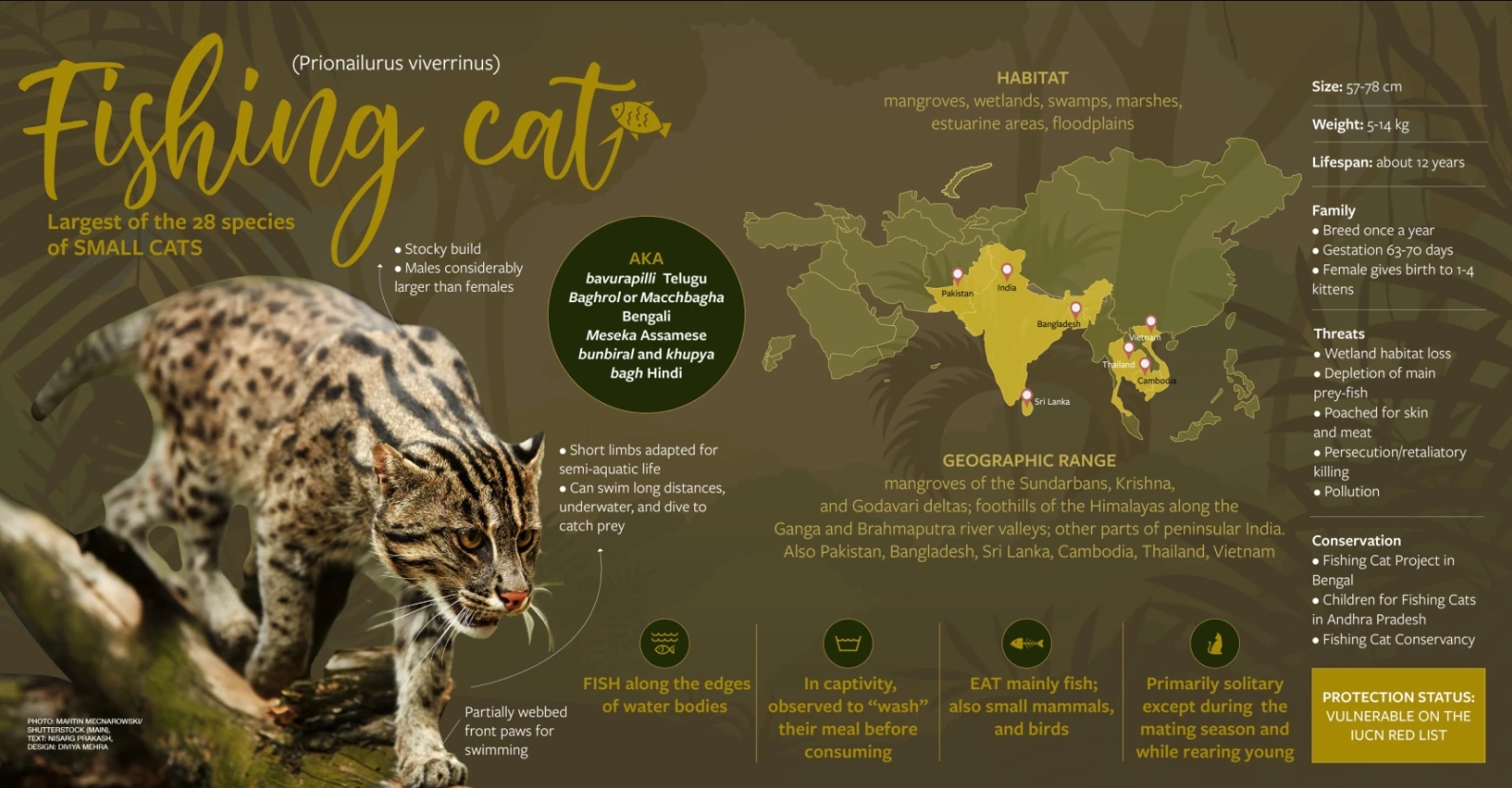
In the wild, India has 15 species belonging to the cat family . Wetlands in India are home to the fishing cat , In its territory, this cat is often the apex predator
Scientific name: Prionailurus viverrinus
IUCN Status: Vulnerable (globally)
Habitat: Wetlands – river floodplains, mangroves, swamps.
Distribution in India:
-
Terai region of Himalayas
-
Marshes of Western India
-
Sundarbans
-
East coast (including Godavari estuaries)
Chilika lagoon and surrounding wetlands in Odisha
Coringa and Krishna mangroves in Andhra Pradesh
-
Sri Lanka
-
Recently rediscovered in Rajasthan’s Keoladeo National Park
-
Size: Twice domestic cat; 7–12 kg.
-
Appearance: Greyish-brown fur, black spots.
-
Adaptations to wet surroundings:
-
Partially webbed paws (for swimming & gripping mud/fish)
-
Dense, water-resistant coat
-
Protruding claws (cannot fully retract)
-
Ability to swim fully submerged
-
-
Diet: Primarily fish; also rodents, chickens, small animals.
The fishing cat is nocturnal (active at night).
Fishing cats breed once a year, typically between January and February, though mating can occur as late as June.
Gestation lasts 63-70 days, after which females give birth to a litter of 1 to 4 kittens, usually 2 or 3.
Fishing cats are generally solitary animals, but males may help females care for the young in captivity.
-
Spends ~50% of hunting time near water’s edge (standing/sitting/crouching)
-
~5% hunting time submerged
-
In shallow water, flushes fish with paws and grabs with mouth
In Cambodia, where images of fishing cats are found carved in the walls of ancient structures, they are known as Kla Trey, ‘Tiger fish’.
-
Chilika Lake, Odisha: Estimated ~750 individuals in 1,100 sq. km (2024 study – Fishing Cat Project).
-
Sundarbans: Rapid decline.
-
Rajasthan: Once thought extinct, now sighted again (Keoladeo NP).
-
Populations exist in scattered pockets, making conservation challenging.
-
Habitat Loss & Wetland Degradation:
-
30–40% wetlands lost/severely degraded in last 4 decades.
-
-
Human Encroachment:
-
Seen as threats to fish ponds & poultry → revenge killings.
-
-
Fragmented Populations:
- Limits genetic diversity & survival chances.
-
Community-based conservation programmes – reduce conflict with locals.
-
Wildlife Institute of India (2025 Project):
-
Tracking fishing cats in Godavari estuaries (Coringa Wildlife Sanctuary, AP).
-
GPS collars + GIS integration for habitat use, movement, human interaction data.
-
Data to guide population-boosting strategies.
- In 2012, the West Bengal government officially declared the Fishing Cat as the State Animal.
- Fishing Cat Conservation Alliance: It is a team of conservationists, researchers, working to achieve a world with functioning floodplains and coastal ecosystems. It will ensure the survival of the fishing cat and all species with which it shares a home.
-
Citizen Science & NGO Efforts:
-
Fishing Cat Project (Tiasa Adhya) – camera traps, population mapping.
-