
FLEXIBLE INFLATION TARGETING (FIT) REVIEW
Background
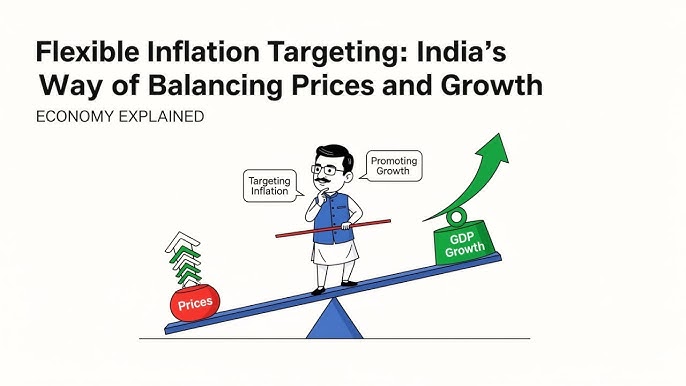
India adopted Flexible Inflation Targeting (FIT) in 2016 under amendments to the RBI Act, 1934.
Target: 4% CPI inflation, with a tolerance band of ±2% (i.e., 2%–6%).
Current mandate ends March 2026; RBI has released a discussion paper to reassess the framework.
Why Inflation Control Matters
High inflation acts as a regressive consumption tax, disproportionately hurting the poor.
It erodes savings, distorts investment decisions, and reduces the credibility of monetary policy.
Historically, the Chakravarty Committee (1985) viewed 4% as the “acceptable” inflation rate, though their reasoning lacked clarity.
Evolution of India’s Monetary Policy Framework
Post-1994: Abolition of automatic monetisation → RBI gains functional autonomy.
2016: FIT institutionalised → focus on CPI inflation.
Since 2016: Inflation remained range-bound, despite large shocks (pandemic, supply disruptions).
What to Target: Headline vs Core Inflation
Headline Inflation
Includes food & fuel.
Relevant if goal is to:
protect poor households
safeguard savings & investments
Food inflation is not always purely supply-driven.
It can respond to monetary conditions (expansionary vs contractionary policy).
Core Inflation (ex-food, fuel)
Less volatile; useful for assessing underlying pressures.
But ignoring food inflation overlooks India’s structure where food → wage → cost spillovers.
Key Insight from Friedman
Without money-supply expansion, general price level cannot rise.
Food price rise alone → relative price changes, not general inflation.
But India experiences second-round effects (wage pressures), so food inflation must be part of policy focus.
Acceptable Level of Inflation
Empirical Findings
Phillips Curve (inflation–growth trade-off) has weak long-term validity.
High inflation → hurts growth after a point → concept of threshold inflation.

India’s Threshold
A quadratic estimation (post-1991 data) suggests:
Threshold = ~3.98% inflation
Implies: ≈4% inflation is optimal for supporting growth without excessive costs.
Forward-Looking Consideration
For 2026–2031: Simulations suggest inflation below 4% is desirable.
No strong justification for raising the target above 4%.
Inflation Band: ±2%
Current Band: 2%–6%
Provided adequate flexibility.
But staying close to upper limit (6%) for long violates the spirit of FIT.
Data suggests:
Beyond 6%: Growth declines sharply.
Point of Concern
No prescription for how long RBI can remain near upper tolerance.
FIT and Fiscal-Monetary Coordination
Historical Context
High inflation in 1970s–80s due to monetisation of fiscal deficit.
Reform path:
Abolition of ad hoc Treasury Bills (1990s)
FRBM Act, 2003
FIT (2016)
Key Principle
FRBM and FIT must work together.
Slippage in fiscal discipline can compromise inflation targets.
Failure in either leads to macro instability.
Prelims Practice MCQs
Q. Which of the following were key reforms that strengthened inflation control in India?
Abolition of ad hoc treasury bills
Ending automatic monetisation of fiscal deficits
Adoption of the FIT framework
Introduction of the Phillips Curve-based inflation targeting model
Select the correct answer:
A. 1, 2 and 3 only
B. 2 and 4 only
C. 1 and 3 only
D. 1, 2, 3 and 4
Answer: A
Explanation:
Reforms 1, 2, and 3 are explicitly mentioned in the article.
Phillips Curve is discussed only theoretically; no targeting based on it exists.
Q. With reference to the debate on headline vs core inflation, consider the following statements:
Headline inflation is preferred as a target because food inflation can have second-round effects on core inflation.
Without an expansion in aggregate demand or money supply, general price level cannot rise.
Core inflation includes food and fuel prices as they are volatile components.
Which of the statements given above is/are correct?
A. 1 and 2 only
B. 2 and 3 only
C. 1 and 3 only
D. 1, 2 and 3
Answer: A
Explanation:
• Statement 1 is correct: Food inflation may spill over to core inflation through wage effects and cost pressures.
• Statement 2 is correct: As Friedman argued, inflation requires expansion of liquidity or money supply; otherwise prices only shift relatively.
• Statement 3 is incorrect: Core inflation excludes food and fuel due to their volatility.
Q. The concept of threshold inflation denotes:
A. A minimum inflation rate required for tax buoyancy
B. The inflation rate beyond which growth begins to decline
C. The ideal inflation rate needed to maintain price stability
D. The inflation level at which money supply stops influencing prices
Answer: B
Explanation:
Threshold inflation refers to the maximum inflation level beyond which economic growth is adversely affected. For India, the estimated threshold is about 4% as per the quadratic relationship in the article.