
Forest Governance under FRA
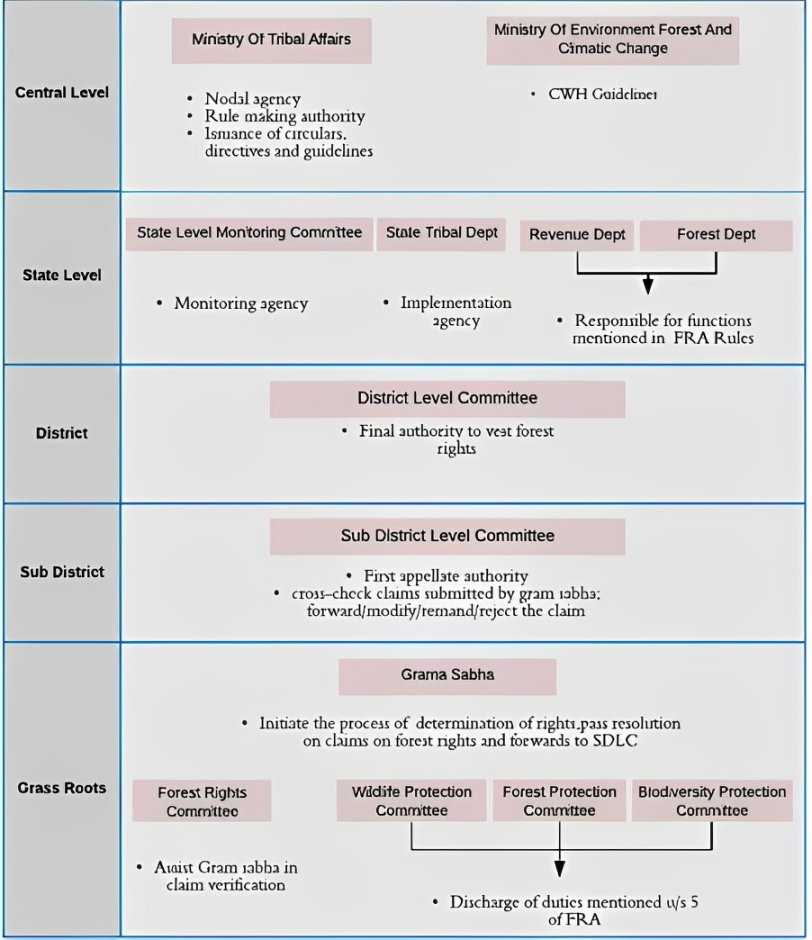
Contesting the Future of Forest Governance under FRA
Why in news: Recently the Chhattisgarh Forest Department’ declared itself as the nodal agency for implementing Community Forest Resource Rights (CFRR) under the Forest Rights Act (FRA), 2006. This move, since withdrawn after local opposition, was legally flawed and undermined the statutory authority of gram sabhas, which are empowered under FRA to manage their customary forests through locally developed plans.

Key Issues:
-
Violation of FRA's Decentralised Mandate:
-
The Chhattisgarh directive enforced a Ministry of Tribal Affairs (MoTA) model plan, not legally mandatory.
-
It excluded NGOs and other departments from assisting gram sabhas.
-
This contradicts FRA’s intent, which prioritises gram sabha autonomy in forest governance.
-
-
Colonial Legacy of Forest Management:
-
Forest departments rely on “working plans” rooted in colonial-era scientific forestry, focusing mainly on timber extraction.
-
Despite ecological critiques (e.g., by Madhav Gadgil), such plans still dominate and remain top-down, excluding community inputs and livelihood concerns.
-
-
Role of Community Forest Resource Rights (CFRR):
-
FRA recognises gram sabhas as central to forest sustainability.
-
Their CFR plans should override conventional working plans in CFR areas and address diverse local needs.
-
However, only ~1,000 out of 10,000 CFRR-holding gram sabhas have drafted such plans due to bureaucratic resistance and lack of support.
-
-
Flawed Interventions by MoTA:
-
MoTA has shown inconsistency, supporting simplified planning in 2015 but later aligning CFR plans with the National Working Plan Code (NWPC) in 2024, diluting FRA’s spirit.
-
NWPC's technical complexity and timber-yield focus are misaligned with community-based, adaptive management.
-
-
Way Forward:
-
Forest departments should relinquish timber-centric approaches and support community-driven, ecosystem-sensitive forest governance.
-
MoTA must defend gram sabha autonomy and ensure CFRR implementation remains faithful to the FRA.
-
Forest governance under the FRA must break from colonial legacies and working plan rigidity, empowering gram sabhas with legal, financial, and administrative support to lead people-centric, ecologically sound forest management.