
Global Soybean Trade and Production
Context
U.S. President Donald Trump announced that Washington would stop importing soybean oil from China.
However, analysts say the move would not impact China, as it has already halted soybean imports from the U.S. (first time in over 20 years).
China is now buying soybeans from Brazil at a premium.
The halt is linked to trade tensions starting during Trump’s first term (2018), when the U.S. imposed tariffs on Chinese goods (solar panels, washing machines).
Shift in Global Soybean Supply Chains
China has diversified its import sources, mainly Brazil, and invested heavily in its ports and railways (e.g., Port of Santos and Port of São Luís).
Chinese state-owned firm COFCO invested $285 million in Brazilian port infrastructure.
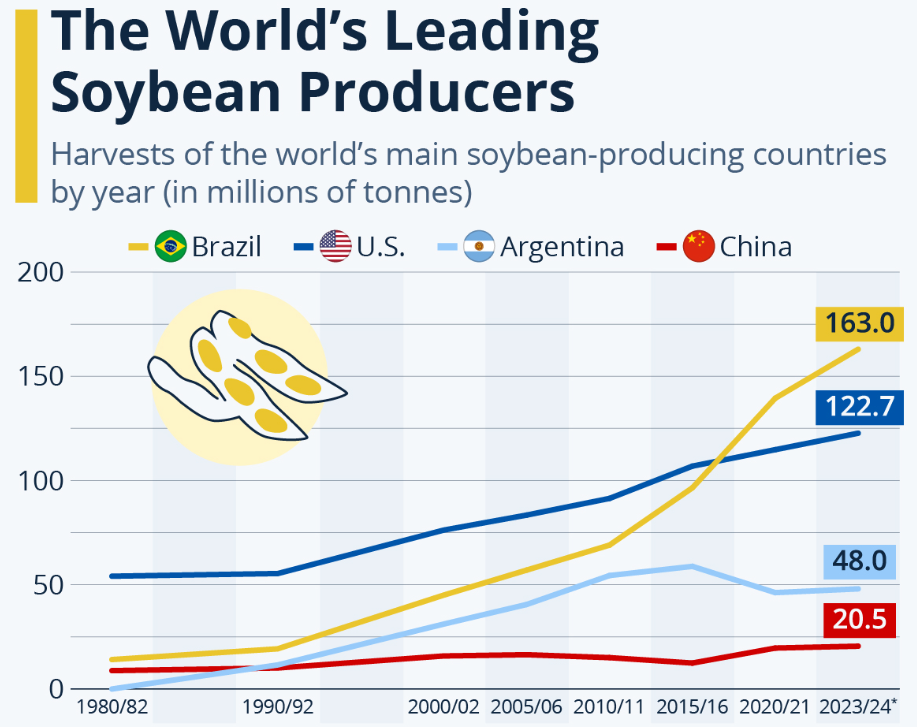
Brazil’s soybean output rose from 96 million tonnes (2015-16) to 175 million tonnes (2025-26), while U.S. production plateaued near 117 million tonnes.

Export Trends (2025-26 estimates)
Country | Exports (million tonnes) |
Brazil | 112 |
U.S. | 45.86 (six-year low) |
Global Soybean Production (2023)
Total production: 371.18 million tonnes.
Top producers:
Brazil – 152.14 million tonnes (41%)
U.S. – 113.34 million tonnes (31%)
Argentina – 25.04 million tonnes (7%)
China – 19.50 million tonnes (5%)
India – 14.98 million tonnes (4%) [ Fifth rank ]
➡ Together, Brazil, U.S., and Argentina = 81% of global output.
Climatic & Soil Conditions
Grows best in hot summers (20–30°C).
Prefers moist, well-drained soils rich in organic matter.
Prelims Practice MCQ
Q. With reference to global soybean production, consider the following statements:
Brazil, the United States, and Argentina together produce more than 80% of the world’s soybeans.
India ranks fourth in global soybean production.
Soybeans grow best in hot, humid climates with temperatures between 20°C and 30°C.
Which of the statements given above is/are correct?
(a) 1 and 3 only
(b) 2 and 3 only
(c) 1 and 2 only
(d) 1, 2 and 3
✅ Answer: (a)
(India ranks fifth, after China.)
Q. Which of the following factors best explain Brazil’s rise as the world’s leading soybean producer?
Expansion of cultivated land in Cerrado region
Heavy Chinese investments in port and rail infrastructure
Government subsidies on soybean exports
High domestic demand for biodiesel
Select the correct answer using the code below:
(a) 1 and 2 only
(b) 2 and 3 only
(c) 1, 2 and 4 only
(d) 1, 3 and 4 only
✅ Answer: (a)
Q. Consider the following statements about the Cerrado biome of Brazil:
It is primarily a tropical savanna ecosystem located on the Brazilian Highlands.
It covers nearly one-fifth of Brazil’s land area.
More than three-fourths of the Cerrado is under public ownership.
Which of the statements given above is/are correct?
(a) 1 and 2 only
(b) 2 and 3 only
(c) 1 only
(d) 1, 2 and 3
✅ Answer: (a)
(About 75% is privately owned, not public.)
The Cerrado Ecoregion (Brazil)
Overview
The Cerrado is a vast tropical savanna ecoregion located in central Brazil.
It spans across multiple states Goiás, Mato Grosso do Sul, Mato Grosso, Tocantins, Maranhão, Piauí, Bahia, Minas Gerais, São Paulo, Paraná, and the Federal District (Brasília).
Core areas lie within the Brazilian Highlands (Planalto Central).

Geographical and Ecological Features
Second largest habitat type in Brazil — after the Amazon Rainforest.
Covers ~21% of Brazil’s total land area (~2 million km²).
Extends marginally into Paraguay and Bolivia.
~75% of its area is privately owned, complicating conservation efforts.
Habitat Types within the Cerrado
Forest Savanna (Cerradão)
Wooded Savanna
Park Savanna
Gramineous-Woody Savanna
Savanna Wetlands & Gallery Forests
These ecosystems form a mosaic of grasslands, shrublands, and woodlands.
Biodiversity
Known as the “biologically richest savanna in the world.” – WWF
Plant species: ~10,000 (many endemic)
Bird species: ~10 endemic bird species
Mammal species: ~200, of which ~14 are endemic
Rich in endemism, comparable to tropical forests.