
Golden jackal
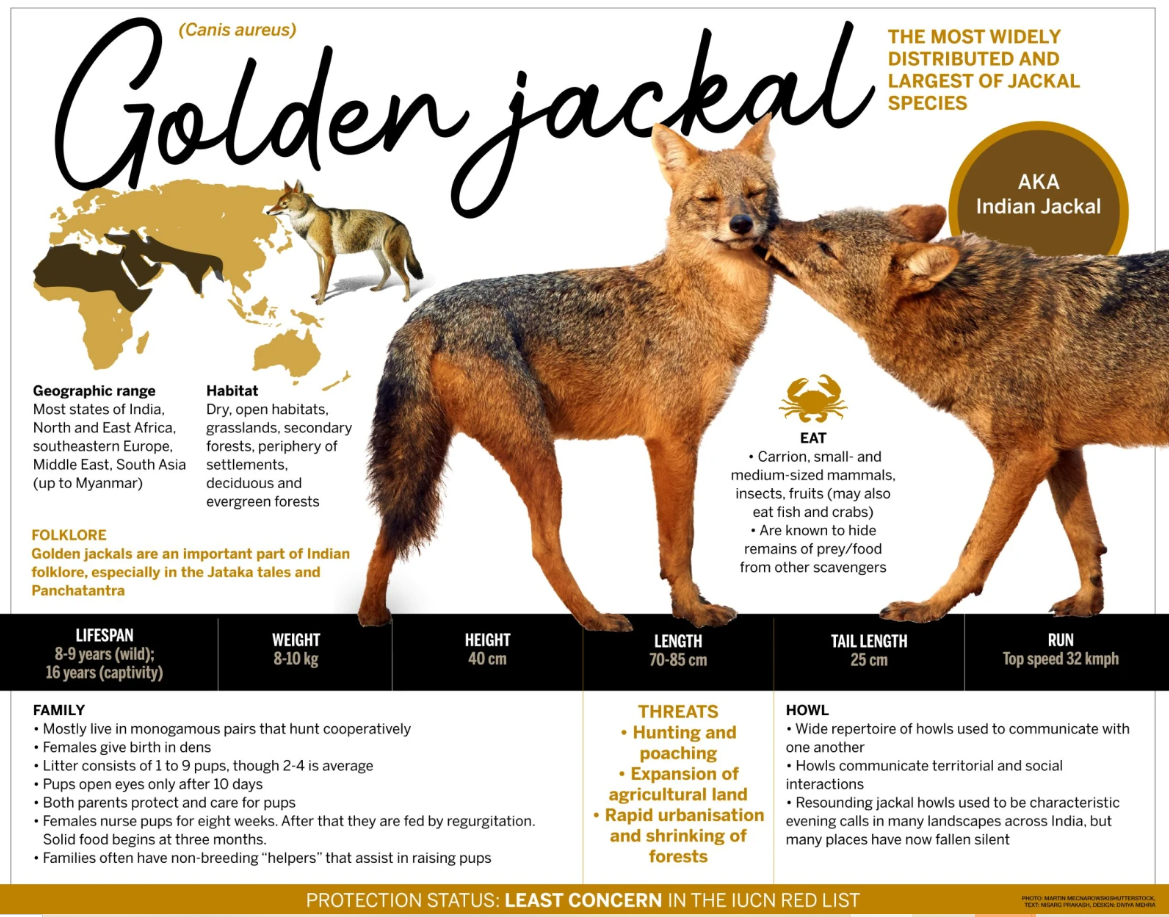
Golden Jackal (Canis aureus)
-
The golden jackal is a widespread and adaptable canid species found across India, excluding high-altitude Himalayan regions.
-
Known for opportunistic feeding and high adaptability, they thrive in both wild and human-dominated landscapes.
Cultural and Literary Significance:
Golden jackals (Canis aureus) are deeply embedded in Indian folklore and ancient literature, particularly in Jataka Tales and Panchatantra.
In Buddhist Jataka tales, jackals frequently appear in stories conveying moral lessons, karmic consequences, and ethical choices.
-
Scientific Name: Canis aureus
-
IUCN Status: Least Concern
-
Protection in India: Listed under Wildlife Protection Act, 1972

Physical Appearance
-
Golden-brown coat with mottled fur.
-
Fur may appear darker in winter depending on geography.
Habitat
-
Found in dry deciduous forests, semi-arid regions, mangroves, agricultural lands, and urban outskirts.
-
Observed thriving in mangrove ecosystems of Mumbai and other peri-urban areas.
Diet (Omnivorous)
-
Prey includes:
-
Rodents
-
Birds
-
Reptiles
-
Insects
-
Fruits
-
Carrion
-
Social Structure
-
Live in pairs or small family groups.
-
Communicate through howls and yelps.
Adaptability
-
Highly adaptable to human-altered landscapes.
-
Observed in urban areas, coconut groves, village edges.
-
Studies indicate presence in Mumbai's mangroves (Mongabay India).
Ecological Role
-
Act as scavengers – help in waste disposal.
-
Regulate prey population – ecological balance.
Distribution in India
-
Found across Indian subcontinent:
-
From Himalayan foothills to Western Ghats.
-
Present in protected areas, farmlands, village outskirts, and cities.
-
Conservation Concerns
-
Threats:
-
Urbanization and habitat loss
-
Hybridisation with stray dogs (affects genetic integrity)
-
Rabies transmission
-
Poultry predation leading to human conflict
-
-
Dependence on anthropogenic waste raises ecological and public health concerns.