
Gravitational Waves and GW250114 Discovery
Background
Gravitational waves are ripples in spacetime predicted by Albert Einstein in his General Theory of Relativity (1915).
They are produced when massive accelerating bodies (like colliding black holes or neutron stars) disturb spacetime.
These waves travel at the speed of light, carrying information about cataclysmic cosmic events.
Historical Timeline
Year | Event | Significance |
1915 | Einstein publishes General Theory of Relativity | Predicts existence of gravitational waves |
1960s–70s | Joseph Weber’s early bar detectors | First attempts to detect gravitational waves (unsuccessful) |
1990s | Construction of LIGO (Laser Interferometer Gravitational-wave Observatory) in the U.S. begins | Foundation for modern detection |
September 14, 2015 | First detection (event GW150914) by LIGO | Confirmed existence of gravitational waves; Nobel Prize (2017) to Weiss, Thorne, Barish |
January 14, 2025 | GW250114 detected by LIGO–Virgo–KAGRA network | Clearest gravitational wave signal to date |
Key Institutions and Collaborations
LIGO (USA): Two observatories — Livingston (Louisiana) & Hanford (Washington)
Virgo (Italy): Operated by the European Gravitational Observatory near Pisa
KAGRA (Japan): Kamioka Gravitational Wave Detector, located underground
These form a global network for triangulating and confirming signals.
Mechanism of Detection (LIGO Principle)
Each LIGO detector has two 4-km-long perpendicular arms forming an L-shape interferometer.
A laser beam is split and sent down both arms, reflected back and recombined.
In the absence of gravitational waves, the beams cancel each other (destructive interference).
When a gravitational wave passes, it distorts spacetime, changing the length of arms by a fraction (less than 10⁻²¹).
This creates a tiny phase difference, producing a measurable flicker of light at the photodetector.
GW250114 (2025) – The Event
Date of detection: January 14, 2025
Detected by: LIGO (USA), Virgo (Italy), and KAGRA (Japan)
Distance from Earth: ~1.3 billion light-years
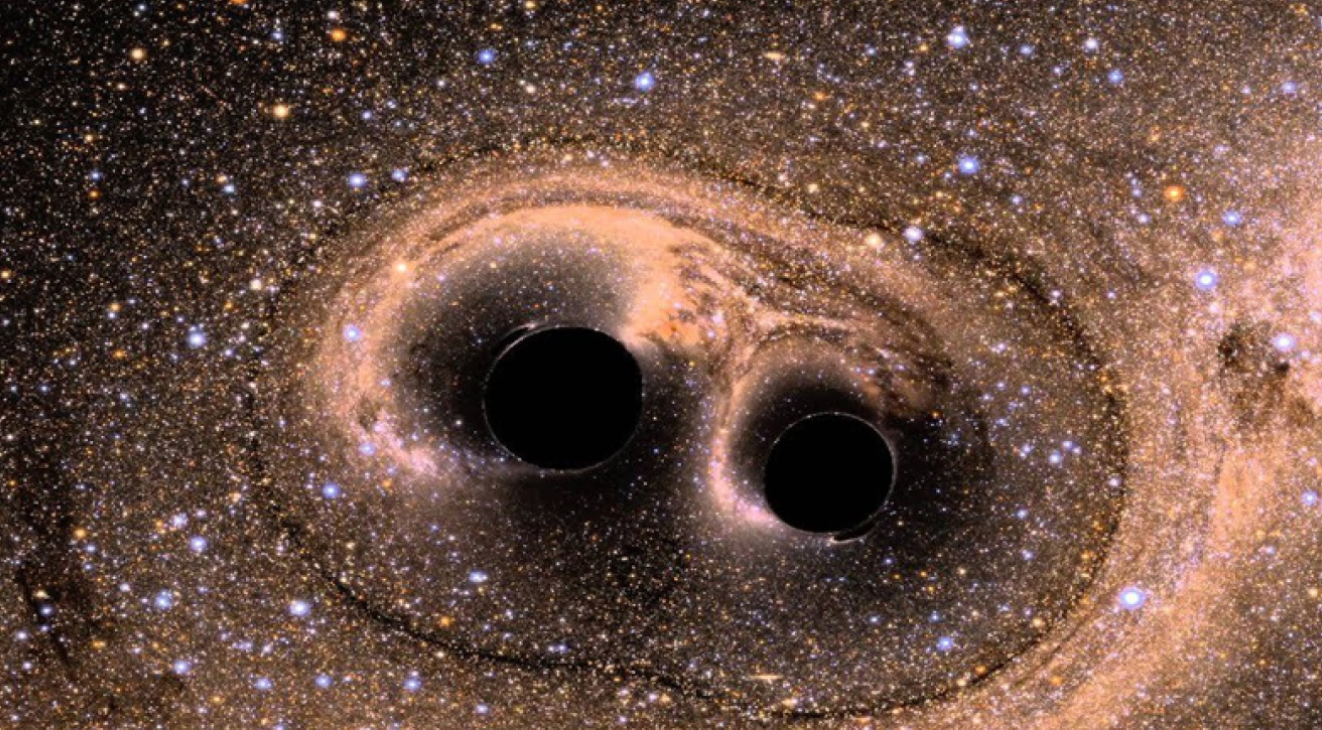
Nature of event: Merger of two black holes, each with mass ~30 times that of the Sun
Resulting object: A rotating black hole (Kerr black hole)
Scientific Advancements Enabling the 2025 Detection
Improved detector sensitivity:
Lower laser noise
Cleaner mirror surfaces
Reduced thermal and seismic interference
Advanced data analysis methods:
Model-agnostic searches: Look for simultaneous energy patterns across detectors without prior assumptions.
Model-dependent searches: Match data with theoretical templates for black-hole mergers.
Better coordination: Joint analysis by LIGO–Virgo–KAGRA collaboration allowed unprecedented accuracy.
Key Findings and Theoretical Verifications
Black Hole Area Theorem – Stephen Hawking (1971):
States that the total surface area of black holes can never decrease (analogous to the second law of thermodynamics).
Using GW250114 data, researchers measured the areas of pre-merger and post-merger black holes and found the total area increased, confirming Hawking’s prediction.
Kerr Black Hole Solution – Roy Kerr (1963):
Describes the structure of a rotating (spinning) black hole.
Post-merger gravitational “ringing” (vibrations) matched predictions from Kerr’s solution, providing strong observational validation.
Clearer signal:
GW250114 is the clearest gravitational-wave signal ever recorded, allowing higher precision in verifying relativity-based models.
Physical Implications
Confirms that General Relativity holds even under extreme gravitational conditions.
Provides empirical evidence for Hawking’s area theorem and Kerr’s rotational model.
Enhances understanding of black hole formation, spin, and merger dynamics.
Aids in constructing a comprehensive catalogue of black-hole mergers, refining estimates of cosmic event frequencies.
Nobel Connection
2017 Nobel Prize in Physics was awarded to Rainer Weiss, Kip Thorne, and Barry Barish for their role in LIGO and the first detection (2015).
The 2025 discovery builds directly on their pioneering work, marking a decade of gravitational-wave astronomy.
Terminology
Term | Meaning |
Interferometer | Device measuring wave interference to detect spacetime distortions |
Event Horizon | Boundary around a black hole beyond which nothing can escape |
Kerr Black Hole | A black hole that rotates about an axis, described by Roy Kerr |
Ringdown Phase | Final stage after merger when the new black hole settles down |
Area Theorem | Surface area of black holes cannot decrease after mergers |
Importance
Validates Einstein’s relativity beyond solar system scales.
Opens new frontiers in multi-messenger astronomy (gravitational + electromagnetic observations).
India’s Role:
India is constructing LIGO-India in Hingoli, Maharashtra, to join the global network by 2030.
This will enhance localization of events and signal sensitivity.
Prelims Practice MCQ
Q. Which of the following statements about gravitational waves is/are correct?
They are ripples in spacetime caused by massive accelerating bodies.
They travel faster than light.
They were first detected in 2015 by LIGO in the United States.
Select the correct answer:
A. 1 only
B. 1 and 3 only
C. 2 and 3 only
D. 1, 2 and 3
Answer: B
Q. The 2025 event GW250114 provided observational support for which two major theoretical predictions?
Hawking’s Black Hole Area Theorem
Kerr’s Rotating Black Hole Solution
Einstein’s Unified Field Theory
Chandrasekhar’s Limit
Select the correct answer:
A. 1 and 2 only
B. 2 and 3 only
C. 1 and 4 only
D. 1, 2 and 3
Answer: A
Q. Consider the following pairs:
Detector | Country | Type |
LIGO | USA | Laser Interferometer |
Virgo | Italy | Ground-based Interferometer |
KAGRA | Japan | Underground Cryogenic Interferometer |
Which of the above pairs is/are correctly matched?
A. 1 only
B. 1 and 2 only
C. 1, 2 and 3
D. 2 and 3 only
Answer: C