
Great Nicobar Project & Forest Rights Issue
Project
-
Mega project worth ₹72,000 crore on Great Nicobar Island.
-
Components: transshipment port, airport, power plant, township.
-
Requires diversion of 13,075 hectares of forest land.
Tribal Concerns
-
Nicobarese Tribal Council (key representative body) says:
-
Forest Rights Act (FRA), 2006 not implemented properly.
-
False certificate issued by A&N administration claiming FRA rights were “identified and settled”.
-
Council says settlement of FRA rights not even initiated.
-
Consent for forest diversion never given by Gram Sabhas of Nicobarese people.
-
Legal Angle
-
FRA, 2006: Requires settlement of tribal rights + Gram Sabha consent before forest diversion.
-
Protection of Aboriginal Tribes Act, 1956 (PAT56): Gives administrator authority to divert forest land.
-
Confusion: Project clearances—unclear whether done under FRA or PAT56.
Centre’s Position
-
Maintains that due process was followed.
-
Cites Gram Sabha meeting approving diversion.
-
Tribal Council denies their participation in this meeting.
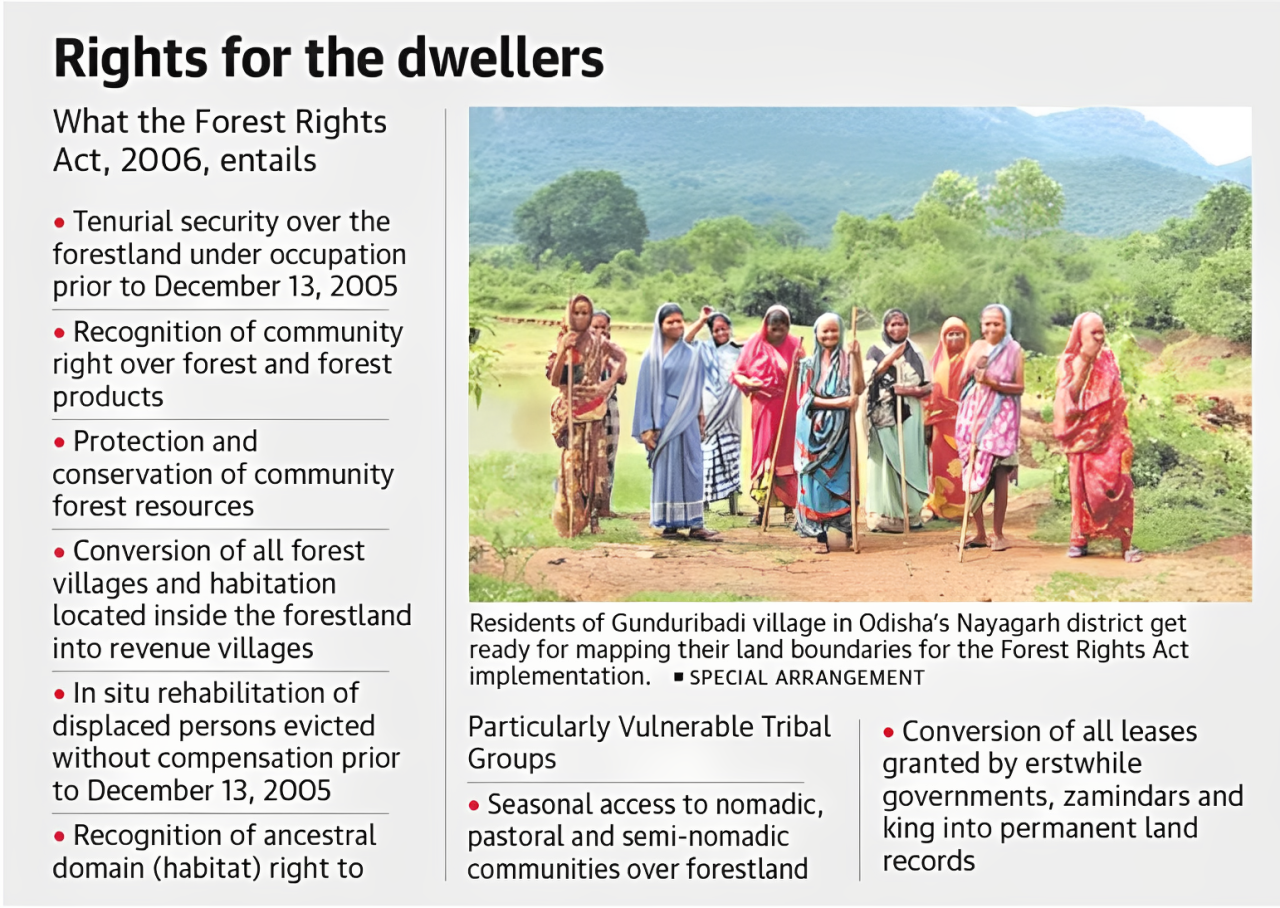
Forest Rights Act (FRA), 2006
Objective
-
To recognize and vest forest rights and occupation in forest land for Forest Dwelling Scheduled Tribes (FDSTs) and Other Traditional Forest Dwellers (OTFDs).
-
To provide security of tenure, livelihood, and safeguard against displacement.
-
To democratize forest governance by involving Gram Sabhas.
Eligibility
-
FDSTs: Must be residing on and cultivating forest land prior to 13th December 2005.
-
OTFDs: Must have primarily resided in forests for at least 3 generations (75 years) prior to 2005.
Types of Rights Recognized (Section 3(1))
13 different usufruct rights, including:
-
Section 3(1)(a): Right to hold and live in forest land for habitation or self-cultivation for livelihood.
-
Community rights over minor forest produce.
-
Grazing rights, fishing and access to water bodies.
-
Rights over community forest resource (CFR).
-
Rights to protect, regenerate, or manage forests for sustainable use.
-
Rights over traditional knowledge and intellectual property.
Key Legal Safeguards
-
Section 4(4):
-
Rights are heritable but not alienable or transferable.
-
Title to be registered jointly in the name of both spouses (if married).
-
In case of a single head household → title in the name of that person.
-
In absence of a direct heir → passes to next-of-kin.
-
-
Section 4(5):
-
No eviction or removal of FDST/OTFD from forest land till recognition and verification procedure is complete.
-
Important Clarifications
-
FRA does not regularize encroachments.
-
It acknowledges pre-existing rights of eligible communities.
-
Applies to all forest areas including National Parks and Wildlife Sanctuaries.
-
Ensures participation of democratic institutions (Gram Sabha, SDLC, DLC) in recognition of rights.
Institutional Mechanism for Recognition of Rights
-
Gram Sabha (village level): Receives claims, verifies, passes resolutions.
-
Sub-Divisional Level Committee (SDLC): Screens and forwards claims.
-
District Level Committee (DLC): Final authority for recognition and vesting of rights.
Committees & Appeal Mechanism
1. Committees under FRA & Rules
-
FRA and Forest Rights Rules (FR Rules) allow only two committees:
-
Forest Rights Committee (FRC) – constituted by Gram Sabha for initial verification.
-
Committee under Rule 4(1)(e) – to assist Gram Sabha in consolidating claims and preparing maps.
-
-
No other committee (especially comprising non-Gram Sabha members) is permitted to function for recognition/vesting of forest rights.
-
Any such unauthorized committee = void and legally invalid.
2. Appeal Mechanism
-
Gram Sabha decision → subject to appeal before Sub-Divisional Level Committee (SDLC).
-
SDLC decision → subject to appeal before District Level Committee (DLC).
-
Section 6(6), FRA: Decision of DLC is final and binding.
-
This marks the end of statutory appeal process under FRA.
3. Remedy against Wrong Decisions
-
If DLC decision contravenes FRA or Rules → Section 8 proceedings can be initiated.
-
This can be done by Gram Sabha, with due notice to the State Level Monitoring Committee (SLMC).
4. Legal Safeguard
-
Ensures democratic, bottom-up decision-making.
-
Prevents external/parallel bodies from interfering in recognition and vesting of rights.
-
Finality of DLC decision → gives certainty, but oversight via Section 8 provides check against misuse.