
Greener Way to Extract Rare-Earths from E-Waste
Context:
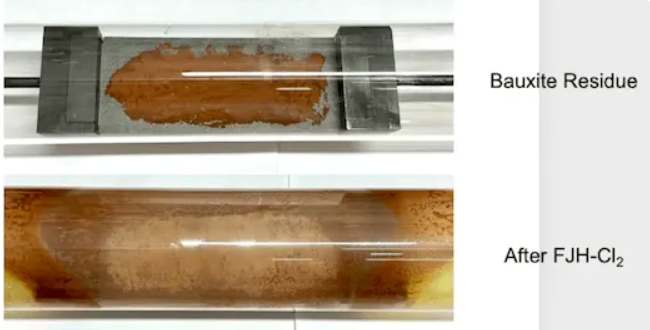
Researchers at Rice University (USA) have developed an innovative and sustainable technique — Flash Joule Heating with Chlorination (FJH–Cl₂) — to recover rare-earth elements (REEs) from discarded magnets in electronic waste.
Key Features of the New Method:
1. Technology Used – FJH–Cl₂ Process:
Flash Joule Heating (FJH): Rapidly heats e-waste material to extremely high temperatures within milliseconds using electrical pulses.
Chlorination Step: Chlorine gas converts rare-earth metals into volatile chlorides, allowing efficient separation and recovery.
2. Efficiency and Environmental Benefits:
Recovery Efficiency: Over 90% purity and yield of critical elements such as neodymium, samarium, and cobalt.
Energy Use: Reduced by 87% compared to traditional hydrometallurgical or pyrometallurgical processes.
Greenhouse Gas Emissions: Lowered by 84%.
Economic Benefit: Cuts processing cost by over 50%.
Environmental Gain: Eliminates acid and water waste, common in conventional extraction methods.
Also produces useful by-products, improving material circularity.
Significance:
Strategic Resource Security: Rare-earth elements are essential for renewable energy systems, EVs, wind turbines, and electronics.
Supports Circular Economy: Enables sustainable urban mining from e-waste.
Reduces Import Dependence: Can be adapted by countries like India to reduce reliance on China, which dominates REE processing.
Contributes to Net-Zero Goals: Aligns with SDG 12 (Responsible Consumption and Production) and SDG 13 (Climate Action).