
Haryana Revises Definition of Aravali Hills and Ranges
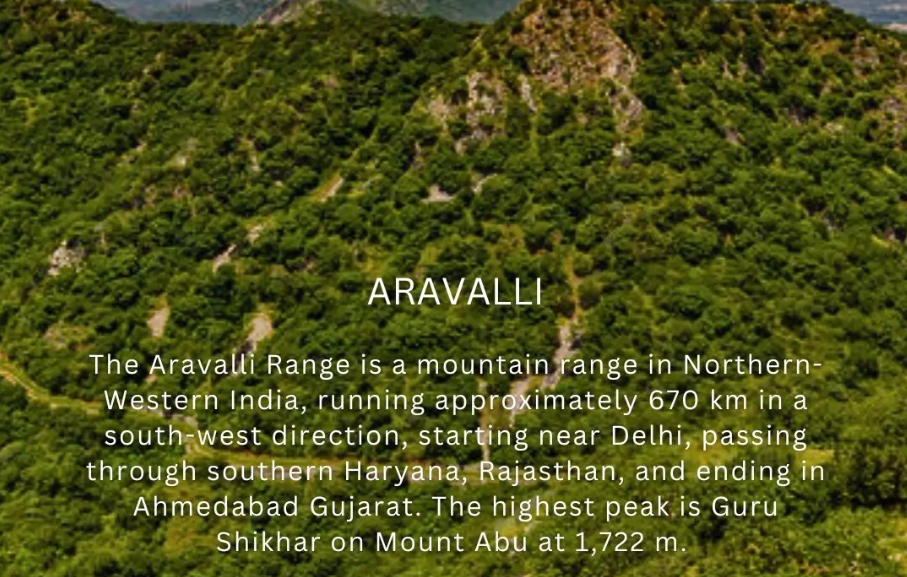
Context
The Haryana government has finalized a new definition for Aravali hills and ranges, introducing minimum geological age and elevation benchmarks.
The move follows objections raised by the Geological Survey of India (GSI) over Haryana’s earlier draft, which had inaccurately included older rock formations.
New Definition (as of October 4, 2025)
As per Haryana’s Department of Geology and Mines:
Only hills rising above 100 metres from surrounding land and
Composed of rocks at least one billion years old will qualify as Aravali hills.
Only rocks belonging to:
Aravali Supergroup (Paleoproterozoic Era)
Delhi Supergroup (Mesoproterozoic Era)
will be considered part of the Aravali range.
Excluded:
Neoproterozoic intrusives such as Erinpura Granite and Malani Rhyolite,
as they are younger and unrelated to the original orogenic (mountain-forming) events.
Key Background
The definition was finalized a day after a video conference chaired by the Union Environment Secretary, where GSI flagged Haryana’s earlier draft for geological inaccuracies.
The new 100-metre elevation benchmark mirrors the standard used by Rajasthan for classification of its Aravalis — though the purpose differs:
Rajasthan: for mining classification
Haryana: for environmental conservation and regulation
Expert Concerns and Criticism
Exclusion of Low-Elevation Aravalis:
The 100-metre elevation criterion excludes large tracts of Aravali forests in Gurgaon, Faridabad, and Nuh, where terrain undulates but does not meet the height benchmark.
These excluded areas are ecologically vital for:
Groundwater recharge
Soil conservation
Urban climate moderation
Wildlife corridors
Ecological vs Geological Definition:
Experts argue conservation should focus on the living landscape (scrub forests, ridges, flora, and fauna) — not merely rock age or elevation.
Former forest conservator M.D. Sinha emphasized protecting the functional ecosystem, not only geological formations.
Potential Impact on Conservation Laws:
Narrowing the definition could reduce the area legally recognized as Aravalis,
thereby affecting protection under:Forest Conservation Act, 1980
Aravali Notification, 1992 (Environment Protection Act, 1986)
May open up more land for real estate and mining activities, undermining Aravali conservation efforts.
Ecological Significance of the Aravalis
Among the oldest mountain ranges in the world (estimated 1.8 billion years old).
Act as a natural barrier against:
Desertification of the Delhi-NCR region.
Expansion of the Thar Desert eastwards.
Serve as crucial watersheds for Sahibi and Najafgarh drains.
Support scrub forests, biodiversity hotspots, and urban climate regulation across Delhi–Haryana–Rajasthan.
Geological Evolution of the Aravalli Range
1. Introduction
The Aravalli Range is one of the oldest fold mountain systems in the world and the oldest in India.
It represents an eroded remnant (stub) of a once-towering mountain chain, shaped by Precambrian tectonic events.
Orientation: Northeast–Southwest trending range in northwestern India (spanning Rajasthan, Haryana, Delhi, and Gujarat).
2. Geological Age and Origin
Formed during the Proterozoic Eon, roughly 2.5–1.6 billion years ago (Ga).
Originated through a series of tectonic collisions and rifting cycles known as the Aravalli–Delhi Orogenic Cycle.
The Aravallis are part of the Indian Shield, a stable continental crust region composed of ancient crystalline rocks.
3. Major Geological Units
The Aravalli system consists of three main geological components:
Unit | Geological Age | Composition and Characteristics |
Archean Bhilwara Gneissic Complex (Basement) | ~4.0 Ga | Oldest gneissic rocks formed by high-grade metamorphism of igneous/sedimentary rocks. Serves as the basement for the Aravalli and Delhi supergroups. |
Aravalli Supergroup (Paleoproterozoic) | 2.5–2.0 Ga | Metasedimentary and metavolcanic rocks formed during passive continental rifting. Represents early marine sedimentation over a stable craton. |
Delhi Supergroup (Mesoproterozoic) | 1.9–1.6 Ga | Formed during active rifting and subduction, leading to island-arc accretion and final mountain building. Represents the Delhi orogeny phase. |
4. Tectonic and Structural Evolution
Stage 1: Aravalli Passive Rifting (≈2.5–2.0 Ga)
Rifting of the Archaean continental crust along a line parallel to the Rakhabdev (Rishabhdev) lineament.
Formation of the Bhilwara aulacogen (a failed rift basin).
Deposition of sediments of the Aravalli–Jharol belt along a passive continental margin.
Stage 2: Delhi Active Rifting and Island Arc Collision (≈1.9–1.6 Ga)
Formation of Delhi island arc to the west due to subduction of the oceanic plate beneath the continental crust.
Collision and accretion of the island arc with the continental margin caused thrusting, obduction, and wrenching (strike-slip faulting).
Led to folding, metamorphism, and mountain building — the Aravalli–Delhi Orogenic Event.
5. Geological Processes Involved
Orogenesis: Mountain formation through continental collision and crustal deformation.
Subduction & Accretion: Undersea plate subduction led to volcanic arc formation and subsequent continental accretion.
Obduction: Partial overthrusting of oceanic lithosphere onto continental crust.
Strike-slip faulting (Wrenching): Horizontal movement along plate boundaries post-collision.
Metamorphism: Transformation of sedimentary and volcanic rocks into metasedimentary and metavolcanic forms.
6. Comparison with Himalayas
Feature | Aravalli Range | Himalayas |
Age | Proterozoic (2.5–1.6 Ga) | Mesozoic–Cenozoic (65 Ma onwards) |
Tectonic Activity | Inactive; ceased uplift millions of years ago | Active; still rising due to Indian–Eurasian collision |
Erosional Stage | Highly eroded and residual hills | Young, rugged peaks |
Type | Ancient fold mountains | Young fold mountains |
7. Cratonic Framework
Aravalli Range connects two ancient crustal blocks (cratons) of the Indian Shield:
Aravalli Craton (Marwar Segment) — to the northwest.
Bundelkhand Craton — to the southeast.
Cratons are old, stable, and rigid parts of the lithosphere that have survived cycles of continental merging and breakup.
8. Geological Significance
Illustrates a complete Wilson Cycle — continental breakup, ocean formation, subduction, and continental collision.
Provides evidence of early plate tectonic processes on the Indian subcontinent.
Rich in metallic minerals (copper, lead, zinc, etc.) due to hydrothermal processes during orogenesis.
A key palaeogeological reference for studying Earth's early tectonic and sedimentary evolution.
9. Present Landscape and Evolutionary Outcome
Once as high as present-day Himalayas, now heavily eroded due to millions of years of weathering and denudation.
Present landscape forms discontinuous ridges and hill chains across Rajasthan, Haryana, and Delhi.
Orogenic uplift ceased as tectonic thrust between plates stopped, stabilizing the region as part of the Peninsular Shield.
10. Summary Table
Aspect | Details |
Geological Period | Proterozoic Eon (2.5–1.6 Ga) |
Rock Type | Metasedimentary & metavolcanic (Aravalli & Delhi Supergroups) |
Basement Complex | Archean Bhilwara Gneissic Complex |
Major Orogenic Events | Aravalli Orogeny, Delhi Orogeny |
Tectonic Processes | Rifting → Subduction → Collision → Obduction → Erosion |
Current Character | Inactive, eroded, residual fold mountains |
Scientific Significance | Evidence of ancient plate tectonics and early Earth crustal evolution |