
HEAVIEST SATELLITE TO BE LAUNCHED FROM INDIA-CMS-03
Context
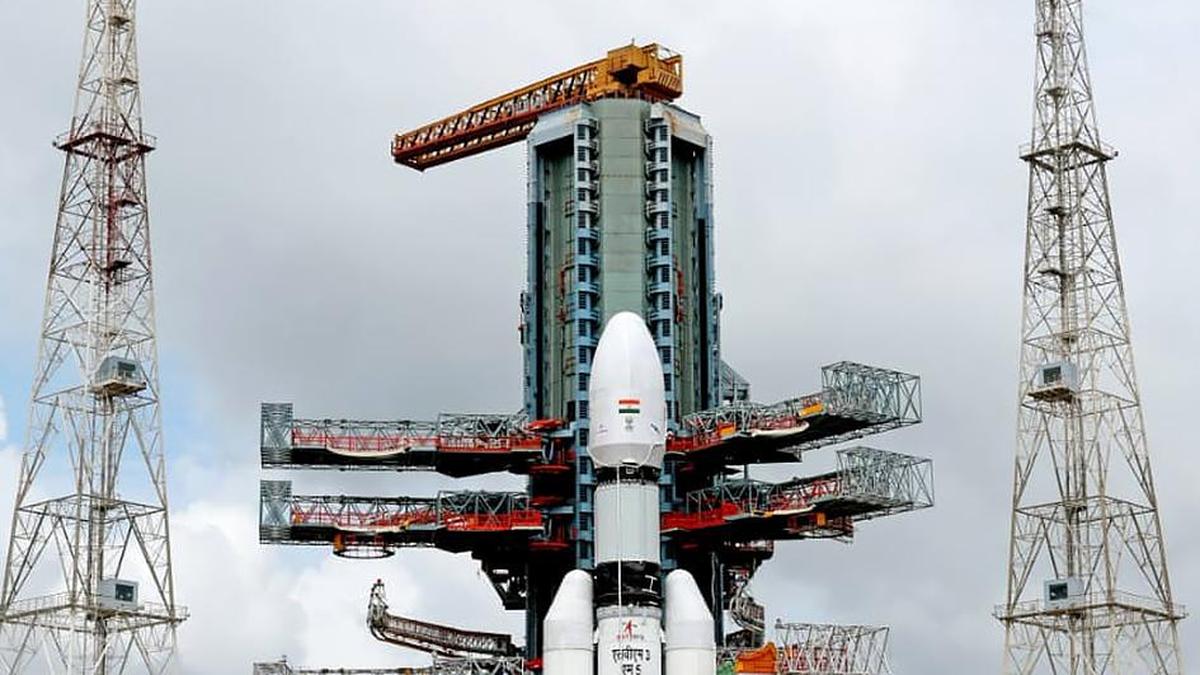
ISRO is set to launch its heaviest communication satellite CMS-03 weighing 4,410 kg using LVM-3 (Launch Vehicle Mark-3).
Launch from Sriharikota; satellite to be placed in Geosynchronous Transfer Orbit (GTO) — around 29,970 km x 170 km.
This marks the first time ISRO will launch a satellite over 4 tonnes from Indian soil using its own heavy-lift rocket.
About CMS-03
CMS-03 is a multi-band communication satellite.
Will provide communication and broadcasting services across India.
Part of India’s growing fleet of GSAT series (Geostationary Satellites).
Launch is a major milestone in India’s capacity to independently deploy heavy satellites without relying on foreign launchers.
About LVM-3 (GSLV Mk 3)
Formerly called GSLV Mk 3, now renamed LVM-3 (Launch Vehicle Mark-3).
Developed by ISRO’s Vikram Sarabhai Space Centre (VSSC).
India’s heaviest and most powerful launch vehicle, also known as ‘Bahubali rocket’.
It uses:
Two S200 solid strap-on boosters
L110 liquid core stage
C25 cryogenic upper stage (using liquid hydrogen and liquid oxygen)
Capabilities
Can carry up to 8,000 kg to Low Earth Orbit (LEO) (~2,000 km altitude).
Can carry up to 4,000 kg to GTO (~36,000 km altitude).
ISRO’s earlier rockets (like PSLV and GSLV Mk II) were limited to lighter payloads, hence heavy satellites were earlier launched abroad (mainly from French Guiana by Arianespace).
LVM-3 now removes that dependence.
Cryogenic Stage (C25)
The cryogenic upper stage provides nearly 50% of the velocity needed to place satellites into GTO.
Current C25 engine can burn 28,000 kg of propellant, producing 20 tonnes of thrust.
A new C32 stage under development will burn 32,000 kg of fuel, producing 22 tonnes of thrust improving payload capacity further.
Future Plans
LVM-3 will be the launch vehicle for Gaganyaan India’s first human spaceflight mission.
ISRO is developing an even heavier launcher Next-Gen Heavy Lift Launch Vehicle (HLV) capable of carrying 8,000–10,000 kg to GTO and up to 80,000 kg to LEO.
Aim: To support crewed lunar and interplanetary missions.
Recent ISRO Launches
LVM-3 previously launched:
Chandrayaan-2 (2019)
OneWeb satellites (2022–23) for global broadband internet
All 7 launches using LVM-3 so far have been successful.
Global Significance
Earlier, India used European rockets (Ariane-5) for heavy satellites like GSAT-19, GSAT-29 etc.
With LVM-3, India joins the league of countries (USA, Russia, China, Japan, ESA) capable of independent heavy satellite launches.
Reduces costs and enhances strategic autonomy in space technology.
Feature | LVM-3 (GSLV Mk 3) |
Type | Heavy Lift Launch Vehicle |
Payload (LEO) | 8,000 kg |
Payload (GTO) | 4,000–4,410 kg |
Height | ~43 m |
Stages | 3 (Solid + Liquid + Cryogenic) |
Cryogenic Stage | C25 using LH2 + LOX |
Max Thrust | 20 tonnes (C25); 22 tonnes in upcoming C32 |
Major Missions | Chandrayaan-2, OneWeb launches, CMS-03 |
Future Use | Gaganyaan (Human Spaceflight) |
Prelims Practice MCQ
Q. With reference to LVM-3, consider the following statements:
It is capable of placing a 4,000 kg class satellite into a geosynchronous transfer orbit.
It uses a cryogenic upper stage powered by liquid hydrogen and liquid oxygen.
It has been used for launching India’s Chandrayaan and OneWeb satellites.
Which of the statements given above are correct?
(a) 1 and 2 only
(b) 2 and 3 only
(c) 1, 2 and 3
(d) 1 and 3 only
✅ Answer: (c)
Explanation:
All statements are correct. LVM-3’s C25 cryogenic stage uses LH2–LOX; it can place 4,000+ kg payloads into GTO; and it launched Chandrayaan-2 and OneWeb satellites.
Q. Which of the following statements correctly describes Cryogenic Rocket Engines used in LVM-3?
They use hydrogen as fuel and oxygen as oxidizer in liquid state.
They operate at very high temperatures to maintain combustion stability.
They are less efficient than solid boosters in producing thrust.
(a) 1 only
(b) 1 and 2 only
(c) 2 and 3 only
(d) 1, 2 and 3
✅ Answer: (a)
Explanation:
Cryogenic engines operate at extremely low temperatures, not high. They use liquid hydrogen (fuel) and liquid oxygen (oxidizer) and are more efficient than solid stages.