
Hope Island
Context
Nearly 20,000 Olive Ridley turtle eggs conserved on Hope Island
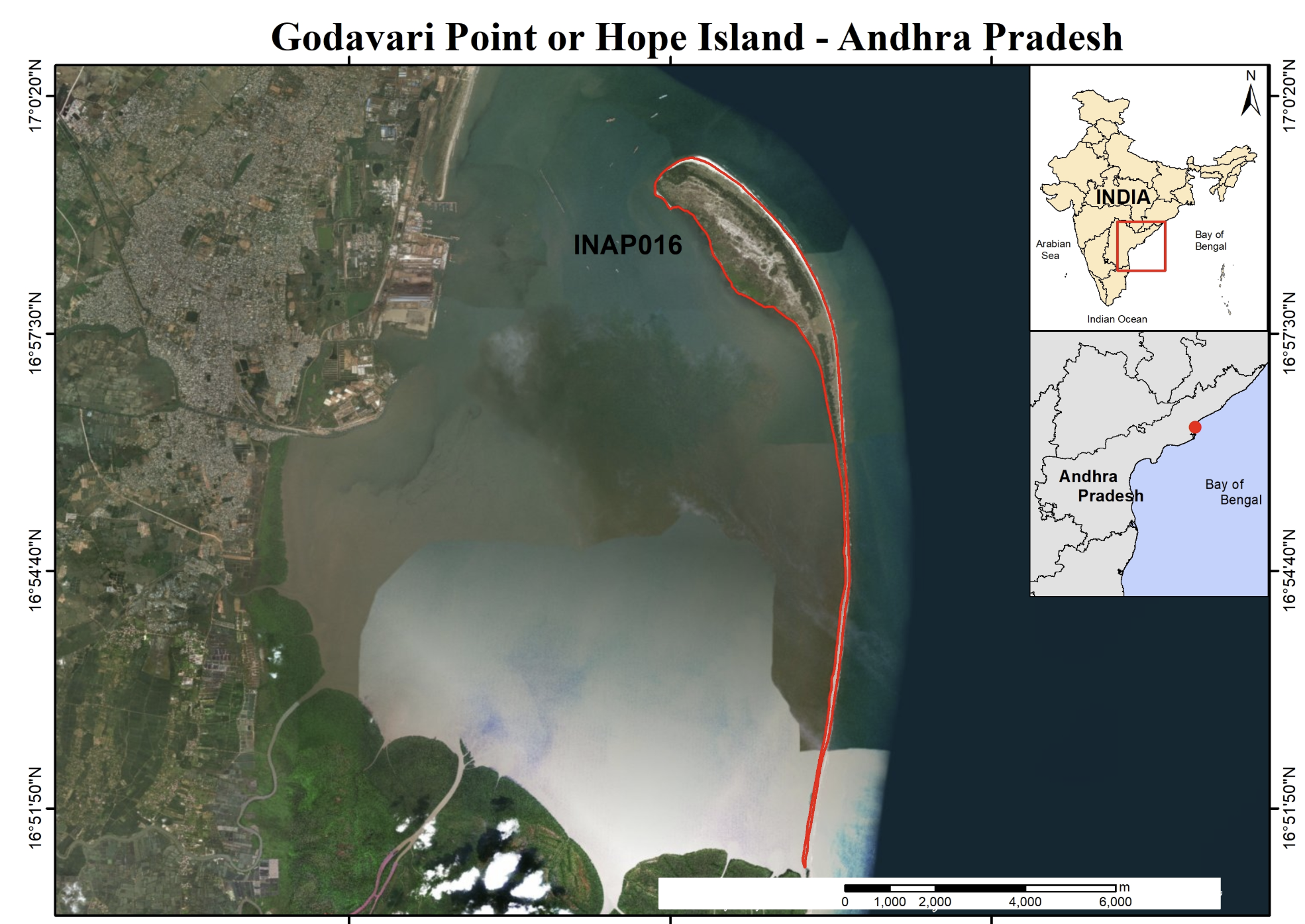
Hope Island is a 16-km-long, tadpole-shaped sand spit located off the Kakinada coast in Andhra Pradesh, India, formed over the last 200 years by the Godavari River.
It is formed in the late 18th century, from the sediment outflow carried by the waters of the Koringa River, a distributary of the Godavari.
Acting as a natural barrier, it protects the Kakinada Port from Bay of Bengal storm surges. It is a tranquil, relatively undeveloped tourist spot known for its pristine beaches, Coringa Wildlife Sanctuary access, and turtle conservation.
About Olive Ridley turtle
Scientific name: Lepidochelys olivacea
One of the smallest and most abundant sea turtles
Known for:
Mass nesting (Arribada) phenomenon
Vulnerable (IUCN)
Distribution
Found in:
Indian Ocean
Pacific Ocean
Atlantic Ocean
In India
Major nesting sites:
Odisha coast (Gahirmatha, Rushikulya)
Andhra Pradesh coast
Prelims Practice MCQs
Q. With reference to Hope Island, consider the following statements:
It is located in the Bay of Bengal along the Andhra Pradesh coast.
It acts as a natural barrier island.
It is part of a cold-water marine ecosystem.
Which of the statements given above is/are correct?
(a) 1 and 2 only
(b) 2 only
(c) 1 and 3 only
(d) 1, 2 and 3
Answer: (a)
Explanation:
Statement 1 is correct → Located in Bay of Bengal (Kakinada Bay).
Statement 2 is correct → Functions as a barrier island.
Statement 3 is incorrect → It is a tropical marine ecosystem.