
Impeachment process of Judge
Context: Initiation of Removal Process
-
The process to remove Justice Yashwant Varma of the Allahabad High Court has begun.
-
Notices were submitted in both Lok Sabha and Rajya Sabha for his removal.
-
Justice Varma was transferred from the Delhi High Court after burnt currency notes were found at his official residence on March 14.
Support in Parliament
-
Rajya Sabha: Notice signed by 63 Opposition MPs.
-
Lok Sabha: Notice received bipartisan backing, with 152 MPs signing, including Rahul Gandhi, Ravi Shankar Prasad, Anurag Thakur, and others.
-
Trinamool Congress and Samajwadi Party members did not sign the notice.
Procedure Under the Constitution & Judges (Inquiry) Act, 1968
-
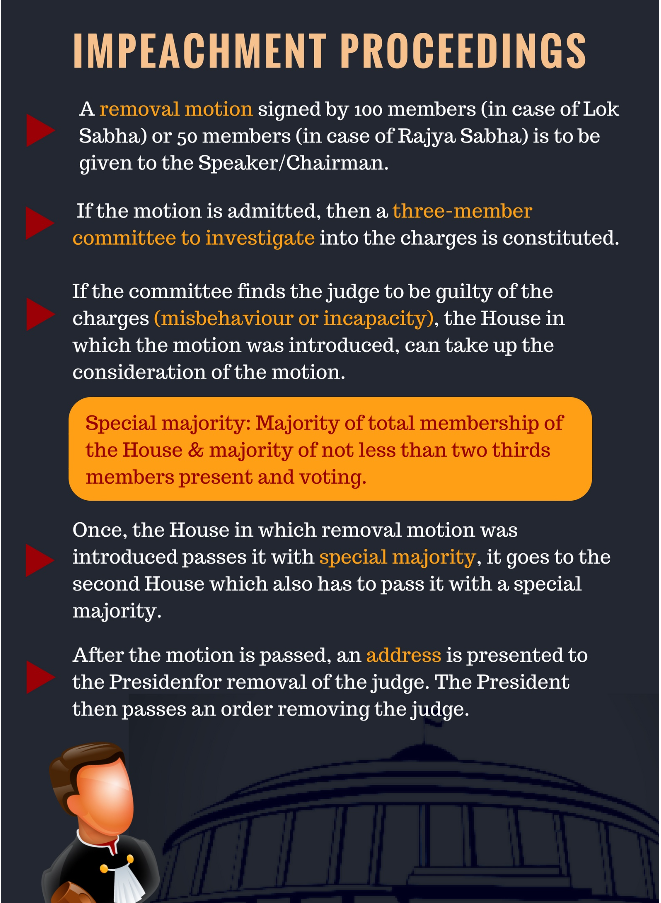
A removal motion must be signed by at least:
-
100 MPs in Lok Sabha
-
50 MPs in Rajya Sabha
-
-
The Speaker or Chairman may admit or reject the motion.
-
Vice President Jagdeep Dhankhar confirmed the Rajya Sabha notice meets criteria.
-
Law Minister confirmed a similar Lok Sabha notice was submitted.
Next Steps: Inquiry Committee Formation
-
If both Houses admit the motion, a three-member inquiry committee will be set up:
-
A Senior Supreme Court judge
-
A Sitting High Court Chief Justice
-
A distinguished jurist
-
-
The committee must submit its report in 3 months.
Past Reference
-
Congress leader Jairam Ramesh noted that a similar motion was submitted earlier against Justice Shekhar Yadav (Dec 13, 2024).
-
That motion was questioned due to a forged duplicate signature on the notice.
This process is in accordance with the constitutional provisions for removal of judges and the Judges (Inquiry) Act, 1968, ensuring accountability of the judiciary through parliamentary oversight.