
India and Sustainable Aviation Fuel (SAF)
Context:
A new feasibility study by the Ministry of Civil Aviation, in partnership with ICAO (UN aviation watchdog) and supported by the EU, highlights India’s potential to emerge as a major producer and exporter of SAF.
The report will be presented at the ICAO General Assembly 2025 (Sept 23, Montreal).
Undertaken under ICAO ACT-SAF (Assistance, Capacity-building and Training for Sustainable Aviation Fuels) Programme.
India’s SAF Potential
India can produce 14–33 million tonnes per year of SAF.
Feedstocks:
Vegetable oils
Sugarcane bagasse
Rice straw
Municipal solid waste (MSW)
Excludes (but has future potential in):
Waste gas fermentation
Power-to-liquids (PtL)
Policy Targets
1% SAF blend by 2027
2% by 2028
5% by 2030 (for international flights under CORSIA – ICAO’s Carbon Offsetting and Reduction Scheme for International Aviation).
Recommendations of the Study
Institutional Setup:
Create a SAF Council with government + industry CEOs to frame vision & strategy.
Policy Framework:
Develop long-term incentives to address high production costs.
Encourage private sector participation and R&D.
Production Pathways:
Prioritize Alcohol-to-Jet (AtJ) SAF process as the largest opportunity for India.
Leverage agricultural residues to reduce stubble burning and emissions.
Significance
Energy Security: Reduces dependence on imported jet fuel.
Environment: Lifecycle GHG emissions reduction, contribution to net-zero goals.
Economy: Opportunity to export surplus SAF, integrate into global value chains.
Farmers’ Income: Utilization of agri-waste like rice straw.
Strategic: Aligns India with ICAO’s global aviation sustainability goals.
Challenges
High cost of SAF production compared to conventional aviation fuel.
Need for supply chain infrastructure and refinery upgrades.
Global price competitiveness with oil-linked markets.
Sustainable Aviation Fuel (SAF)
Definition
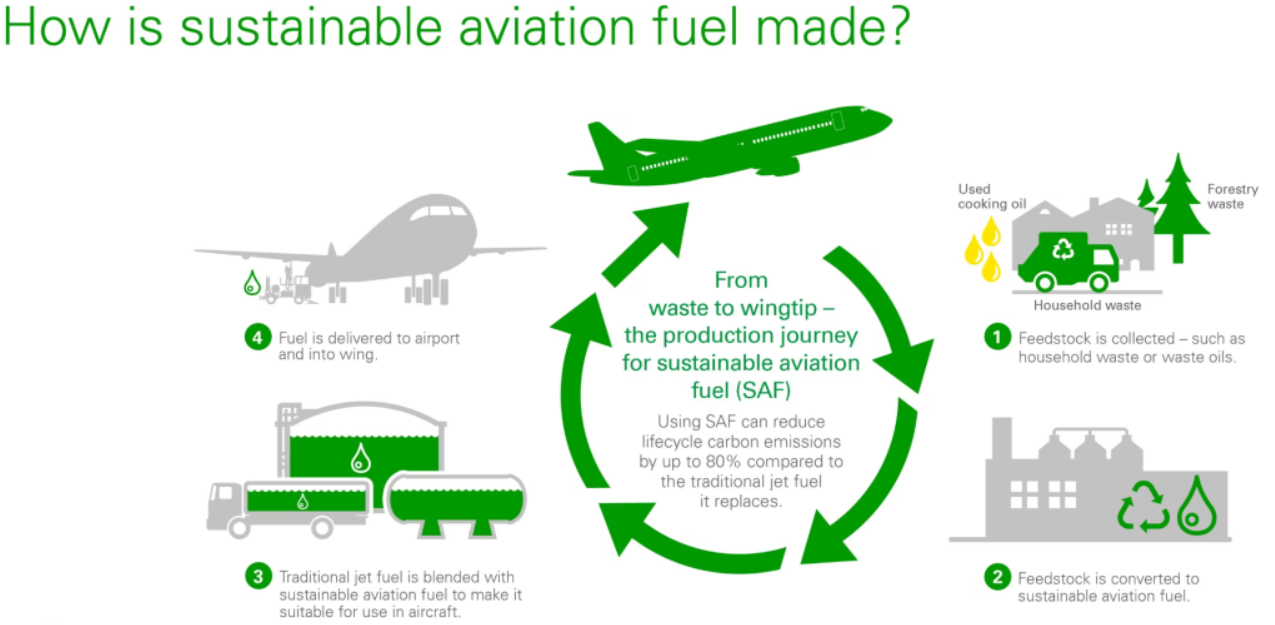
SAF is a liquid fuel used in commercial aviation that can reduce CO₂ emissions by up to 80% compared to conventional jet fuel.
It is termed “sustainable” because:
Feedstocks do not compete with food crops or water supply.
Production does not lead to deforestation or ecosystem degradation.
It recycles CO₂ already absorbed by biomass, unlike fossil fuels which release long-stored carbon.
Feedstock Sources
Waste oils & fats (e.g., used cooking oil, animal fat).
Agricultural residues & non-food crops (sugarcane bagasse, rice straw, jatropha).
Municipal solid waste (MSW).
Synthetic SAF via Direct Air Capture (DAC) and Power-to-Liquids.
Production Pathways
Currently 7 certified biofuel pathways to produce SAF.
Examples:
HEFA (Hydroprocessed Esters and Fatty Acids).
FT-SPK (Fischer-Tropsch Synthetic Paraffinic Kerosene).
AtJ (Alcohol-to-Jet).
SAF is a “drop-in fuel”:
Can be blended directly with Jet A1 fuel.
Fully compatible with existing airport infrastructure & modern aircraft engines.
Global Need for SAF
Aviation accounts for ~2–3% of global CO₂ emissions.
IATA (International Air Transport Association):
SAF could provide ~65% of total emission reductions needed for aviation to reach Net Zero by 2050.
Largest production scale-up expected in the 2030s, as policy support, cost competitiveness, and carbon credit markets mature.