
India become first country to commercially produce bio-bitumen.

Context
India has entered the era of “Clean, Green Highways” with the successful technology transfer of bio-bitumen via pyrolysis.
Road, Transport and Highways Minister Nitin Gadkari has said that India has become the first country in the world to commercially produce bio-bitumen in road construction.
A 100-metre trial stretch has been laid on NH-40 (Jorabat–Shillong Expressway), Meghalaya, proving feasibility.
Indigenous technology
The bio-bitumen technology is fully indigenous, developed within India.
It reduces dependence on imported petroleum bitumen and supports Atmanirbhar Bharat.
Institutions involved
Developed jointly by:
CSIR–Central Road Research Institute (CRRI), New Delhi
CSIR–Indian Institute of Petroleum (IIP), Dehradun
What is bio-bitumen
A bio-based alternative to conventional bitumen.
Produced from farm residue/biomass using pyrolysis.
Used as a road binder in highway construction.
Key features
Pyrolysis produces:
Bio-binder for roads
Gaseous fuel
Bio-pesticide fractions
High-grade carbon
Emission-free, cost-effective, and sustainable.
Patent filed; industries onboarded for commercialisation.
Economic and environmental significance
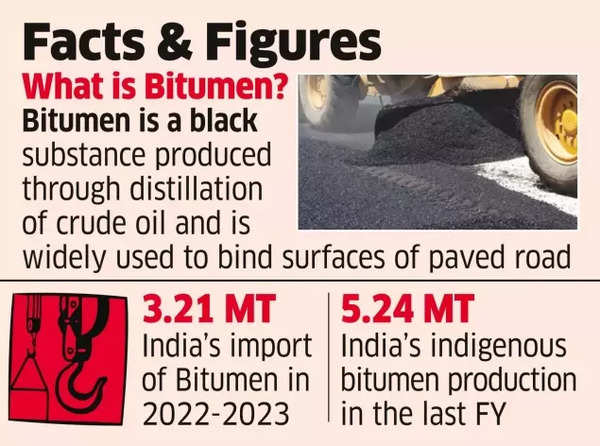
India imports nearly 50% of its bitumen requirement.
Potential to replace ₹25,000–30,000 crore worth of imports annually.
Supports:
Waste-to-wealth
Circular economy
Stubble management
Green infrastructure
Prelims Practice MCQs
Q. Consider the following statements regarding bio-bitumen:
It helps reduce India’s dependence on imported bitumen.
It supports the waste-to-wealth approach by using farm residue.
It completely eliminates the need for any blending with conventional bitumen.
Which of the statements given above are correct?
A. 1 and 2 only
B. 2 and 3 only
C. 1 and 3 only
D. 1, 2 and 3
Correct answer: A
Explanation:
Bio-bitumen reduces imports and uses agricultural waste. At present, blending with conventional bitumen is proposed, not total replacement.
Q. The successful field demonstration of bio-bitumen road construction was carried out on:
A. Delhi–Mumbai Expressway
B. Bengaluru–Chennai Expressway
C. Jorabat–Shillong Expressway (NH-40)
D. Amritsar–Jamnagar Expressway
Correct answer: C
Explanation:
A 100-metre trial stretch using bio-bitumen was laid on NH-40 (Jorabat–Shillong Expressway) in Meghalaya, proving its on-ground feasibility.