
India becomes the world’s fourth largest economy
Context
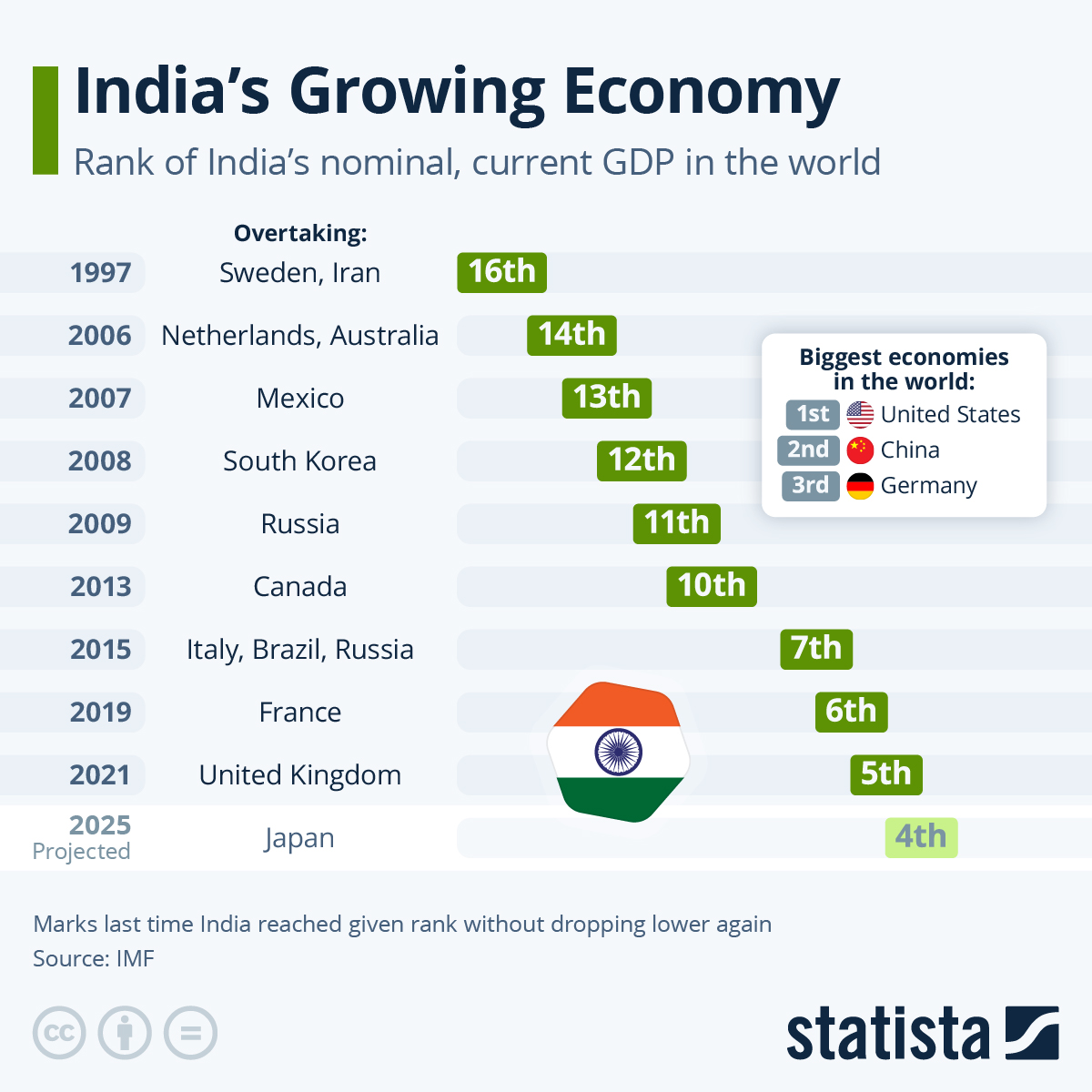
India has surpassed Japan to become the world’s fourth largest economy.
GDP size: $4.18 trillion (nominal terms).
Ranking ahead:
United States
China
Germany
India
India is projected to overtake Germany to become the third largest economy by 2030.
Projected GDP by 2030: $7.3 trillion.

Growth performance (2025–26)
Quarterly real GDP growth
Q4 (2024–25): 7.4%
Q1 (2025–26): 7.8%
Q2 (2025–26): 8.2% (six-quarter high)
➡️ Indicates accelerating growth momentum.
Drivers of growth
Domestic demand-led growth
Key driver:
Robust private consumption
Supporting factors:
Strong urban consumption
Benign financial conditions
Healthy credit flow to commercial sector
Improving export performance
Growth achieved despite global trade uncertainties, highlighting economic resilience.
Global agencies’ growth projections for India
Institution | Growth projection |
World Bank | 6.5% (2026) |
Moody’s | 6.4% (2026), 6.5% (2027) |
International Monetary Fund | 6.6% (2025), 6.2% (2026) |
Organisation for Economic Co-operation and Development | 6.7% (2025), 6.2% (2026) |
S&P Global Ratings | 6.5% (FY25), 6.7% (FY26) |
Asian Development Bank | 7.2% (2025) |
Fitch Ratings | 7.4% (FY26) |
Broad international consensus on India remaining the fastest-growing major economy.
Long-term vision
India aims to attain high middle-income status by 2047, the centenary of Independence.
Growth strategy rests on:
Structural reforms
Strong domestic demand
Social and economic foundations
Prelims Practice MCQs
Q. Which of the following has been identified as the primary driver of India’s recent economic expansion?
a) Government capital expenditure
b) Export-led growth
c) Private consumption
d) Foreign direct investment
Answer: c
Explanation:
The government explicitly stated that robust private consumption was the central growth driver.