
India–European Union Free Trade Agreement (FTA)
Why in news
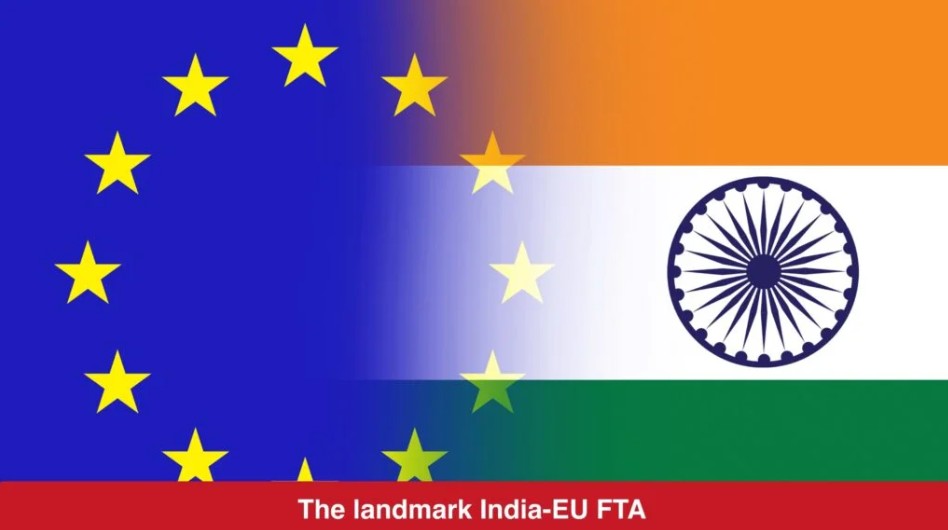
India and the European Union have concluded negotiations on a comprehensive Free Trade Agreement after nearly two decades, calling it India’s largest-ever FTA.
Both economies together accounted for nearly 25% of the global GDP.
Background
India–EU FTA talks launched: 2007
Negotiations suspended: 2013
Talks revived: 2022
Agreement concluded: 2026
Ratification pending after legal scrubbing, translation, and approval by European Parliament
Trade Profile India–EU
Bilateral merchandise trade (2024-25):
INR 11.5 Lakh Crore (USD 136.54 billion)
India’s exports to EU:
INR 6.4 Lakh Crore (USD 75.85 billion)
Trade in services (2024):
INR 7.2 Lakh Crore (USD 83.10 billion)


Key economic features
Market access
EU to eliminate tariffs on 99.5% of Indian exports
India to offer tariff concessions on 97.5% of EU imports
Indian exports gaining maximum benefit
Immediate (Day-1) duty elimination (90.7%):
Textiles and apparel
Leather and footwear
Gems and jewellery
Tea, coffee, spices
Toys and sports goods
Marine products
Phased elimination (3–5 years):
Certain marine and processed food products
Arms and ammunition
Labour-intensive advantage
Over ₹2.87 lakh crore ($33 billion) worth of exports to gain zero-duty access
Sectors currently facing 4–26% EU tariffs become more competitive
Concessions by India
Goods
Immediate tariff elimination: ~49.6% tariff lines
Phased elimination (5–10 years): ~39.5%
Duty-free or reduced access for:
Machinery and electrical equipment
Aircraft and spacecraft
Pharmaceuticals
Chemicals
Motor vehicles
Medical and surgical instruments
Automobiles and wine
European cars priced above ₹25 lakh:
Import duty reduced from 110% to ~10%
Subject to quota restrictions
Wine imports also under quota-based liberalisation
Protected / excluded sectors
India
Dairy sector
Sensitive agricultural products
European Union
Beef, sugar, rice, chicken meat
Milk powder, honey, bananas
Soft wheat, garlic, ethanol
Services trade
EU commitments
144 services sub-sectors, including:
IT/ITeS
Professional services
Education
Business services
India commitments
102 services sub-sectors, covering:
Telecommunications
Maritime services
Financial services
Environmental services
Intellectual Property Rights
Reinforces TRIPS protections
Covers:
Copyright
Trademarks
Designs
Trade secrets
Plant varieties
Affirms Doha Declaration
Recognises Traditional Knowledge Digital Library (TKDL)
Promotes technology transfer and business partnerships
Strategic and geopolitical significance
India and EU together account for ~33% of global trade
Seen as a response to:
Fragmenting global trade
Uncertainty due to US tariff policies
Carbon Border Adjustment Mechanism (CBAM)
Limited agreement reached on Carbon Border Adjustment Mechanism
Key outcomes:
Accreditation pathway for Indian carbon verifiers
Automatic extension to India if EU grants CBAM concessions to any third country
Defence, security and mobility cooperation
New India–EU Security and Defence Partnership
Cooperation areas:
Counter-terrorism
Maritime security
Cybersecurity
Talks launched on Security of Information Agreement
Framework enables Indian firms to access EU defence initiatives
Prelims Practice MCQs
Q. With reference to the India–EU Free Trade Agreement, consider the following statements:
The EU will eliminate tariffs on more than 99% of Indian exports.
India has completely opened its dairy sector under the agreement.
Most labour-intensive Indian exports will get zero-duty access from the first day.
Which of the statements given above are correct?
(a) 1 and 2 only
(b) 1 and 3 only
(c) 2 and 3 only
(d) 1, 2 and 3
Answer: (b)
Explanation:
Statement 1 is correct (99.5% tariff elimination).
Statement 2 is incorrect (India’s dairy sector remains protected).
Statement 3 is correct (90.7% of exports get day-one duty elimination).
Q. The Carbon Border Adjustment Mechanism (CBAM), recently discussed in India–EU FTA negotiations, primarily aims to:
(a) Subsidise green exports from developing countries
(b) Impose carbon-linked tariffs on imports into the EU
(c) Replace EU Emissions Trading System
(d) Promote voluntary carbon markets globally
Answer: (b)
Explanation:
CBAM is designed to impose a carbon cost on imports into the EU to prevent carbon leakage and ensure fair competition.
Q. Which of the following sectors is explicitly excluded from tariff elimination by the European Union under the India–EU FTA?
(a) Textiles
(b) Marine products
(c) Beef
(d) Gems and jewellery
Answer: (c)
Explanation:
The EU retains tariffs on sensitive agricultural products including beef, sugar, rice, and certain food items.