
India–European Union free trade agreement: ‘Mother of all deals’
Context
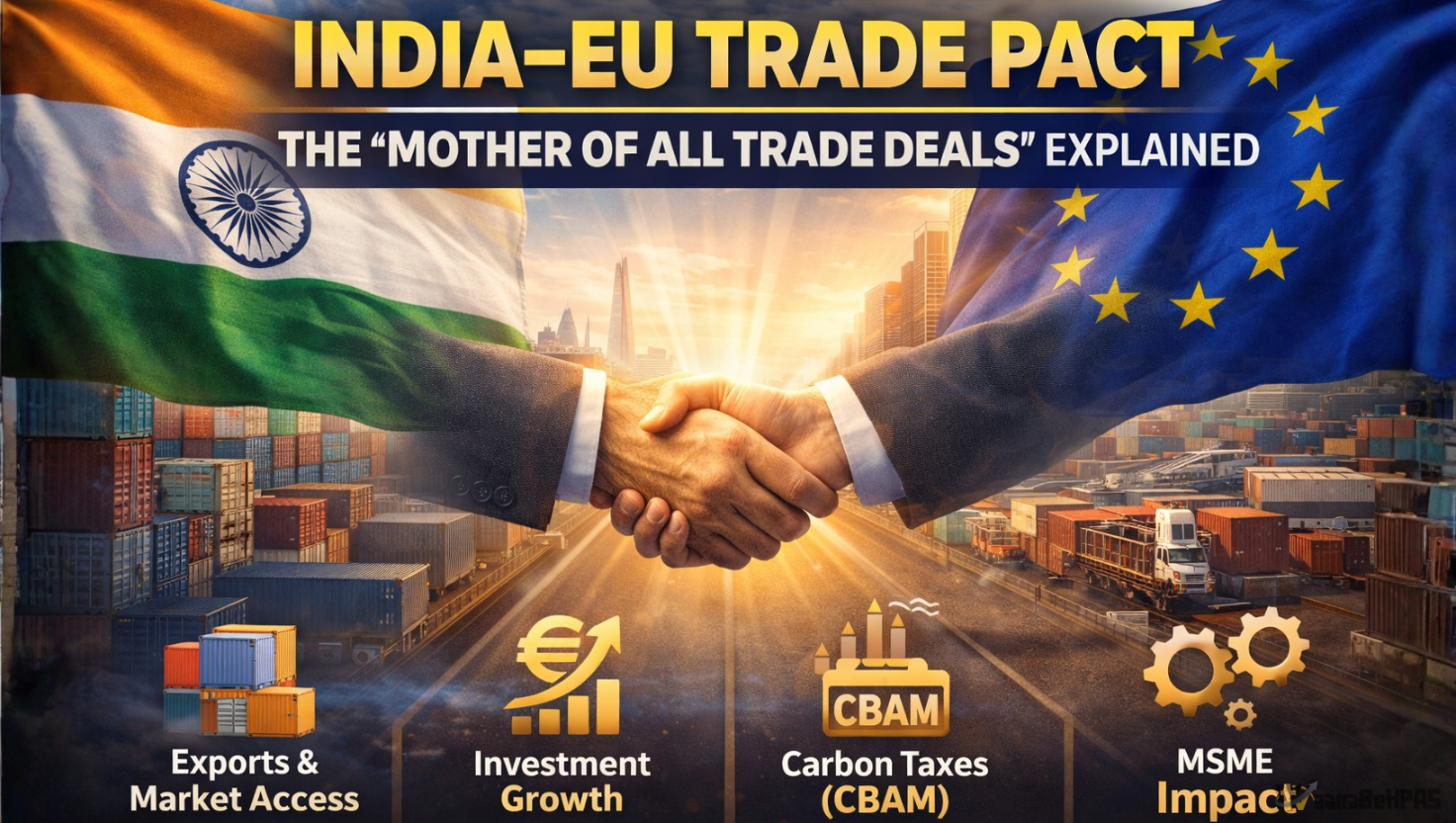
India is negotiating a comprehensive Free Trade Agreement (FTA) with the European Union (EU). Union Commerce and Industry Minister Piyush Goyal described the proposed pact as the “mother of all deals”, highlighting its scale and strategic importance compared to India’s earlier trade agreements with developed economies.
Key statements
The India–EU FTA would be larger and more significant than the seven FTAs India has already signed with developed countries.
India has concluded trade agreements with:
The United Kingdom
Mauritius
United Arab Emirates
Oman
Australia (Early Harvest Agreement)
The European Free Trade Association (EFTA) countries — Switzerland, Norway, Iceland, and Liechtenstein.
The deal would be win-win, as India and the EU largely do not compete directly and have complementary economic interests.
Why the India–EU FTA is significant
1. Scale of the European Union
The European Union is one of the world’s largest trading blocs.
It is among India’s top trading partners in goods, services, and investment.
2. Market access for India
Better access for Indian exports in:
Pharmaceuticals
Textiles and garments
Engineering goods
IT and digital services
Potential boost to Make in India and export-led growth.
3. Gains for the EU
Improved access to the Indian market in:
Automobiles
High-end manufacturing
Wines and spirits
Green and clean technologies.
4. Strategic and geopolitical value
Strengthens India’s economic engagement with Europe amid global supply chain reorientation.
Reduces over-dependence on any single trade partner or region.
Enhances India’s profile as a reliable trade and investment destination.
Issues and challenges in negotiations
Tariff reductions on sensitive sectors (e.g., dairy, automobiles).
EU concerns on:
Intellectual property rights
Sustainability and labour standards
Carbon Border Adjustment Mechanism (CBAM).
India’s concerns regarding:
Policy space for domestic industries
Data protection and digital sovereignty.
Conclusion
Calling the India–EU FTA the “mother of all deals” underlines its economic scale, strategic depth, and long-term impact. While timelines remain flexible, the agreement is expected to play a pivotal role in shaping India’s future trade architecture and its engagement with developed economies.
Prelims Practice MCQs
Q. Which of the following countries are members of the European Free Trade Association (EFTA)?
Switzerland
Norway
Sweden
Liechtenstein
Select the correct answer using the code given below:
(a) 1 and 2 only
(b) 1, 2 and 4 only
(c) 2 and 3 only
(d) 1, 3 and 4 only
Correct answer: (b)
Explanation:
The European Free Trade Association consists of Switzerland, Norway, Iceland, and Liechtenstein. Sweden is a member of the European Union, not EFTA.
Q. India has signed trade agreements with which of the following developed economies since 2014?
United Kingdom
United Arab Emirates
Japan
Australia (Early Harvest Deal)
Select the correct answer using the code given below:
(a) 1, 2 and 4 only
(b) 1 and 3 only
(c) 2 and 3 only
(d) 1, 2, 3 and 4
Correct answer: (a)
Explanation:
India has signed trade deals with the UK and UAE, and an Early Harvest Agreement with Australia. No new comprehensive FTA has been concluded with Japan in this period.